Breaking Bad Habits: The System That Actually Works
Wanting to stop a bad habit is not the problem. Most men who carry a habit they want to eliminate have wanted to eliminate it for months or years. The problem is method. The standard approach, trying harder, using more willpower, committing to stopping, fails reliably because it misidentifies the mechanism of habit as a motivation issue. It is not. A habit is a neurological loop: a cue triggers a routine that delivers a reward. That loop runs automatically. Willpower does not interrupt an automatic process reliably. Structure does. Breaking bad habits is not a character challenge. It is a design challenge, and it has a system.
Why Willpower Fails as a Habit-Breaking Strategy
Charles Duhigg, whose research on habit formation is documented in his book "The Power of Habit," established the habit loop framework that most serious habit research now builds on. The loop has three components: a cue that triggers the behaviour, the routine behaviour itself, and the reward the brain receives from completing it. The loop is stored in the basal ganglia, a structure that operates largely below conscious control. Once a habit is established, the loop runs with minimal input from the prefrontal cortex, which is the part of the brain responsible for deliberate decision-making.
This is why willpower fails. Willpower is a prefrontal cortex function. It can interrupt a habit loop in progress, but only at a significant cognitive cost, and only for as long as the prefrontal cortex has sufficient capacity to override the automatic response. That capacity depletes across a day. By evening, when the cue fires, the prefrontal cortex is running on a fraction of its earlier capacity and the habit loop wins.
The implication is that breaking a bad habit is not about generating more willpower at the moment of the cue. It is about redesigning the cue, the routine, or the reward before the moment arrives. You are not fighting the loop when it fires. You are engineering the conditions so the loop fires differently or does not fire at all.
The Three-Step Audit: Identifying What Is Actually Driving the Habit
Before you can break a bad habit, you need to identify its specific loop. Most men try to stop a behaviour without knowing what triggers it, and they fail because they are addressing the symptom rather than the cue.
The audit has three steps. First, identify the routine. This is the habit itself, the behaviour you want to eliminate. Be specific. Not "I waste time on my phone" but "I open Instagram within the first 20 minutes of waking up and again during any moment of downtime during the day." Specificity in the routine gives you precision in what to target.
Second, identify the cue. Cues typically fall into five categories: location, time, emotional state, other people, or an immediately preceding action. To find the cue, run a simple observation for a week. Every time the habit fires, write down the time, the location, your emotional state, who is around you, and what you just did. Patterns will emerge within three to five days. The habit almost certainly fires in the same cue context most of the time. That context is the target.
Third, identify the reward. What is the habit actually delivering? The phone habit often delivers novelty, social validation, or relief from boredom or discomfort. The late-night eating habit often delivers comfort or stress relief. The reward is rarely what the behaviour looks like on the surface. Identifying the real reward tells you what to substitute.
Breaking Bad Habits Through Substitution, Not Elimination
The most reliable method for breaking a bad habit is not elimination. It is substitution: keeping the cue and the reward while replacing the routine with a behaviour that delivers the same reward without the cost.
This works because the neurological loop does not care about the specific routine. It cares about the reward. A man who reaches for his phone when stressed is not addicted to the phone. He is seeking relief from stress. If you give the brain a different route to that same relief, the loop can be retrained.
The substitution process: identify the cue, identify the real reward, then choose a replacement routine that delivers the same reward with no downside. The phone-during-stress loop might be replaced with two minutes of slow breathing, a short walk, or a specific physical gesture that has been pre-conditioned to signal relief. None of these are as immediately satisfying as the original habit. That is the trade-off and it is temporary. With repetition, the new routine builds its own loop and the old one weakens from disuse.
The key word is repetition. Substitution does not work once. It works across thirty to sixty consistent iterations. The brain needs enough repetitions of the new loop to begin running it automatically. This is where most men's habit-breaking attempts fail: they substitute successfully for five days, then return to the old routine on a harder day, and conclude the method does not work. The method works. Five days is not enough repetitions. Aim for sixty.
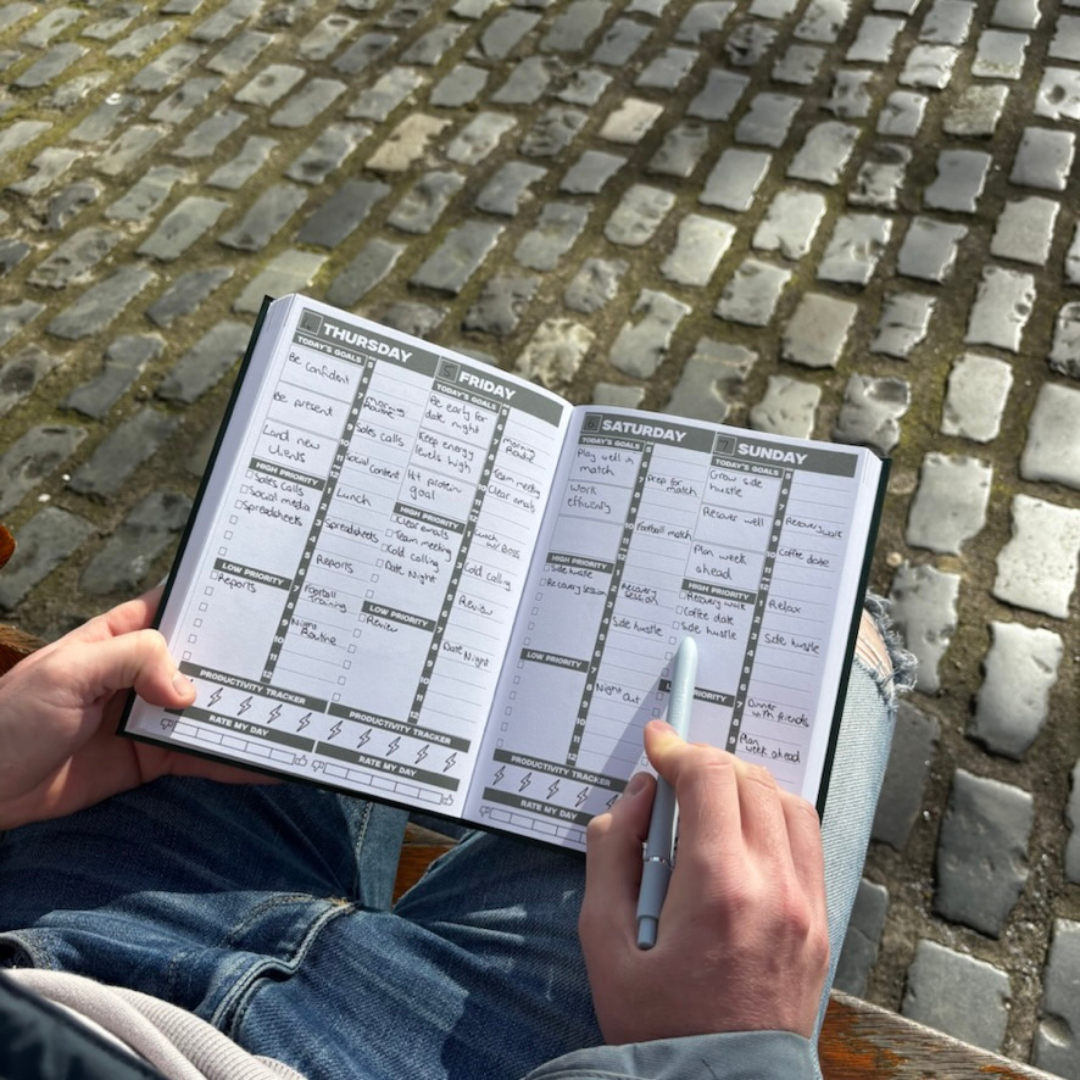
The Plan Your Growth undated weekly agenda is a practical tool for tracking substitution consistency. Writing the replacement habit into the daily layout each morning creates a visual commitment that the new routine has a home in your day, and checking it off at the end of the session builds the evidence of consecutive days that the brain uses to form the new loop.
Environment Design as a Habit-Breaking Lever
Substitution addresses the routine. Environment design addresses the cue. If you can eliminate or reduce the frequency of the cue, the loop has fewer opportunities to fire and therefore fewer opportunities to win.
The architecture of environment design for bad habits is simple: increase the friction between you and the behaviour. The phone that wakes you up in the morning is a cue machine. It delivers the trigger for your worst morning habits the moment you pick it up. Buying a five-euro alarm clock and charging the phone in another room increases the friction enough to break the automatic morning loop in most men within a week.
The late-night snacking habit is driven by the kitchen's proximity to the living room. The cue is often a specific time of evening combined with the completion of whatever you were doing. Removing the snacks from the house entirely is more effective than relying on willpower to resist them. No cue, no loop.
Apply this logic to every bad habit on your list. What is the cue environment? What physical or digital change would reduce the frequency of that cue or increase the friction between the cue and the routine? Make the change at the environment level and the willpower requirement drops dramatically.
The Identity Shift That Makes Breaking Bad Habits Permanent
Structure and substitution will break a bad habit in the short to medium term. Identity is what makes the change permanent.
James Clear, whose research at jamesclear.com on habit formation draws on a wide body of behavioural science, makes the case that the most durable habit changes are anchored in identity rather than outcomes. The man who is trying to stop drinking too much is fighting a habit. The man who has decided he is someone who does not use alcohol to manage stress is operating from a different self-concept. The same behaviour, the same cue, the same moment of choice, but a completely different internal frame.
This is not a motivational reframe. It is a functional one. When the behaviour is inconsistent with your identity, it generates cognitive dissonance, and the brain is motivated to resolve cognitive dissonance. Every time you act in line with your new identity, you generate evidence that confirms it. The evidence accumulates. The identity strengthens. The old habit loses its grip not because willpower increased but because it no longer fits who you are.
Building the new identity requires the first sixty days of consistent substitution to generate that evidence. That is the structural argument for getting through the hard early period. You are not just breaking a habit. You are building the evidence base for a new self-concept.
The Bottom Line
Breaking bad habits is a design problem, not a character test. Identify the cue, routine, and reward that make up the loop. Substitute the routine with a behaviour that delivers the same reward. Reduce the cue through environment design. Repeat the substitution enough times to build the new loop, approximately sixty iterations. And use the identity frame to make the change durable: not "I am trying to stop this" but "this is not who I am." The willpower plays a supporting role. The system does the heavy work.
The Plan Your Growth undated weekly agenda gives you the daily structure to track your substitution habit, hold your cue audit notes, and build the consecutive days that wire in the new loop. Systems break habits. Plans make systems visible.