Building Discipline: 7 Daily Habits That Actually Compound
Mental toughness is not a trait, not a temperament, not something you were born with or without. It is the compounding output of daily habits most men know they should run but consistently do not. The research is clear on this. Angela Duckworth's work at the University of Pennsylvania, documented extensively in her book "Grit," demonstrates that sustained high performance is driven not by raw talent or innate willpower, but by consistent, deliberate behaviour over long time horizons. The uncomfortable truth this points to is that building discipline is a systems problem, not a character problem. Fix the system and the discipline follows.
Why Willpower Is the Wrong Target
Every man who has tried to "be more disciplined" by forcing himself to push harder has eventually hit the same wall. Willpower is a finite resource. It depletes across a day of decisions, stress, and demands. By the time a man who relies on willpower reaches the hard part of his day, the tank is empty and he capitulates, skips the workout, opens the feed, eats the wrong thing.
This is not weakness. It is biology. And it explains why the men who appear most disciplined from the outside are rarely the ones gritting their teeth the hardest. They are the ones who have designed their environment and their daily habits so that the right behaviour requires the least friction and the wrong behaviour requires the most. The discipline is in the design, not the grinding.
The seven habits below are not motivational. They are structural. Each one reduces the cognitive load required to make a good decision and increases the probability of consistent execution. Run them daily. Let them compound.
Habit 1: Set Three Non-Negotiables the Night Before
Before you close out your day, write down three tasks that must happen tomorrow. Not ten. Not a full list. Three. These are your non-negotiables, the outputs that, if achieved, make tomorrow a successful day regardless of what else happens.
This matters for two reasons. First, it means you wake up with a clear target instead of spending your highest-value morning time deciding what to work on. Second, it creates a daily minimum that is achievable even on bad days. On a difficult day, three is enough. On a good day, three becomes six. But the floor is always defined.
Habit 2: Begin the Day Without Reactive Input
No phone, no email, no news for the first 60 minutes. This was covered in depth in the morning routine post, but as a standalone discipline habit, it deserves its own position in the list. The man who begins his day reacting to other people's agendas never fully leads his own. Every notification you process first thing is a micro-choice that costs attention and primes your brain for continued reactivity.
The habit: phone stays off or face-down until your first deep work session is complete. You will feel the pull for the first two weeks. After that, you will wonder how you ever let it run the other direction.
Habit 3: Execute the Hardest Task First
The cognitive science behind this is straightforward. Willpower and decision-making capacity are highest at the start of the day. The hardest task requires the most of both. Therefore, the hardest task should be first.
This habit is sometimes called "eating the frog," a frame attributed to Brian Tracy and built on Mark Twain's observation about procrastination. The mechanism is simple: once you have done the one thing you were most likely to put off, the psychological weight of it is gone. The rest of the day moves faster because you are no longer carrying the anticipatory dread of an unaddressed hard task.
Discipline building is partly a skill in tolerating discomfort long enough to reach the other side of hard work. Running this habit daily trains that tolerance systematically.
Habit 4: Block and Protect Deep Work Time
Covered in full in the time blocking post, but as a discipline habit it needs to be framed differently here. The discipline is not in doing the deep work. The discipline is in protecting the block before external demands fill it.
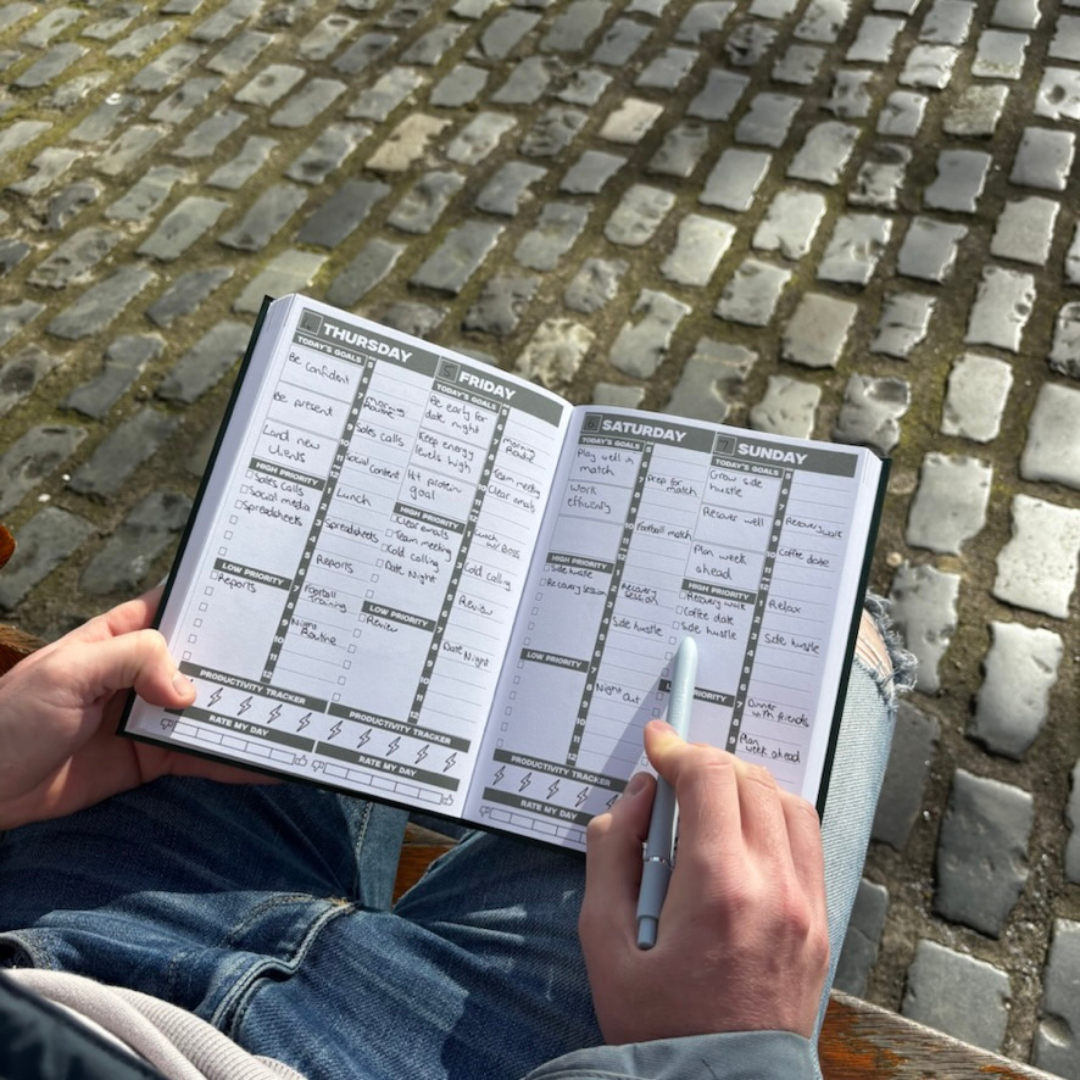
Say no to the 10 a.m. meeting when your Tier 1 block runs from 9:00 to 11:00. Say no to the quick call that "only takes fifteen minutes." Build the habit of treating your deep work blocks as non-negotiable appointments with your most important goals, because that is exactly what they are. The Plan Your Growth undated weekly agenda gives you the weekly layout to block and visually protect those sessions so they do not get silently overwritten by reactive demands.
Habit 5: Conduct a Daily Shutdown Ritual
At the end of every workday, run a five-minute shutdown sequence. Review what you completed against your three non-negotiables. Capture any open loops, unfinished tasks, or tomorrow's emerging priorities. Close every browser tab and application. Say, out loud or in writing, "shutdown complete."
This sounds almost absurdly simple. Cal Newport, who writes extensively on deep work at Georgetown University, advocates for this habit precisely because of how effectively it signals the brain that the work day is over. Men who do not have a shutdown ritual carry their work mentally into the evening, which degrades sleep, recovery, and the quality of the next day's focus. The ritual creates a hard boundary. That boundary is a discipline tool.
Habit 6: Audit One Week of Your Own Behaviour Monthly
Once a month, spend thirty minutes reviewing the last four weeks. How many of your non-negotiables did you actually complete? How often did your deep work blocks hold? How many mornings did you start reactive? Where did your plan break down most consistently?
This monthly audit is where men who build real discipline separate from men who cycle through motivation. The audit is not self-criticism. It is data collection. When you can see the actual pattern of your behaviour across four weeks, you stop attributing performance gaps to vague character flaws and start identifying specific structural failures you can fix.
The men who build lasting discipline do it through this kind of iterative self-analysis. They treat themselves like a system to be optimised, not a personality to be judged.
Habit 7: Recover Without Drama
You will miss a day. You will blow a week. You will hit a stretch where the morning routine falls apart, the blocks get hijacked, and the three non-negotiables stay at the top of tomorrow's list for five consecutive days. This is going to happen.
The discipline habit here is not staying perfect. It is recovering fast. The research on habit formation consistently shows that single lapses do not break habits. What breaks habits is the response to the lapse. The man who misses a week and decides the system "doesn't work for him" has made a conclusion from noise. The man who misses a week, notes what broke the sequence, and re-enters the system on Monday without self-flagellation is the man who builds something durable.
Never miss twice. Reset without drama. That phrase is the entire habit.
The Bottom Line
Building discipline is not about grinding through willpower you do not have. It is about designing seven daily habits that reduce friction, front-load decisions, and compound across time. Set your three non-negotiables the night before. Protect the first hour from reactive input. Eat the frog first. Block and protect your deep work. Shut down with intention. Audit monthly. Recover without drama. Run that sequence for 90 days and you are not the same man who started. The gap between who you say you are and how you actually spend your days will close. Not because you got tougher, but because you got smarter about the structure.
The Plan Your Growth undated weekly agenda is the physical home for habits 1, 4, and 6 in this system. The daily layout, the weekly view, and the goal-setting structure exist precisely to make these habits concrete rather than conceptual. Get the tool that holds the system.