Building Discipline: 7 Daily Habits That Actually Compound
Discipline is not a character trait. That framing lets too many men off the hook. It becomes something you either have or you do not, a fixed point on a personality spectrum rather than something you build through daily action. The reality is that building discipline is a construction project. You lay one habit at a time and the structure either holds or it collapses, based entirely on the habits you chose and whether you actually showed up for them daily. Here are the seven habits that compound fastest for ambitious men who are serious about execution rather than intention.
Why Most Men Get Discipline Wrong From the Start
The first and most common mistake is going too big too fast. A man decides on a Tuesday that he will wake at 5 a.m., work out for an hour, meditate, journal, eat clean, and do two hours of deep work before 9 a.m. By Thursday he is back to his old schedule and has added a new data point to his belief that he lacks discipline.
James Clear, author of Atomic Habits, makes the mechanism clear in his research: behaviour change happens at the system level, not the motivation level. Motivation is a variable. It rises and falls based on energy, mood, sleep, and circumstance. A system that requires heroic motivation to sustain will not survive contact with a difficult week. The habits below are not heroic. They are small, stackable, and specifically designed to be maintained when motivation is low, which is exactly when discipline is actually being built.
The goal is not a perfect day. The goal is a repeatable day. Perfectionism in habits is a trap. It creates an all-or-nothing relationship with the behaviour so that any deviation becomes a reason to abandon the habit entirely. Repeatability is the mechanism. Done consistently at 80 percent is worth more than done perfectly twice and then abandoned. Compound this understanding across 90 days and the output becomes undeniable.
Habit 1: Decide the Day the Night Before
Discipline starts the evening before it is tested. Before you sleep, write down the three things you will do tomorrow that move your most important goal forward. Not a 15-item to-do list that makes you feel productive without creating clarity. Three things. Prioritised. Specific. This eliminates the morning decision cost that kills momentum before 9 a.m.
Decision fatigue is a documented phenomenon. The quality of decisions deteriorates as the number of decisions made increases across a day. Men who decide next day's priorities at night arrive at their desk with a clear target and zero ambiguity about what the first action is. They execute rather than deliberate. The deliberation has already happened in a lower-stakes environment, and the morning energy goes directly into output.
This takes four minutes. Do it every night for 21 days and it becomes automatic. Skip it and you will spend the first 30 to 40 minutes of your best cognitive hours figuring out what to do while your most valuable mental hours drain away.
Habit 2: Protect the First Hour Without Exception
Whatever your morning looks like, the first working hour belongs to your most important task. Not to email. Not to social media. Not to messages from anyone, regardless of who they are. The world will survive 60 minutes without your response. Your goals require that hour.
Men who open their phone or inbox first thing have handed the first hour to other people's priorities. That is not a neutral act. It is a choice, even when it does not feel like one. The inbox is a list of other people's requests sorted by whoever sent them last. It is not a priority system. It is an attention trap dressed in productivity clothing.
The first hour of building discipline is creating the habit of protecting the first hour. Close the tabs. Put the phone in a drawer or another room. Name the task you will work on, and start it within two minutes of sitting down. No preamble. No warm-up browsing. The task and then the work. Sixty minutes of undistracted output at peak morning energy outperforms three hours of fragmented effort in the afternoon for most men. That ratio improves as the habit deepens.
Habit 3: Use a Written Weekly Plan as Your Operating System
A digital calendar is a logistics tool. It tracks when external commitments happen. A written weekly plan is a discipline tool. It forces you to decide what matters before the week assigns that decision to external pressure and whoever shouts loudest.
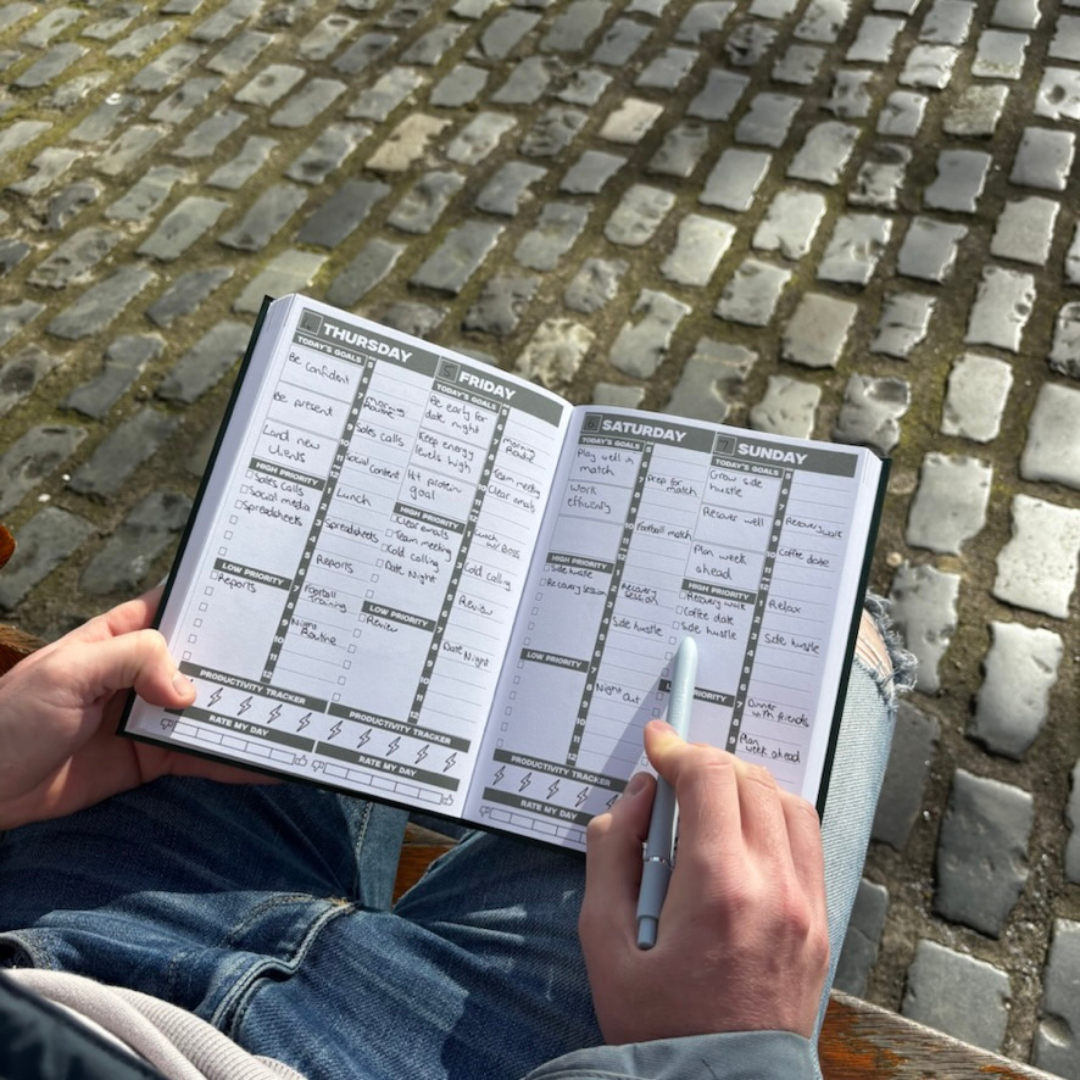
The Plan Your Growth undated weekly agenda is designed around this function. The weekly layout puts your full seven days in front of you in a single view so you can build the week with intention before it is filled by default. When you write a commitment by hand, you own it differently than when you type it. The physical act creates a different relationship with the plan. The friction of handwriting is not a drawback. It is the mechanism that makes the plan meaningful.
Use it every Sunday for 20 minutes. Name the three outcomes. Block the work. That plan becomes the reference point that pulls you back when the week tries to pull you somewhere easier.
Habit 4: Do the Hard Thing First Every Day
Every day has one task you are avoiding. Usually it is the task that would move things forward most significantly if completed. The avoidance is rarely about difficulty. It is about discomfort. The task requires sustained focus, creative risk, a difficult conversation, or a decision with real consequences. Your brain defaults to easier options that feel productive without being so.
Build the habit of naming the hardest task each morning and starting it before anything that could be classified as productive busywork. Email is not hard. Admin is not hard. Responding to messages is not hard. The quarterly review you have been delaying for three weeks: that is hard. Do it first. The compounding effect of this habit over 90 days changes the shape of your year more than almost any other single discipline.
The psychological benefit is also significant. Getting the hardest thing done first changes the character of the entire day. The rest of the day feels manageable in a way it does not when the hard task is hanging over everything.
Habit 5: One Hour of Physical Training, Non-Negotiable
Discipline in the body transfers to discipline in the mind. This is not motivation-poster philosophy. It is physiology. Training consistently regulates the hormonal systems that govern stress response, sharpens executive function in the prefrontal cortex, improves sleep quality and duration, and gives you a daily proof point that you can commit to something uncomfortable and follow through.
The specific training type matters less than the commitment structure. Three to five sessions a week, 45 to 60 minutes each. Same days and same time where your schedule allows. Non-negotiable unless you are injured or genuinely ill, not just tired or unmotivated.
Men who train consistently report the same pattern within four to six weeks: the training session becomes the anchor habit that holds the rest of the day's structure together. When the workout is done by 7 a.m., the standard for the rest of the day rises automatically. The self-image of a man who trains is different from the self-image of a man who intends to train. That difference in identity drives behaviour across every other habit.
Habit 6: Build a Hard Stop Into Every Workday
High-performing men are often undone not by laziness but by the inability to stop. They work late, sleep poorly, arrive at the next day depleted, and perform below their capability in the hours that should be their best. The discipline to stop is as important to long-term performance as the discipline to start.
Set a hard stop for work every day, the same time where possible. When the stop arrives, close the laptop, write down where you are with any open tasks, and leave the workspace physically if you work from home. The daily shutdown ritual signals to your nervous system that the work period is over and recovery can begin. Without the signal, the work persists mentally even when you are not at the desk.
Recovery is where adaptation happens. In training, adaptation occurs in the recovery period, not during the workout. Cognitive performance follows the same logic. The man who works until exhaustion every night is not more disciplined. He is borrowing against future capacity and paying interest in the form of degraded performance across the following week.
Habit 7: Run a Weekly Honest Accounting
Once a week, usually at the end of Friday or on Sunday before planning begins, spend 15 to 20 minutes asking yourself three questions:
What did I say I would do this week? What did I actually do? What is the gap, and what caused it specifically?
The answers tell you where your discipline system is leaking. Most men skip this step because the honest answer is uncomfortable. That discomfort is precisely why it needs to happen every week without exception. You cannot fix what you do not measure, and you cannot measure what you do not look at.
The weekly accounting is not self-punishment. It is quality control. It turns a collection of habits into a compounding system with a feedback loop. Without it, the same weaknesses repeat week after week. With it, every week is fractionally better calibrated than the last.
The Bottom Line
Building discipline is a seven-habit system: decide the day the night before, protect the first hour, use a written weekly plan, do the hard thing first, train consistently, build a hard stop into every day, and run a weekly honest accounting. None of these require exceptional willpower to begin. All of them require consistency to compound. The return on these seven habits is not linear. It is exponential. Start with the one you are currently missing most. Add the next one in two weeks. By 90 days, you will not recognise the structure of your days, and the gap between your current self and your previous self will be the clearest measure of what discipline actually produces.
The Plan Your Growth undated weekly agenda supports habits 1, 3, and 7 in a single tool. Your nightly plan, your weekly layout, and your end-of-week review live in one place built for men who are serious about compounding their output over time rather than working harder with less structure.