Consistency Over Motivation: How to Show Up Every Day
Motivation is not a reliable foundation for anything you want to build. Every man who has started something significant, a business, a training programme, a skill, a plan, has experienced the motivation curve: high at the start, declining by week three, unreliable by week six, and gone entirely sometime before the goal is reached. This is not a character flaw. It is the predictable neurochemistry of novelty wearing off. The problem is that most men build their execution plans on the assumption that motivation will be there when needed, and when it is not, the plan collapses. Consistency is the alternative. Not a feeling, not a state of readiness, but a system that produces output regardless of how today feels. That system is buildable, and it is what separates men who finish things from men who restart them.
Why Motivation Cannot Be the Engine
Motivation has a neurological basis: it is driven primarily by dopamine anticipation, the spike your brain produces when it expects a reward. Novelty produces dopamine. The first week of a new training programme, the first days of a new business idea, the first pages of a new planning system, all feel energised because they are new and your brain is responding to the anticipation of where they might lead.
That novelty fades. It always does. The dopamine response to a familiar activity is significantly lower than the response to a new one. By week four of a training programme, the workout is no longer new. The brain is not producing the same anticipatory response. The feeling of wanting to do it is diminished. And the man who built his execution plan on that feeling now finds himself without fuel.
Consistency as a system works differently. Instead of waiting for the motivational state to arrive, it builds the behaviour into the structure of the day so completely that the absence of motivation does not interrupt execution. The workout happens because 6:30am is workout time, not because you woke up feeling energetic. The deep work block happens because 9:00 is deep work time, not because you feel inspired. The system removes the feeling from the decision. The decision was already made in the planning session. Today you just execute it.
Angela Duckworth, whose research on grit and sustained performance at the University of Pennsylvania is documented at angeladuckworth.com, consistently finds that the highest-performing individuals are not those with the most motivation. They are those who have built consistent practice that persists through the periods when motivation is absent. The system is the competitive advantage.
The Habit Architecture That Makes Consistency Automatic
Consistency at scale is not willpower. It is habit architecture. A behaviour that requires conscious decision-making every day will eventually lose to a day when the conscious decision-making is depleted. A behaviour that is so deeply embedded in the structure of the day that it runs automatically requires almost no decision at all.
Building that automaticity requires three things.
First, specificity of time and context. "I will exercise more" produces inconsistent results because it requires a daily decision about when. "I will exercise at 6:30 every morning before I check my phone" produces consistent results because the decision is made once and the behaviour has a fixed time and context anchor. The specificity makes the habit loop more reliable because the cue, 6:30am in workout clothes, always fires in the same context.
Second, a minimum viable version. Most men build ambitious habit plans and miss them when life is hard, then experience the failure as evidence that they cannot maintain the habit. The minimum viable version is the insurance policy. Define the smallest version of the habit that still counts. For a writing habit, it might be one paragraph. For a workout habit, it might be ten minutes of movement. For a planning habit, it might be two minutes reviewing tomorrow's priorities. When the full version is not possible, the minimum version still maintains the streak and the identity. "I did something" is always true. "I did nothing" begins to feel like who you are.
Third, friction reduction. The evening before, lay out what you need for the morning habit. The workout gear on the floor. The planner open to tomorrow's page. The book next to the coffee machine. The behaviour that requires the least setup at the point of execution is the behaviour that survives the hard mornings. Preparation is the consistency tool most men overlook.
The Role of the Planning System in Building Consistency
A planning system is the infrastructure that consistency runs on. Without it, the consistent man is relying on memory and determination to maintain his habits across a full week. With it, the habits have a home: a time slot, a named output, a visible position in the week that can be checked and honoured.
The weekly planning session is the moment where consistency is built in advance. You are not deciding on Monday morning whether to run the habit. You decided on Sunday evening. Monday morning you execute a decision that already exists. The cognitive cost is minimal. The compliance rate is significantly higher.
This is the operational case for a physical planner over a mental list. A mental list is held in working memory, competes with every other demand on that memory, and is vulnerable to the bad morning, the stressful afternoon, or the busy evening that displaces it. A planner holds the habit visibly, independent of your cognitive state. You can be having the worst day of the month and still look at the page and see what is supposed to happen next.
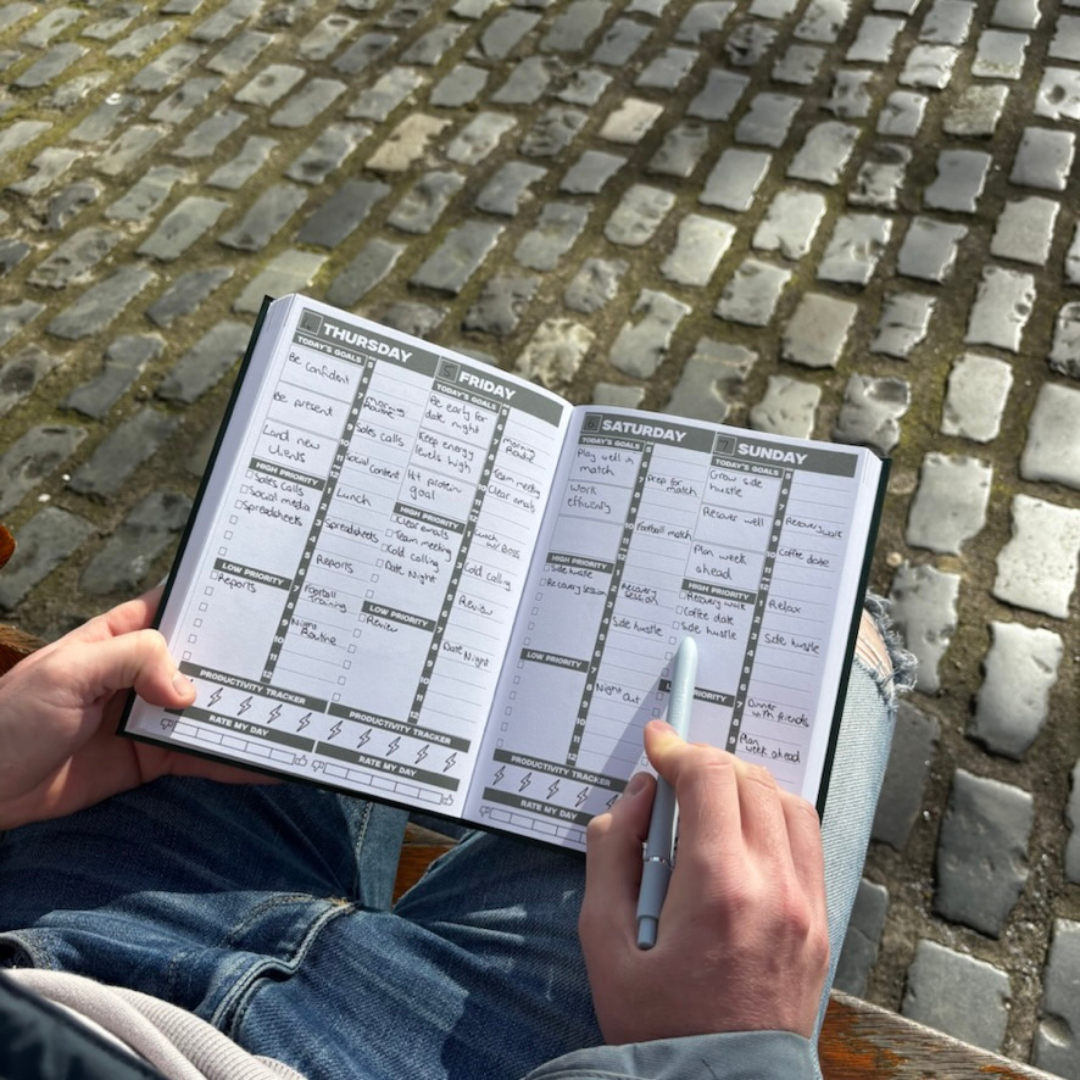
The Plan Your Growth undated weekly agenda is built for exactly this purpose. The weekly layout gives your habits a fixed position in the week. The daily layout gives them a named slot in the day. The act of writing them in before the week begins is the planning equivalent of laying your workout clothes on the floor. The decision is made. The execution is just what follows.
Recovering Consistency After a Break
Every man who builds a consistency practice will break it. A holiday, an illness, an extraordinary work stretch, a difficult personal period. The break will happen. The men who maintain long-term consistency are not the ones who never break it. They are the ones who recover from breaks faster and without the identity narrative that turns a two-week disruption into a permanent abandonment.
The recovery protocol is simple and non-negotiable: never miss twice. One missed day is variance. Two consecutive missed days is the beginning of a new habit that runs in the wrong direction. The morning after a missed session, the habit runs. Not a bigger version to compensate. Not a lengthy reflection on why it did not happen. Just the original habit, at its original time, without drama.
The framing that helps most here is treating the streak as directional rather than cumulative. A 40-day streak broken by one missed day is not back to zero. It is a 40-day directional trend with one exception. The question is not "how do I get my streak back" but "what direction am I trending over the last month?" A man who misses one day in thirty is a consistent man. A man who notices he has missed five of the last fourteen needs to examine the system, not his character.
Consistency and Identity: The Long-Term Compound
The deepest reason to build consistency over motivation is not the output. It is the identity. A man who shows up consistently for his most important habits, who runs his morning session when he does not feel like it, who writes the three priorities before he checks his phone, who completes the deep work block when the inbox is demanding his attention, that man builds a specific self-concept: I am someone who does what I said I would do.
That self-concept is one of the most valuable things an ambitious man can build. It transfers across every domain. The man who is consistent in his training is consistent in his planning. The man who is consistent in his planning is consistent in his professional execution. Consistency in one area builds the identity that drives consistency in others, because the underlying belief, that you are the kind of man who shows up, applies everywhere.
Motivation produces output when the conditions are right. Consistency produces output when the conditions are wrong, when you are tired, when the day is harder than expected, when nothing is going the way it should. That is where the men who build things separate from the men who intend to build things. The gap is not talent. It is the daily decision to show up regardless.
The Bottom Line
Consistency over motivation is the operating principle of every man who has built something significant. Motivation is a starting fuel, not a running fuel. Build the architecture that does not require it: specific time anchors, minimum viable versions for hard days, friction reduction the evening before, and a planning system that holds the habits visibly before the week begins. Recover from breaks with the two-day rule and the directional framing. Build the identity of a man who shows up. That identity, compounded across twelve months, is the difference between intention and execution.
The Plan Your Growth undated weekly agenda is the physical infrastructure your consistency runs on. Your habits have a home. Your week has a plan. The decision is made before the day begins. All that is left is to show up and execute it.