Deep Work for Men: How to Produce More in Less Time
The average knowledge worker spends roughly 60 percent of their working hours on shallow work: email, meetings, administrative tasks, and reactive messages. This is work that is easy to replicate, cognitively undemanding, and rarely the work that moves careers or businesses forward in any significant way. Deep work is the opposite. It is the concentrated, distraction-free effort on tasks that create real value, require genuine cognitive exertion, and produce outputs that cannot easily be replicated. It is also a skill that most men have allowed to atrophy without noticing, because the environment of modern work actively works against it.
What Deep Work Actually Is (and Is Not)
Deep work is not being in the zone. That framing makes it sound like a mental state you stumble into when conditions align, which is part of why men fail to cultivate it deliberately.
Deep work is, as defined by Cal Newport in his research and writing at calnewport.com, professional activity performed in a state of distraction-free concentration that pushes your cognitive capabilities to their limit. Three words in that definition carry the most weight: distraction-free, concentration, and limit. Each of those three is a variable you control. The definition is a design brief, not a description of luck.
It is also not the same as working long hours. A man who works 12 hours a day in a state of constant interruption and context switching produces less meaningful output than a man who does four hours of genuine deep work and stops. The metric that matters is not hours invested but depth of cognitive engagement during those hours. Time is the input everyone optimises. Depth is the input almost nobody manages deliberately.
What deep work is not: it is not email that requires careful thought. It is not a complex meeting. It is not multi-step administrative work, even when that work is challenging. It is the kind of output that, when complete, has moved a project, developed a skill, or advanced a strategy in a direction that required your specific expertise and sustained concentration. Writing, strategic analysis, complex problem-solving, high-stakes financial decisions, creative development. These are deep work categories. Most of the other 60 percent of your working day is not.
The Four Deep Work Philosophies: Choose the Right One
Newport identifies four structural approaches to scheduling deep work. The mistake most men make is adopting one that does not fit their actual professional context and then concluding that deep work does not suit them when the model fails.
The Monastic Philosophy eliminates shallow work almost entirely and commits to deep work as the dominant professional activity. This model works for a narrow category of men: academic researchers, full-time writers, some solo founders in the early stages of building. If your role requires ongoing communication with a team, clients, or stakeholders, this is the wrong model and it will create more problems than it solves.
The Bimodal Philosophy divides time clearly into deep periods and shallow periods at a larger scale. A man might work in deep mode Monday through Wednesday and handle meetings and administration Thursday and Friday. Or work deeply for two weeks of each month and shallowly for the other two. This works well if you have genuine calendar autonomy over your week.
The Rhythmic Philosophy is the most sustainable for most ambitious men in standard professional roles. You carve out a regular daily deep work block at the same time each day and protect it with the same reliability you would give a standing meeting with your most important stakeholder. 90 minutes to three hours in the morning is the standard. This model does not require authority over your entire working week. It requires one protected window, defended consistently.
The Journalistic Philosophy drops into deep work whenever a gap opens in the schedule. This sounds flexible but it requires the ability to switch cognitive modes instantly and deeply, a skill that most men have not built and that takes years of deliberate practice to develop reliably. It is the least effective structure for men who are new to the deep work practice.
Start with the Rhythmic Philosophy. Build the daily block as a habit first. Extend the duration as the skill develops. Consider Bimodal once the rhythm is reliable and your calendar authority allows it.
Building the Deep Work Environment
The environment precedes the behaviour. A man who attempts deep work at a cluttered desk, with phone visible and face-up, in a space where colleagues or family regularly interrupt, is fighting his environment in every session. A significant portion of the cognitive effort in each block goes to resisting distraction rather than into the work itself. The solution is not stronger willpower. It is a better-designed environment.
Remove every visible source of distraction from the physical workspace during the deep work block. Close every browser tab unrelated to the task. Every one, not most of them. The visual presence of unrelated tabs creates a low-level cognitive pull even when you are not actively looking at them. Turn off every notification from every application. Not silent. Off entirely. The anticipation of an incoming message is cognitively disruptive even without a sound, because part of your attention is allocated to monitoring for it.
Build a physical cue that signals the deep work block is beginning. Some men use a specific lamp, headphones on even with no audio playing, or a particular drink. The cue trains your nervous system over repeated sessions to transition into a focused state when the signal appears. This is habit architecture applied to cognitive performance, and it works faster than most men expect.
Before the block begins, write one sentence on paper naming the specific output you intend to produce in this session. Not a task category but a specific deliverable. Specificity eliminates the start-up cost of the session and prevents mid-block drift into easier sub-tasks when the primary work becomes demanding.
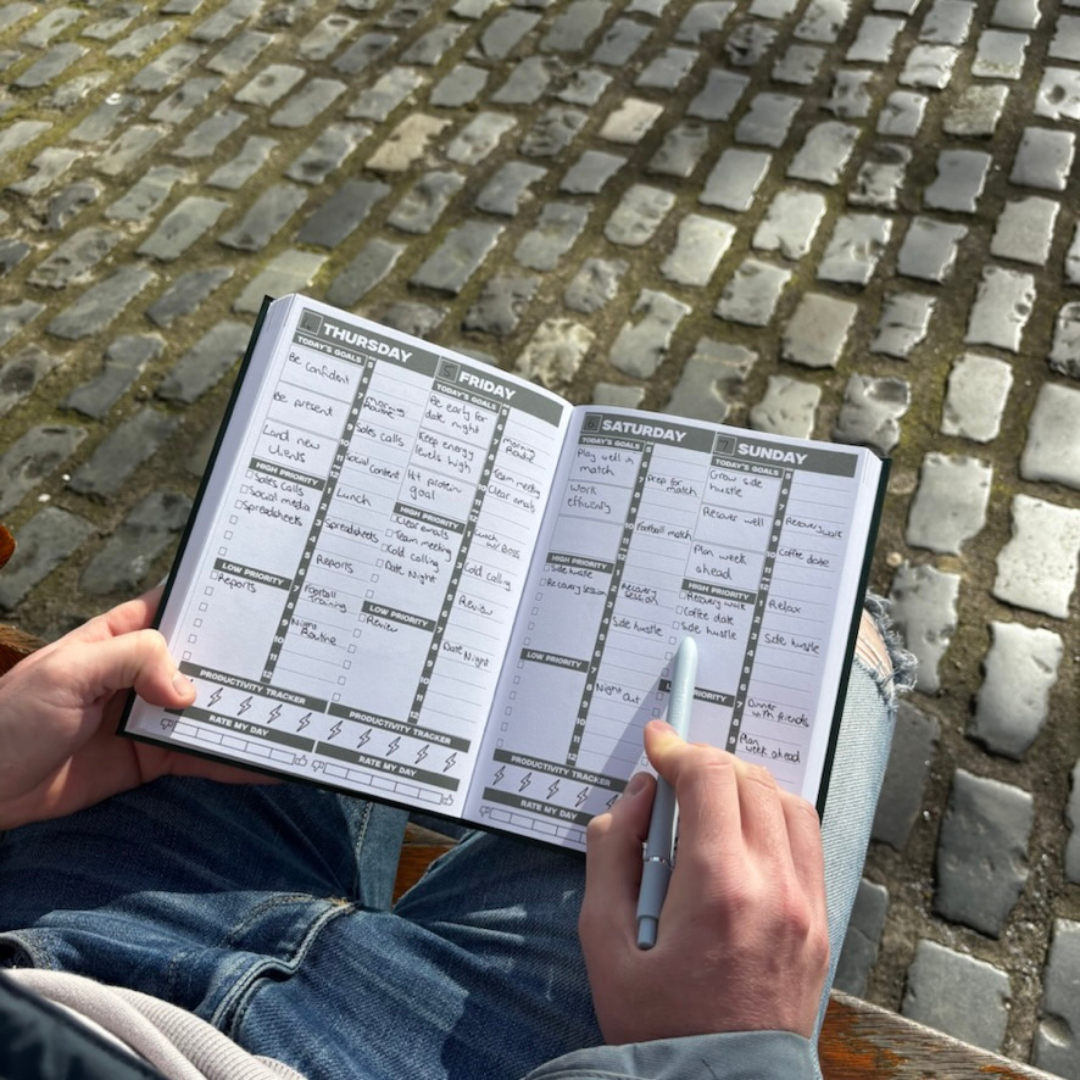
The Plan Your Growth undated weekly agenda keeps your deep work blocks visible in your weekly structure so they are treated as genuine commitments rather than aspirational time. Block them at the start of every week, name the output for each session, and protect them as you would any other serious professional commitment.
The Depth Ramp: Building From 60 Minutes to Four Hours
Most men who attempt deep work for the first time discover they cannot sustain focus for more than 30 to 40 minutes before the urge to check something becomes overwhelming. This is not a character flaw or a sign that deep work is not for them. It is the entirely predictable output of a brain that has been conditioned by years of fragmented attention, short content loops, and the dopamine structure of notification-based communication.
The depth ramp is the practice of progressively extending the duration of the deep work block over time, treating it the same way you would treat building physical endurance.
Begin with 60 minutes per day. One session. For two weeks, commit to 60 minutes of distraction-free output on your single most important task. When 60 minutes becomes reliably manageable, extend to 90. Then to two hours over the following two weeks. Then to three hours. The progression should feel mildly uncomfortable at each stage, not impossible. If three hours feels completely unmanageable at first, 90 minutes is the right target for now.
Track your deep work hours every week. Even a single line in your weekly review noting how many hours of genuine deep work you produced is enough data to improve over time. Most men are genuinely surprised when they see the actual number. It is almost always significantly lower than they believed, often by a factor of two or three. That gap between perceived and actual deep work output is the clearest indication of how much capacity remains untapped.
Common Deep Work Killers and the Fix for Each
The meeting that encroaches on the deep work block is the most common structural problem. The fix is blocking the time on the calendar before meetings can fill it. Make the block visible to anyone who can book your time. Treat it as a standing commitment rather than free time that happens to look like focus.
Opening the inbox first thing in the morning is the most common habit problem. The first-hour inbox check reframes the first working hour as reactive and distributes your initial cognitive energy across other people's priorities before you have applied any of it to your own. The fix is simple and requires no technology: do not open email until after the deep work block is complete.
The mid-block escape is the most common in-session problem. You are 25 minutes into a demanding writing session and you open a browser tab to check something tangentially related. Then another. The session fragments. The fix is to keep a physical notepad beside you during the block. When the urge to check something fires, write the impulse on the notepad and return to the task immediately. The impulse is captured and can be addressed after the block. Its urgency disappears when it is externalised.
The variable schedule is the most common structural failure over time. Men who move the deep work block based on how the morning unfolds are negotiating with the system daily, and negotiable systems rarely survive. The fix is the same time every day, treated as non-negotiable, until the block is automatic rather than chosen.
The Bottom Line
Deep work for men is not a productivity style or a personality preference. It is the practice that separates high output from high activity, and it is a skill that compounds significantly with deliberate practice over time. The mechanism is straightforward: choose the Rhythmic Philosophy and build a daily block, design the environment to support depth rather than fight it, ramp the duration progressively over 60 to 90 days, and track the hours weekly so improvement is visible and not left to feel. Men who apply this framework consistently for a full quarter produce more meaningful work in four focused hours than they were producing across their entire previous workday. The skill compounds. The output compounds. The gap between where you are and where you could be is measured primarily in depth, not in hours.
If you are building a deep work practice, the Plan Your Growth undated weekly agenda belongs in the system. Use it to block and protect your daily sessions at the start of each week, record the output from each session, and run your weekly review to keep the practice improving rather than plateauing.