Deep Work: The Skill That Separates High Performers
The average office worker spends only 28 percent of his day on tasks that require serious cognitive effort, according to research from the McKinsey Global Institute. The rest is coordination, communication, and the low-grade busyness of appearing productive. Most men instinctively know this ratio is wrong. They end their days tired but uncertain whether they actually moved anything forward. That feeling is not laziness. It is the symptom of a working life built almost entirely around shallow work, the emails, the meetings, the quick replies, the context-switching that consumes hours without producing much of lasting value. Deep work is the corrective. It is the capacity to focus without distraction on the cognitively demanding tasks that create real output, and it is the skill that produces the largest leverage gap between men who build it and those who do not.
What Deep Work Is and Why Most Men Never Do It
Cal Newport, a computer science professor at Georgetown University whose work on deep work has been widely adopted across high-performance industries, defines deep work as professional activities performed in a state of distraction-free concentration that push your cognitive capabilities to their limit. His research, documented at calnewport.com, draws a sharp distinction between deep work and shallow work: tasks that can be performed while distracted, that require low cognitive effort, and that add minimal value when done.
The distinction matters because shallow work expands to fill available time. Email is always there. Slack is always there. The meeting that did not need to happen is always available. If you do not actively protect time and cognitive capacity for deep work, shallow work will consume it. This is not a character failing. It is the natural outcome of working in an environment designed around constant connectivity and low-latency response.
Most men who say they are not getting enough meaningful work done are not failing to work hard enough. They are failing to protect the conditions that deep work requires. The output gap between a man who does two hours of genuine deep work per day and one who does none is not proportional to the time difference. It compounds dramatically over months because the quality and leverage of the work produced in deep focus is categorically different from the work produced while fragmented.
The uncomfortable implication of this is that your most cognitively demanding work deserves the best of your attention, not whatever is left over after the inbox is managed and the messages are replied to. Flipping that order is the fundamental move.
Building Deep Work Capacity: The Practical Architecture
Deep work is a skill, not a switch. Men who have spent years in reactive, fragmented working environments do not immediately produce two-hour focused sessions just by deciding to. The capacity needs to be built progressively, the same way physical endurance is built: starting at a manageable threshold and extending it over weeks.
If you currently have no real deep work practice, start with 45 minutes. One 45-minute block per day, with zero incoming information during it. No phone, no email, no browser tabs unrelated to the task. Work on one specific, pre-selected task. When the 45 minutes is up, you stop and return to the reactive layer of your work.
Run that for two weeks. Then extend to 60 minutes. Then 90. Then two hours. Most men find that 90 minutes to two hours is the practical ceiling for a single deep work session, after which cognitive performance declines and a recovery period becomes necessary. Two strong deep work sessions per day, each 90 minutes, produces more real output than eight hours of fragmented effort. That is not an exaggeration. It is what the research on cognitive performance consistently shows.
The time you assign to deep work must be protected before the day begins, not carved out reactively when everything else is done. Everything else will never be done. Your deep work block goes in the calendar first, in your highest-energy window (typically the first three to four hours after waking), and everything else is scheduled around it.
Environment Design as a Deep Work Prerequisite
The ability to do deep work is not purely a mental discipline question. It is an environment design question. Your environment either makes deep focus easy or makes it effortful. Most men's working environments make it effortful.
Notifications on. Phone face-up on the desk. Email tab open in the background. Colleague conversations audible from the desk. Every one of these is a low-level attentional pull that your brain has to actively resist during a deep work session. The resistance is not free. It costs cognitive resources you would otherwise direct at the work itself.
The environment fix is structural, not motivational. Turn notifications off during the block. Put the phone in a different room or face-down at minimum. Close every browser tab that is not directly related to the task. If your physical environment is noisy, use noise-cancelling headphones. If working from home, use a designated workspace that you associate exclusively with focused work and not with leisure.
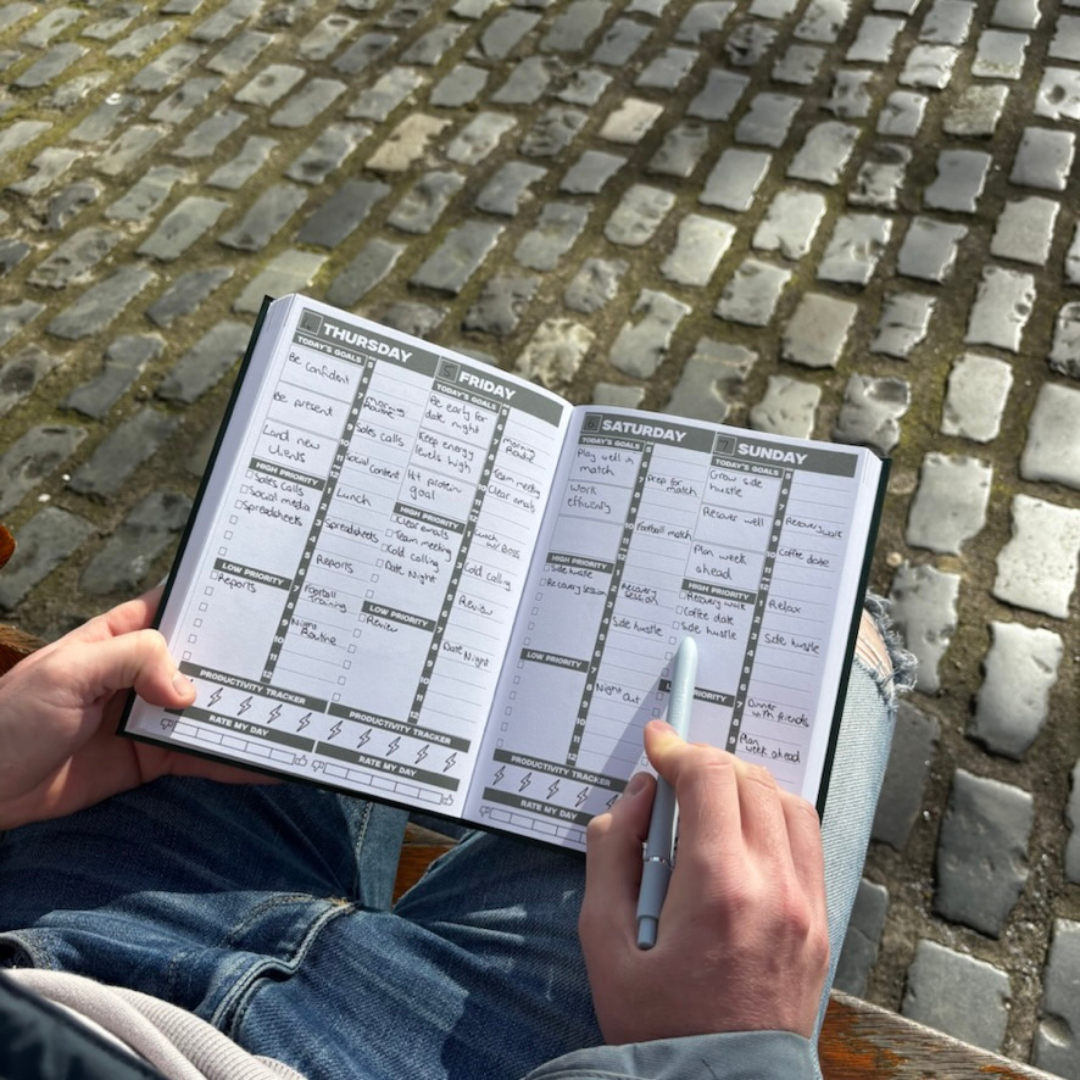
The Plan Your Growth undated weekly agenda is the planning tool that holds this architecture week to week. The weekly layout lets you schedule your deep work blocks as first-class calendar commitments alongside everything else, so the block is visible, protected, and connected to the specific task it serves. What gets scheduled gets done. What gets left to chance gets displaced.
The Single-Tasking Discipline
Deep work and multitasking are incompatible. This is not a productivity preference. It is neuroscience. The brain does not actually multitask on cognitively demanding work. It switches rapidly between tasks, and each switch carries a cognitive cost in the form of attention residue: the mental threads from the previous task that remain active and reduce performance on the current one.
A man who is writing a proposal while monitoring his email is not doing two things. He is doing one thing badly and occasionally doing another thing badly. The proposal suffers. The email suffers. And at the end of the session he is more mentally fatigued than if he had done either task with full focus.
Single-tasking during a deep work block means one task, one browser window if needed, one objective, one measure of whether the session was productive. Before the block begins, you identify the specific output you are working toward. Not "work on the project" but "complete the financial projections section" or "draft the first 800 words of the report." Specificity in the task enables full engagement with it. Vagueness keeps the mind searching for direction inside the block, which is itself a form of fragmentation.
Protecting Deep Work Against the Always-On Culture
The hardest part of building a deep work practice is not the focus itself. It is the social and professional pressure to be perpetually available. The expectation that emails get replies within the hour. The meeting culture that treats your calendar as a shared resource. The Slack norms that define responsiveness as professionalism.
These pressures are real and ignoring them entirely is not viable for most men in professional environments. The solution is not invisibility. It is defined availability. You are not always available. You are available during specific windows, and those windows are communicated clearly to the people who need to reach you.
In practice: set two email response windows per day, one mid-morning and one late afternoon. Communicate your deep work hours to colleagues and managers as a standing commitment. Decline meetings that do not require your specific input or that could be resolved with an email. The men who protect their deep work blocks are not the ones who are least collaborative. They are the ones who produce the most and therefore have the most credibility to set the terms of their availability.
The resistance to this will come. Hold the line. A week of protected deep work blocks produces enough visible output to make the case that the practice is worth defending.
The Bottom Line
Deep work is the highest-leverage skill available to any man whose output depends on his cognitive capacity. It is built progressively, protected deliberately, and sustained through environment design and single-tasking discipline. Start with 45-minute blocks in your peak energy window. Extend over weeks. Design the environment to remove attentional friction before the session begins. Define your availability rather than being always-on. Two hours of genuine deep work per day, run consistently across 90 days, will produce more than most men manage across a full working week of fragmented effort. The gap is that large.
The Plan Your Growth undated weekly agenda gives your deep work blocks a fixed home in the weekly structure. Schedule them first. Build everything else around them. That single decision, made consistently every Sunday, is where the practice begins.