The Eisenhower Matrix: Stop Doing the Wrong Work
Busy and productive are not the same thing. Most men confuse the two because busyness feels like progress. The calendar is full, the inbox is active, the day ends in exhaustion. And yet the important work, the goals, the projects, the decisions that would actually move something forward, stays untouched. This is not a time problem. It is a prioritisation problem. Dwight D. Eisenhower, the military commander and 34th President of the United States, reportedly observed that what is important is seldom urgent and what is urgent is seldom important. That observation became the foundation for one of the most practical prioritisation tools available: the Eisenhower Matrix. It takes less than ten minutes to apply and it changes the entire shape of a man's working day when he runs it consistently.
What the Eisenhower Matrix Actually Is
The Eisenhower Matrix is a simple 2x2 grid. One axis runs from urgent to not urgent. The other runs from important to not important. Every task you face belongs in one of the four quadrants this grid creates, and each quadrant has a defined response.
Quadrant 1 is urgent and important. Do it now. These are genuine crises: the deadline that is today, the client emergency, the system failure. Every man has Quadrant 1 work. The goal is not to eliminate it but to limit it. A working life dominated by Quadrant 1 is a working life spent reacting, and reactive men do not build anything. They manage disasters.
Quadrant 2 is not urgent but important. Schedule it. This is the most valuable quadrant and the most consistently neglected one. Quadrant 2 contains your strategic work: long-term planning, relationship building, skill development, the projects that will change your position in six months. Because this work is not urgent, it never fires the alarm that pulls your attention. Without a deliberate structure to protect it, it never happens.
Quadrant 3 is urgent but not important. Delegate or defer it. These are the interruptions, the requests, the meetings that feel critical but do not actually advance your goals. Most email lives here. Most Slack messages live here. Most requests from other people live here. These things demand your attention without deserving it.
Quadrant 4 is not urgent and not important. Eliminate it. Time-wasting activities that serve neither your immediate obligations nor your long-term goals. The scroll. The low-value meeting. The habit of looking busy.
Why Most Men Live in the Wrong Quadrants
Ask any man where he spends most of his working day and the honest answer, if he tracks it, is Quadrants 1 and 3. Genuine crises and urgent-but-unimportant demands. Quadrant 2, the strategic work that would actually move his life and career forward, gets the leftovers: the end of Friday, the odd quiet moment that gets interrupted before anything meaningful happens.
This is not laziness. It is the natural gravitational pull of urgency. Urgent things announce themselves. They fire notifications, generate pressure, demand immediate attention. Important-but-not-urgent things sit quietly in the background, never demanding anything, and therefore never getting anything. The man who responds to what demands his attention rather than deliberately directing it toward what matters will always under-invest in Quadrant 2 and over-invest in Quadrant 3.
The cost is compounding. A week of Quadrant 3 dominance does not just produce low-leverage output for that week. It produces a month of low-leverage output, then a year. The important projects that were never scheduled, never started, never completed. The skills that were never built. The goals that kept rolling forward into the next quarter.
The Eisenhower Matrix is the intervention because it forces the categorisation decision before the day begins, not in the moment when urgency is already pulling.
Applying the Eisenhower Matrix to Your Week
The most effective way to use the Eisenhower Matrix is not as a real-time triage tool. It is as a weekly planning tool. During your Sunday planning session, you list every significant task and demand you expect this week and run each one through the four quadrants.
Quadrant 1 tasks go into the schedule immediately. They need to happen and the timing is largely fixed by their urgency. Note them, assign them realistic time estimates, and protect the time around them.
Quadrant 2 tasks get scheduled into your Tier 1 blocks, your highest-energy hours of the day, before anything else touches the calendar. This is the counterintuitive move that most men never make. The important-but-not-urgent work goes first into the calendar, not last. If it does not have a named time slot before the week begins, it will not happen. The calendar fills with urgency regardless.
Quadrant 3 tasks get batched. Instead of responding to each request as it arrives, you group them into defined reactive windows, typically mid-morning and mid-afternoon. This limits the contamination of your deep work time while still honouring the legitimate parts of these demands.
Quadrant 4 tasks get an honest look. Some will be social or recovery activities that serve a real purpose and belong in rest time. Others are purely habitual and can be cut without consequence. Cut them.
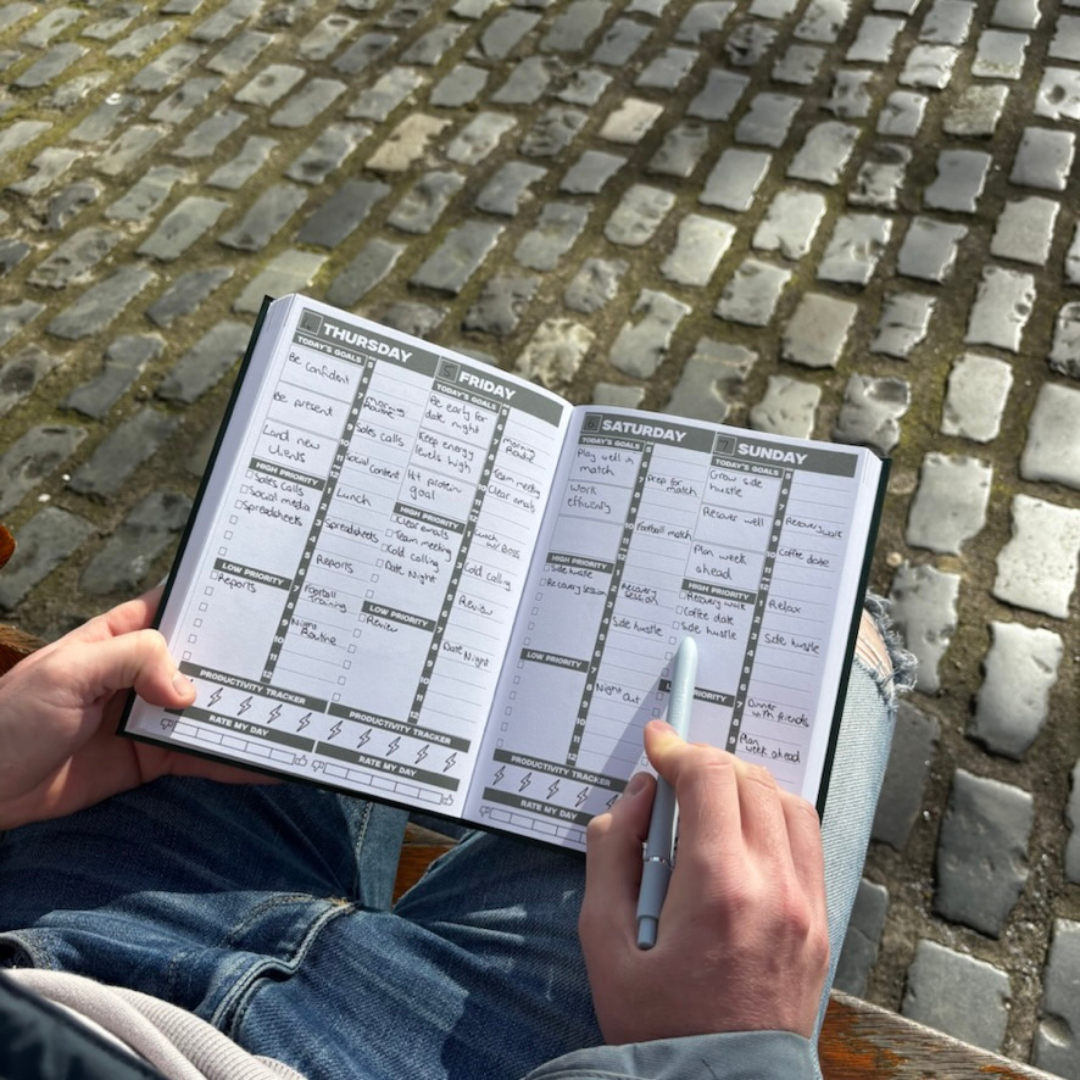
The Plan Your Growth undated weekly agenda is the physical home for this weekly categorisation. The weekly layout gives you the space to run the matrix at the start of the planning session and assign every Quadrant 2 task a named block before the week begins. That single discipline, done every Sunday, shifts the balance of the week toward what matters.
The Eisenhower Matrix and Email
Email deserves specific treatment because it is the clearest example of a Quadrant 3 category that most men allow to colonise their Quadrant 2 time.
The default position for email in most men's working lives is open, always-visible, and checked continuously. This means every incoming email, regardless of its quadrant, has direct access to their attention during the highest-value hours of the day. The urgent-but-unimportant email about a meeting room booking lands in the same attentional window as the deep work block reserved for the strategic project. And the email wins, every time, because it is visible and the strategic work is not.
Running email through the matrix produces a clear operational rule: almost all email is Quadrant 3. It is urgent (it has arrived, it demands response) but it is not important in the sense that it advances your most significant goals. The correct handling is therefore defined response windows, not continuous monitoring. Open email twice a day. Process it fully in those windows. Close it completely between them.
The man who thinks his professional obligations prevent this has usually not tested it. He has assumed it. Most professional environments adapt quickly to a colleague who responds reliably within four hours rather than responding within ten minutes across a fourteen-hour window. The reliability matters more than the speed.
Protecting Quadrant 2 as a Long-Term Strategy
The real payoff of the Eisenhower Matrix is not in any single week. It is in the compounding effect of consistently protecting Quadrant 2 across months.
A man who carves two hours of Quadrant 2 work per day out of a previously Quadrant 3-dominated day produces the following over a year: approximately 500 hours redirected from low-leverage reactive work into strategic, important, non-urgent projects. That is the difference between a man whose position is the same at year end as it was at year start, and a man who has built something, advanced significantly, or fundamentally changed his capacity in some domain that matters.
This is not a motivational claim. It is arithmetic. Two hours per day, protected, directed at Quadrant 2, compounded across twelve months. The Eisenhower Matrix is the tool that makes those two hours defensible against the urgency pressure that would otherwise consume them.
The framework does not require genius or extraordinary willpower. It requires ten minutes of categorisation on Sunday morning and the discipline to honour the schedule that emerges from it. Both are available to any man who decides they matter.
The Bottom Line
The Eisenhower Matrix is a prioritisation tool that forces an honest categorisation of every task into one of four responses: do it, schedule it, delegate or defer it, or eliminate it. The leverage is in Quadrant 2: important but not urgent. This is where strategic work lives, and it is chronically under-resourced in most men's weeks because urgency always announces itself louder. Run the matrix in your Sunday planning session. Schedule Quadrant 2 blocks before anything else. Batch Quadrant 3 into defined windows. Eliminate Quadrant 4 without guilt. Over twelve months, the compounding effect of consistently protecting what matters over what shouts is significant.
The Plan Your Growth undated weekly agenda is where the weekly matrix output lives: your Quadrant 2 blocks named and scheduled, your reactive windows defined, your priorities visible throughout the week. The matrix does the thinking. The planner holds the result.