Environment Design: How to Build a Space That Makes You Perform
Most men try to overcome their environment with willpower. They keep their phone on the desk and resolve not to check it. They work in the same space they watch television in and wonder why focus is difficult. They keep junk food in the kitchen and rely on discipline at 10pm. This is fighting uphill. Environment design is the upstream move: instead of using willpower to resist what your environment is offering, you change the environment so that the right behaviour requires the least friction and the wrong behaviour requires the most. The research behind this approach is solid. James Clear, whose work on habit formation draws on decades of behavioural science, frames environment as the invisible hand that shapes behaviour more consistently than motivation or willpower ever will. Engineering your environment is not a life hack. It is one of the highest-leverage structural changes an ambitious man can make.
How Your Environment Is Currently Working Against You
Your environment is not neutral. Every object in your space, every layout decision, every default setting on your devices, is either making the right behaviour easier or the wrong behaviour easier. In most men's lives, the balance is currently skewed in the wrong direction.
The phone on the desk is available for checking thirty times a day. The television in the living room is the default evening activity because it requires the least activation energy. The gym bag unpacked in the bedroom means the workout requires a decision and a set-up before it can begin. The email tab permanently open in the browser means every time focus wavers, there is a low-friction alternative available.
These are not character problems. They are architecture problems. The man who checks his phone constantly is not weaker than the man who checks it rarely. He has a worse environment. Change the architecture and behaviour follows, not because motivation has increased but because friction has been redistributed.
The principle, drawn from behavioural economics research on choice architecture, is that people reliably take the path of least resistance when faced with decisions. Most decisions are not made through conscious deliberation. They are made by defaulting to whatever is most available and most convenient. Environment design uses this tendency deliberately, making the behaviours that serve your goals the most convenient ones.
The Four Friction Levers You Can Adjust Today
Environment design operates through four practical levers. Adjust any of them and behaviour shifts.
Visibility. What you see, you do. What is out of sight tends to stay out of mind. Your workout gear on the floor beside your bed increases the probability of morning exercise. Your phone out of sight in another room decreases the probability of distraction. Your planner open on the desk increases the probability that you actually consult it. Put your goals where you will see them. Remove the things that pull you away from them from your field of vision.
Proximity. What is close gets used. What requires effort to reach gets avoided. Keep a glass of water on your desk. Put your phone charger in a room you do not work in. Keep the book you want to read on your pillow rather than on a shelf across the room. The distance between you and a behaviour is a surprisingly accurate predictor of whether you perform it.
Convenience. How many steps does the right behaviour require? Friction is the enemy of consistency. If your deep work setup requires ten minutes of organising before you can begin, you will begin it less often than if it requires opening a notebook and clicking a timer. Pre-set the environment. Leave the notebook open to tomorrow's page. Close unnecessary tabs at the end of the day so the morning begins clean.
Association. Your brain links environments to behaviours through repetition. The bed becomes associated with sleep. The coffee shop becomes associated with work. The living room couch becomes associated with passive consumption. Use these associations deliberately. Work only at your desk, not on the sofa. Reserve one physical space exclusively for your most important focused work and protect it from other activities. Over time, entering that space becomes a cue for the focused state you want.
Designing Your Physical Workspace for Performance
Your physical workspace is the most controllable element of your environment. Here is the standard most high-performing men aim for.
A dedicated work surface that is used exclusively for work, not for eating, watching content, or gaming. A clear desk with only what is needed for the current task visible. Nothing that serves as an invitation to switch context. The computer positioned away from the window if bright light creates glare, facing the window if natural light improves alertness.
Noise is a context-dependent variable. Some men focus better in complete silence. Others benefit from a consistent ambient background that masks unpredictable interruptions. Noise-cancelling headphones are one of the most effective environment design investments available because they give you control over the auditory environment regardless of where you are working.
Temperature matters more than most men account for. Research consistently shows cognitive performance peaks in environments between 19 and 22 degrees Celsius. A too-warm room reduces alertness. A too-cold room increases distraction from physical discomfort. If your workspace temperature is outside this range, adjusting it is a legitimate performance variable.
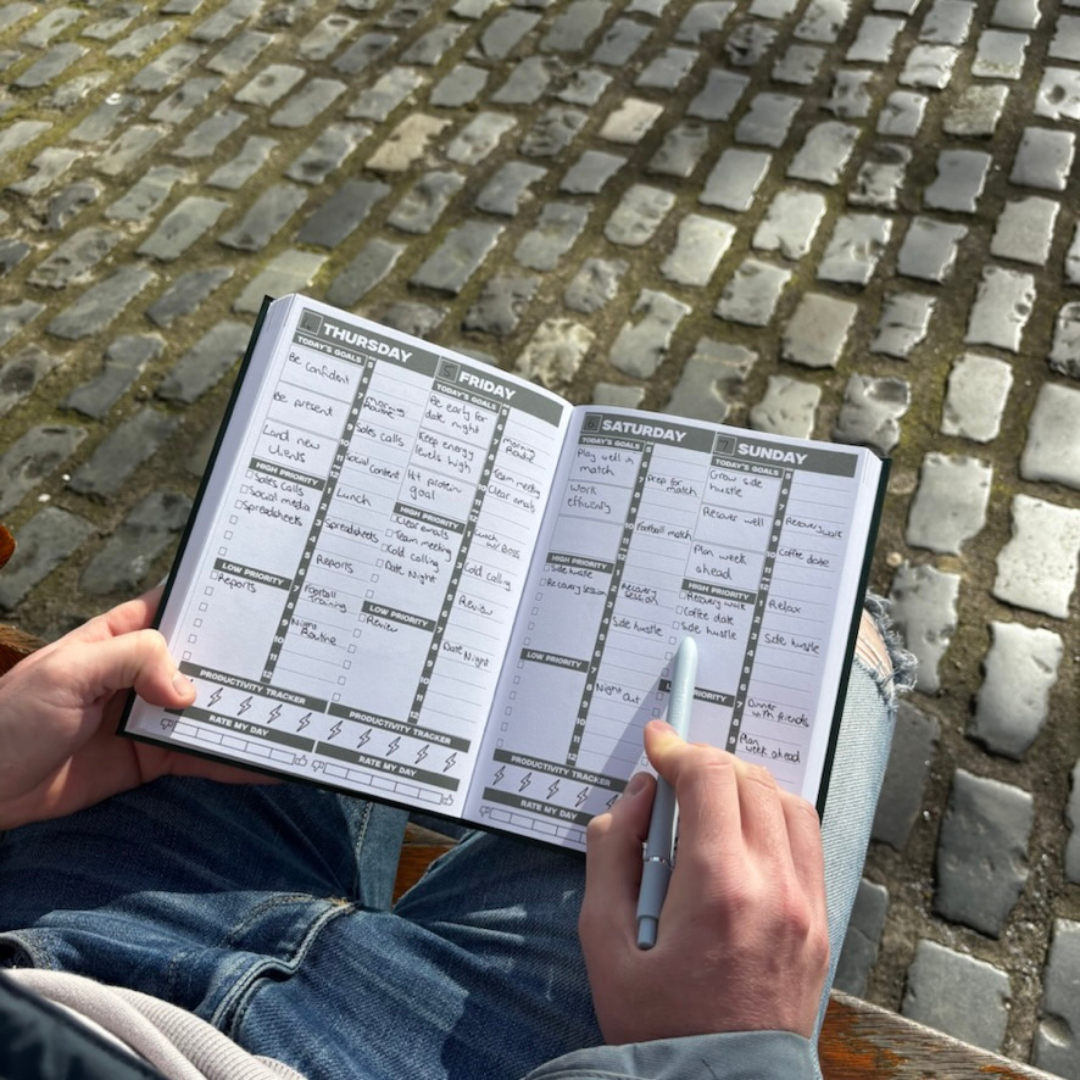
The Plan Your Growth undated weekly agenda belongs on the desk as a permanent fixture, not in a drawer. Having your weekly plan visible means your priorities are always within sight during the work session, which reduces the cognitive cost of remembering what you are supposed to be doing and resisting the pull toward lower-priority tasks.
Designing Your Digital Environment
The physical environment gets the most attention in productivity discussions, but the digital environment is where most modern men lose the most time and attention.
Default settings on every device and application are designed to maximise engagement with that application, not to support your focus. Notifications are on by default. The social feed is the home screen by default. The email inbox opens automatically on browser launch by default. Every one of these defaults is working against your ability to sustain focused work.
Reset the defaults. Notifications off except for phone calls and calendar alerts. Social media apps moved off the home screen or removed from the phone entirely. Email client closed except during the two designated response windows in your day. Browser tabs cleared at the end of every session. Your phone screen set to greyscale, which research from the Behavioural Insights Team shows reduces the compulsive pull of the screen significantly.
These are small changes. The cumulative effect of running them consistently is significant. Each one reduces the frequency of unintentional context switches during your work sessions, and each unintentional context switch costs attention residue that would otherwise go to the task in front of you.
Environment Design for Evenings and Recovery
Environment design is not only for work performance. It also applies to the recovery that makes sustained performance possible.
The evening environment shapes sleep quality, and sleep quality shapes the cognitive capacity available the following day. A bedroom with a television is an environment that signals wakefulness rather than sleep. A bedroom with the phone charging beside the bed is an environment that makes late-night scrolling the default activity. A bedroom that is dark, cool, and associated exclusively with sleep and rest is an environment that produces better sleep outcomes.
Matthew Walker, a sleep neuroscientist at the University of California Berkeley whose research on sleep is extensively documented, has consistently identified light exposure and device use in the hour before bed as primary disruptors of sleep quality. The environment design response is structural: no screens in the bedroom, a specific wind-down sequence that begins at a consistent time, and a sleep environment that is cool (around 18 degrees Celsius), dark, and quiet.
Men who sleep better think more clearly. Men who think more clearly make better decisions and produce better work. The performance case for designing your recovery environment is exactly as strong as the performance case for designing your work environment.
The Bottom Line
Environment design is the highest-leverage habit intervention available because it works on the conditions of behaviour rather than on behaviour itself. Change what is visible, what is proximate, what is convenient, and what your spaces are associated with, and behaviour shifts without requiring willpower to drive it. Start with the four friction levers. Redesign your physical workspace for clarity and your digital environment for minimum distraction. Apply the same logic to your recovery environment. The man who has engineered his environment well is not more disciplined than the man who has not. He is smarter about where discipline is needed.
The Plan Your Growth undated weekly agenda is the physical object that holds your week in plain sight and makes your priorities part of your visual environment. Keep it on the desk. Open it every morning. Let it do the work of keeping you oriented without requiring you to carry the plan in your head.