The Evening Routine That Prepares You to Dominate Tomorrow
Your brain at night is a system winding down. Cortisol drops, melatonin rises, core body temperature falls, and the prefrontal cortex begins the long process of filing the day's information for memory consolidation. Every habit you hold in that window either supports or sabotages the biology that is already trying to happen. Stare at a phone for thirty minutes in bed and you suppress the melatonin rise by forty-five minutes. Drink a second whiskey with dinner and you fragment your REM sleep. Have the difficult argument at 10:30 and your cortisol does not come back down by midnight, so you wake up tired even after eight hours.
The men who have dialled-in mornings have almost always first dialled-in evenings. The mistake is trying to optimise morning output without repairing the underlying sleep architecture. A routine is the cheapest intervention available. No supplements, no tech, no expense. Just a sequence of behaviours held consistently enough that your nervous system learns it is safe to shut down at the same time every night.
The 90-Minute Wind-Down: The Structural Frame
The evening routine for men that actually works splits into three thirty-minute blocks across the 90 minutes before your target bedtime. Each block has one job. Together they do what no single habit can.
Block one is the transition block. This is where the workday ends. Not "where you stop checking Slack while watching TV." An actual bounded end. If your target sleep time is 11 p.m., this block runs roughly 9:30 to 10:00. The phone goes face down. Email is closed, not just backgrounded. Anything urgent is written down in tomorrow's slot so your brain stops cycling on it. The mental shift is from producer to non-producer. Most men never make this shift, and then wonder why they cannot fall asleep at midnight.
Block two is the recovery block, 10:00 to 10:30. This is where you do whatever actually recovers you as a person. Reading a real book. A shower. A conversation with your partner that is not about logistics. A ten-minute walk if the weather allows. This block is non-negotiable and it is the block men sacrifice first when the day runs long. Do not. Recovery is the input to tomorrow's performance. Skipping it is borrowing against your next-day self at high interest.
Block three is the shutdown block, 10:30 to 11:00. This is the ritual that puts the day to bed. Teeth, water, lights down, phone in another room, alarm set. You are telling your body it is safe to drop out of high alert. The body needs the repetition to learn that signal. A routine you hold for six weeks will do more for your sleep than any sleep tracker you buy.
The Shutdown Ritual: Five Minutes, Non-Negotiable
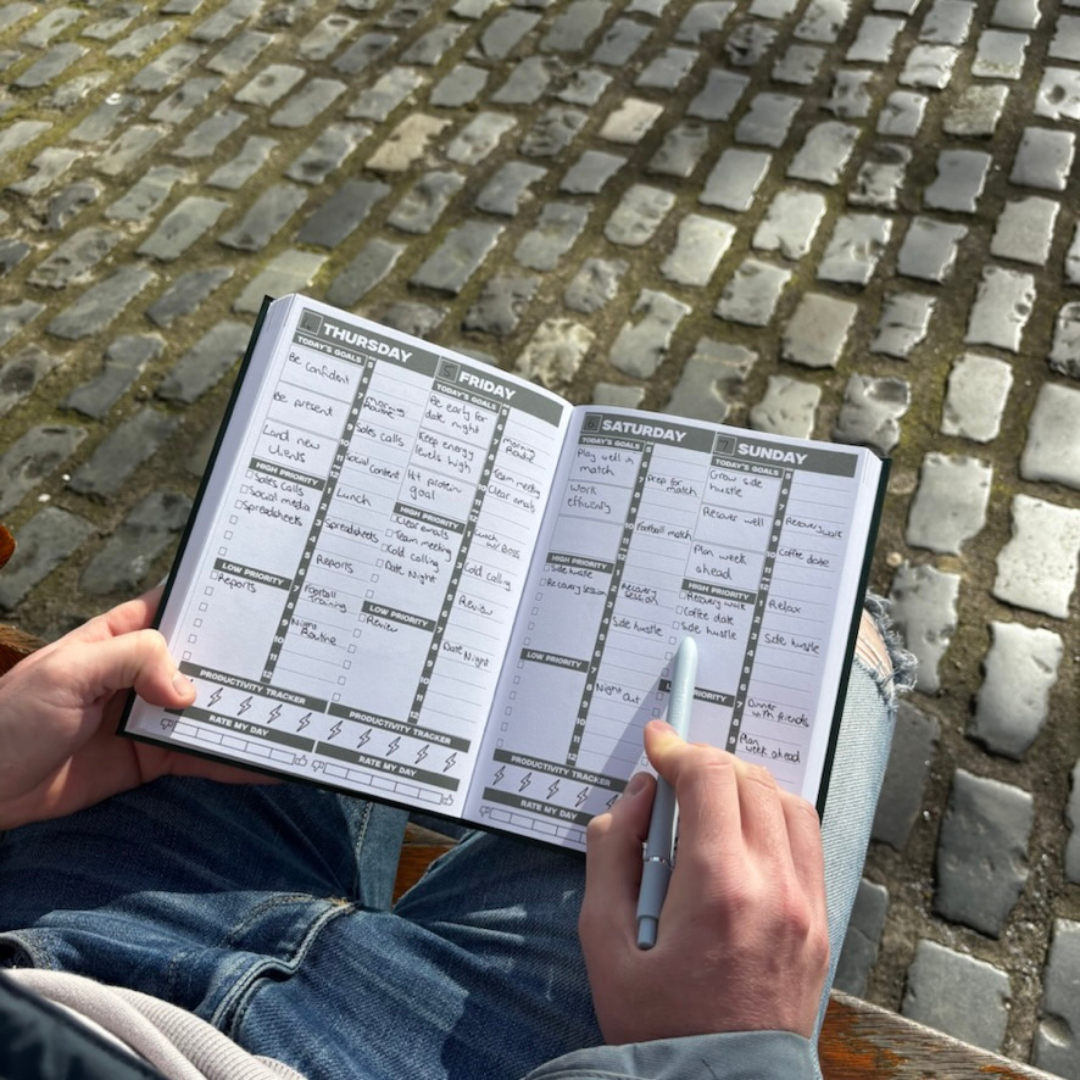
Inside the shutdown block there is a smaller ritual that matters more than the rest combined. Five minutes, same order, every night. Open your planner. Write the top three outcomes for tomorrow. Look at tomorrow's calendar and note any first meeting or first commitment so your brain files it. Write one line on how today actually went. Close the planner.
This single habit eliminates most of what keeps men awake at 1:15 a.m. The reason your brain runs work loops in the middle of the night is that it has unresolved information from the day and no confidence the information is captured somewhere it will be seen again. Writing the three outcomes closes the loop. The brain says, fine, this is stored, I can stop working on this. You fall asleep faster. You wake up already knowing what matters.
The other benefit is continuity. You are never starting tomorrow from zero. You open your agenda in the morning and yesterday's note is already there, yesterday's three outcomes tell you where the momentum was, today's outcomes are already set. That continuity is what separates men who build over years from men who restart every Monday.
What to Cut From Your Evening Routine
As important as what you add is what you remove. Three things sabotage the 90-minute wind-down more than anything else, and cutting them is the fastest single improvement you can make to sleep quality.
Screens inside the last hour. Yes, including Netflix. The blue light component matters, but the content activation matters more. Your brain does not wind down while it is processing plot and narrative. Read a paperback instead. The difference in sleep latency is noticeable inside a week.
Alcohol within three hours of sleep. It makes you feel sleepy because it is a central nervous system depressant, but what it actually does is suppress REM and fragment the sleep architecture. You wake at 3 a.m. You wake unrefreshed. You think the whiskey helped you sleep. It did not.
Big decisions after 9 p.m. Your evening brain is not your decision brain. Huge arguments, financial decisions, career conversations belong to the morning or to a specifically booked slot earlier in the day. Men who fight important battles at 10:30 at night lose both the argument and the night.
Making the Evening Routine Stick
The difference between men who have evening routines and men who try to have evening routines is almost always the anchor. You do not hold a routine by wanting to hold it. You hold a routine by tying it to a physical anchor that is harder to skip than it is to execute.
The simplest anchor is a time-triggered phone alarm at the start of block one. 9:30 p.m. phone buzzes. You have trained yourself to treat that buzz as the signal to close the laptop. That is it. After three weeks the body starts doing this without the alarm. Before three weeks, you need the alarm or you will not hold the routine.
The other anchor is the planner. The Plan Your Growth undated weekly agenda has a nightly slot for the three outcomes and a daily line for the shutdown ritual. The physical act of opening the book and writing five lines is the behavioural glue. Men who have a daily anchor built into a physical tool hold the routine at a vastly higher rate than men who rely on memory or phones. The tool is the structure. The structure is how you hold the night.
What to Do When the Routine Breaks (Because It Will)
A real evening routine is going to break. A late night at work. A friend in town. A kid who will not sleep. A first date. An argument that runs long. The question is not whether it breaks. The question is how you respond when it does. Men who maintain a multi-year evening routine all share the same recovery pattern, and if you learn it early you will save yourself the frustration of quitting.
Rule one is that one bad evening is not the end of the routine. It is a single data point. The men who lose the routine after a single slip are the men who had the routine attached to an identity of perfection. The men who keep it for years treat it as a default they return to, not an identity they violated. If you stayed up until 1 a.m. on a Tuesday, you run the normal routine on Wednesday. You do not start a new routine in January. You just return.
Rule two is that two bad evenings in a row is a signal, not a failure. Something in your life has shifted and the routine needs to adapt to the new reality rather than collapse. Maybe the new baby changed the timing. Maybe a new role added late evenings. Maybe the winter changed your willingness to walk at 10 p.m. Notice the shift in your Sunday review, adjust the routine to the new circumstances, and hold the new version. Rigidity is what kills evening routines. Thoughtful adaptation is what keeps them alive.
Rule three is that the shutdown ritual is the part that survives no matter what. Even if you cannot hold the transition or recovery blocks on a given night, five minutes writing tomorrow's three outcomes and closing the laptop is always available. Make that five-minute ritual the non-negotiable floor. Everything else above it is optional. The floor is the part that protects continuity through bad weeks.
The Bottom Line
Your morning is built the night before, and most men ignore this until they are forty and wondering why they feel foggy. The evening routine for men who want to dominate tomorrow is not elaborate. Ninety minutes split into three thirty-minute blocks: transition, recovery, shutdown. A five-minute ritual inside the shutdown block that closes today and prepares tomorrow. Screens, alcohol, and big decisions cut from the last hour. An anchor that makes the routine automatic after three weeks. Do this for six weeks and the mornings you were trying to build by changing 6 a.m. start happening on their own.
If you want the structure on paper so the evening ritual has a home instead of living in your head, the Plan Your Growth undated weekly agenda was built for this. Nightly three-outcome slot, daily shutdown line, weekly spread for the week you are actually owning. Pick a colour, put it on your bedside, and run your first shutdown tonight.