Evening Shutdown Routine: End the Day Like a High Performer
Most men do not end their working day. They drift away from it. The last task trails off, the email stays open, the laptop sits on the coffee table while something plays in the background, and somewhere around 11pm the day just ends because exhaustion makes it end. There is no deliberate close. No transition. No moment where the work day is finished and something else begins. The result is poor sleep, a restless mind that keeps cycling through unfinished tasks, and a morning that starts from yesterday's residue rather than from a clean position. An evening shutdown routine is the fix. It takes 10 to 15 minutes. It closes the day with intention, sets the next one up with clarity, and creates the psychological boundary that separates work from genuine recovery. High performers run some version of this. Most men do not. That gap is worth closing.
Why the Evening Is More Important Than Most Men Think
The way you end your day determines the quality of your recovery, and the quality of your recovery determines the cognitive capacity you bring to the following day. This is not abstract. It is physiology.
Matthew Walker, a neuroscientist and sleep researcher at the University of California Berkeley, whose findings on sleep and cognitive performance are documented at sleepdiplomat.com, has established clearly that sleep quality is significantly affected by the mental state you carry into bed. A man who finishes work with multiple unresolved tasks circling in working memory, no clear plan for tomorrow, and the low-grade anxiety of open loops will sleep lighter and recover less fully than a man who has closed those loops, written the plan, and signalled to his brain that the working day is complete.
The difference in cognitive performance the following morning between these two men is measurable. The man who recovered properly makes better decisions earlier, sustains focus longer, and produces higher-quality output in his first Tier 1 block. The man running on accumulated sleep debt and unprocessed evening anxiety is operating at a fraction of his potential before 9am.
The evening shutdown routine is not a wellness practice. It is a performance protocol for the following day.
The Five-Step Evening Shutdown Sequence
The shutdown sequence takes 10 to 15 minutes and should happen at the same time every evening to build the conditioned association between the sequence and the transition to rest.
Step 1: Task audit (2 minutes). Look at what you planned to do today and what actually happened. Tick the completions. Note the items that did not happen and make an explicit decision about each one: reschedule it for a specific slot this week, move it to next week with a date, or consciously drop it. Nothing drifts to a vague "later." Everything gets a decision.
Step 2: Capture open loops (3 minutes). Everything still circling in your head gets written down. Ideas, worries, follow-up items, things you remembered mid-afternoon and did not have time to act on. The physical act of writing these down tells your brain they are captured and do not need to be held in active memory. This is the primary mechanism that reduces middle-of-the-night rumination.
Step 3: Set tomorrow's three priorities (2 minutes). Before you close the planner, write the three tasks that must happen tomorrow. Not the full task list. The three non-negotiables. This decision, made tonight rather than tomorrow morning, saves you the decision fatigue of figuring out what matters most during your highest-value cognitive window. You wake up with the plan already made.
Step 4: Prepare the environment (3 minutes). Close every browser tab. Shut the laptop. Clear the desk of anything that belongs to tomorrow's session rather than tonight. Put the planner open to tomorrow's page. Charge the phone somewhere other than the bedroom. These are not symbolic acts. They are environmental resets that make tomorrow's start lower friction and tonight's rest less contaminated by work associations.
Step 5: Say the words (30 seconds). Cal Newport, who has written and spoken extensively about the shutdown ritual in his work on deep work, recommends verbally stating "shutdown complete" at the end of the sequence. This sounds almost absurdly simple. The mechanism is real: a consistent verbal cue, repeated nightly, becomes a conditioned signal to the brain that the working day is finished. Without a signal like this, the transition from work to rest remains ambiguous, and the brain continues to process work-related content in the background.
Why Most Men Skip the Shutdown and What It Costs Them
The shutdown routine gets skipped for two predictable reasons. First, the day runs long and by the time it ends there is no energy for a 15-minute close. Second, men underestimate the cost of not doing it, because the consequences (fragmented sleep, a slower morning start, accumulated cognitive debt) are diffuse and hard to trace back to the skipped routine.
The response to the first problem is to set the shutdown earlier than feels natural. If your intention is to stop working at 7pm, set the shutdown ritual for 6:45. This way the ritual is part of the closing of work rather than something that happens after you have already mentally checked out. Men who try to run the shutdown after they have drifted away from work consistently skip it. Men who run it as the defined end of the working day consistently do it.
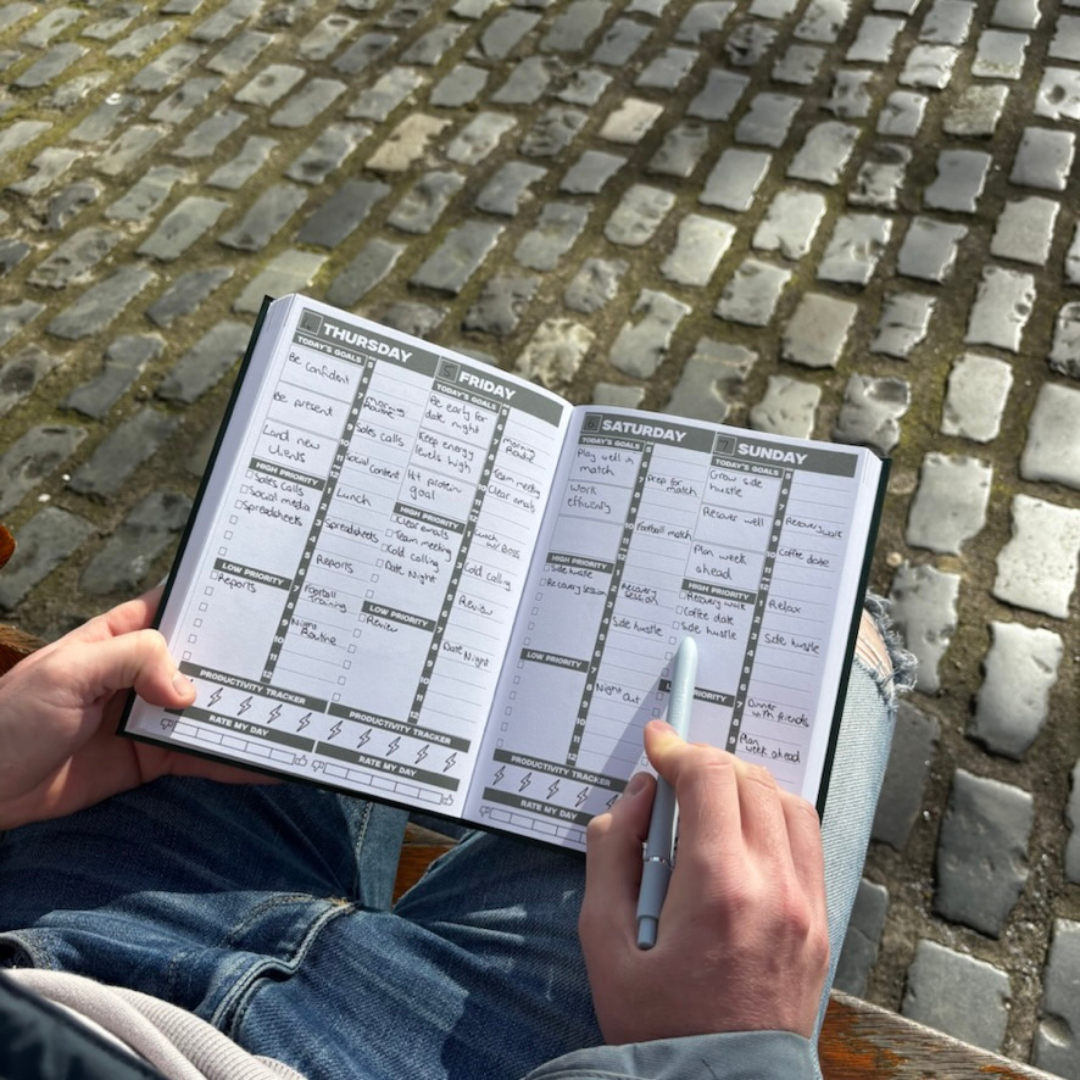
The Plan Your Growth undated weekly agenda is the physical centrepiece of steps 1, 2, and 3 of the shutdown. The daily layout gives you the space to audit your tasks, capture your open loops, and write tomorrow's three priorities in the same place where your weekly plan lives. The shutdown session has a home rather than being a vague concept that gets improvised differently each night.
What the Shutdown Protects
A consistent evening shutdown routine protects three things that compound over time.
Sleep quality. By closing open loops and building a clear plan for tomorrow, you reduce the working memory load your brain carries into sleep. Less to process means deeper rest and stronger recovery.
Morning performance. The man who wrote his three priorities last night starts his morning from a position of clarity. There is no decision to make at 7am about what matters most today. The decision is already on the page. He goes straight to execution.
The boundary between work and life. Men who have no defined end to their working day carry work into every part of their lives. The conversation at dinner, the evening walk, the time with family. They are physically present and mentally in the inbox. The shutdown routine creates a real close, not a drift. What happens after it is not work. It is everything else.
That boundary is not just a wellbeing question. It is a performance question. A man who genuinely disconnects in the evening recovers more fully than one who stays partially on. The recovery produces the output. Skip the recovery and the output degrades, slowly and then all at once.
The Bottom Line
An evening shutdown routine is a 10 to 15 minute sequence that closes the working day with intention: audit your tasks, capture your open loops, set tomorrow's three priorities, reset the environment, and give the shutdown a verbal signal that the day is done. Run this at the same time every evening and it becomes the conditioned transition between work and genuine recovery. The sleep that follows is better. The morning that comes after is sharper. The cumulative performance advantage of this routine, compounding across 90 days, is significant. Most men never build it because they underestimate what unstructured evenings cost them. Now you know. Build the sequence and run it.
The Plan Your Growth undated weekly agenda holds the daily structure your shutdown runs on. Task audit, open loop capture, tomorrow's three priorities. Ten minutes a night. The best investment you make in tomorrow's output happens the evening before.