How to Build Mental Toughness: 10 Daily Habits That Compound
Mental toughness is not a personality you were born with or failed to inherit. It is the compounding output of a small number of daily habits done at a boring enough cadence to become automatic. That framing matters, because a lot of what gets sold online as mental toughness is theatre. Cold plunges posted to Instagram. Ice baths followed by coffee that undoes the cortisol effect. Performative discomfort that photographs well and changes nothing. Real mental toughness is invisible from the outside. It is the man who decided at 5:45 that today was a running day and went for the run. It is the choice you made in the moment nobody was watching. Here is how you build it on purpose.
What Mental Toughness Actually Is
The academic literature on this is clearer than most men realise. Researchers like Dr. Angela Duckworth at UPenn, whose work on grit has become the reference point for the field, describe mental toughness as two combined capacities: the ability to sit with short-term discomfort in service of a longer-term outcome, and the ability to stay consistent with a direction over years. That second part is where most men fall apart. They can tolerate two weeks of discomfort. They cannot string together two years of consistent direction. Mental toughness habits are the mechanism that bridges the two.
None of the habits below are novel. You have heard versions of them before. That is not a bug. Mental toughness is not built with exotic inputs. It is built with boring inputs applied at a cadence most men cannot maintain. Your edge is not going to be a secret. Your edge is going to be that you actually did the thing.
Habit One: Same Wake Time, Seven Days a Week
Not five days. Seven. The men who crumble on the weekend have not built a sleep schedule, they have built a work schedule. Pick a wake time and hold it on Saturday and Sunday too, inside thirty minutes either side. This single habit changes your relationship to energy more than any supplement you will buy.
Habit Two: The First Decision of the Day Is the Hardest One
Whatever you have been avoiding, do it before 10 a.m. The cold sales call. The awkward conversation with your partner. The payment you owe. The gym session you keep pushing. You are training the default that the hardest thing gets dispatched first, which means the rest of the day operates without the drag of avoidance. Discipline is downstream of this habit.
Habit Three: One Daily Moment of Deliberate Discomfort
Notice the word deliberate. This is not punishment and it is not theatre. It is a small, controlled dose of physical or mental discomfort you choose every day to keep the tolerance muscle trained. Thirty seconds of cold water at the end of your shower. Two minutes of plank. The last set to failure. Sit with the boredom of a silent ten-minute walk instead of a podcast. The form does not matter. The repetition does. A man who does one small deliberate discomfort a day is not the same man six months later.
Habit Four: No Phone in Bed, Either Side
The first thing you see and the last thing you see shapes the neurochemistry of the whole day. Phone lives outside the bedroom. An analog alarm clock costs ten euros. The first forty-five minutes of your day belong to you, not to an algorithm that is optimised for your attention, not your wellbeing.
Habit Five: Write Three Outcomes Before You Open Email
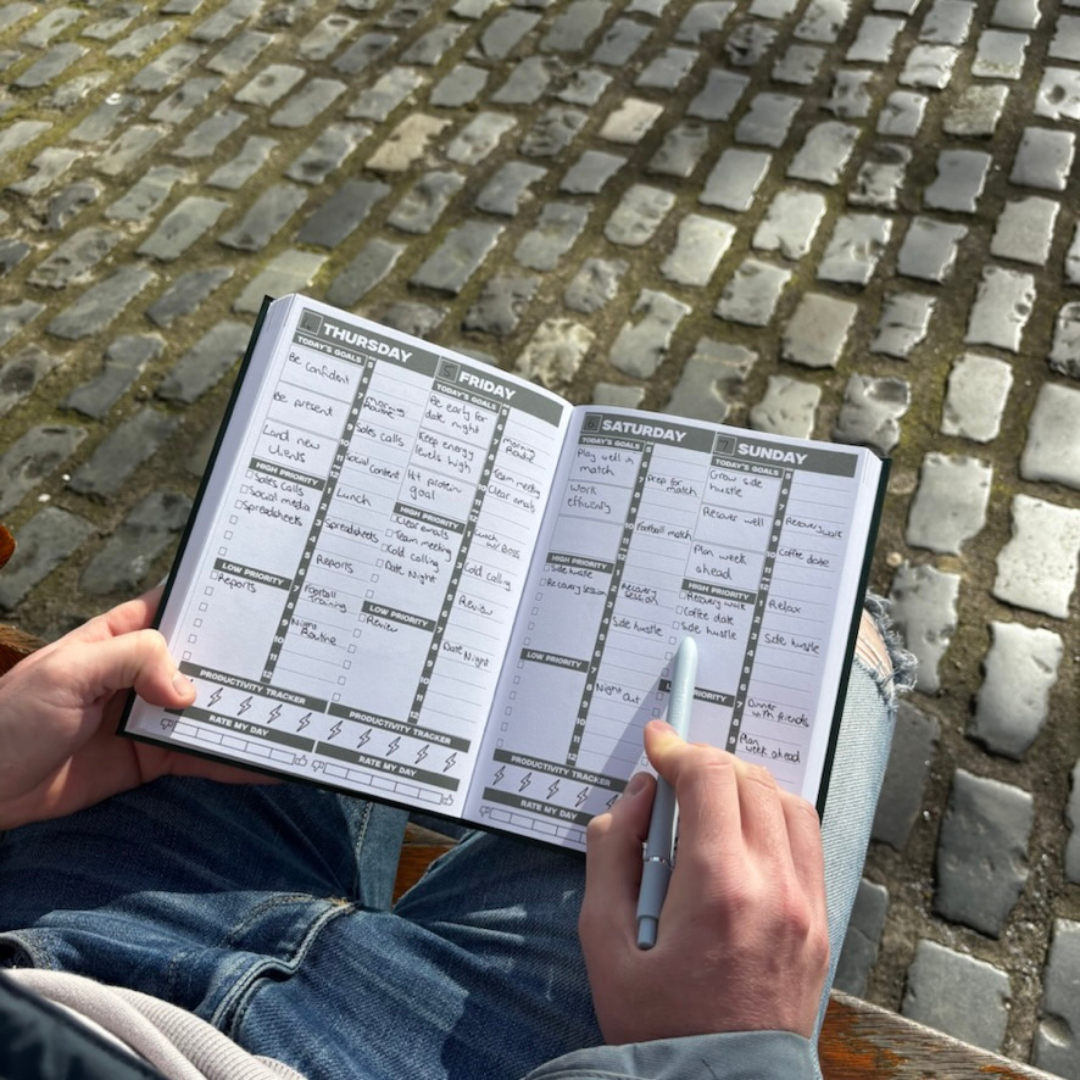
Open your planner before you open your inbox. Write the three outcomes that matter for this day. This is ninety seconds of work. It protects you from spending the morning reacting to other people's priorities. Men who do this consistently end the day having done what they wanted to do. Men who skip it end the day having done what their inbox wanted them to do. The difference compounds into years.
Habit Six: Eat the Same Breakfast for Thirty Days
Decision fatigue is a real thing and breakfast is where most men burn willpower they will need later. Pick a breakfast you can tolerate. Eat it every day for a month. Stop negotiating with yourself about food before 9 a.m. The point is not the breakfast. The point is removing a daily decision so your decision budget is available for the afternoon choices that actually matter.
Habit Seven: Train Four Times a Week, Minimum
Not every day. Four days. Non-negotiable. Whatever format works for you. The actual body is a secondary benefit. The primary benefit is that you become a man who does not negotiate with himself about training. Negotiation is where most men lose, because the version of them at 7 p.m. on a Wednesday always loses to the version of them at the weekly review on Sunday. Remove the negotiation by deciding once and holding the line. The training will happen. The mental toughness will form.
Habit Eight: Keep a Single Weekly Commitment to Someone Else
Accountability with another person is the oldest mental toughness hack humans have. Join a team. Agree to a standing Wednesday run with a friend. Commit to a monthly coffee with a mentor where you review your own progress out loud. Something that requires another human's presence and therefore makes flaking feel shameful. You will honour commitments to other people at a much higher rate than commitments to yourself. Use that.
Habit Nine: The Ninety-Second Shutdown at Day's End
At the end of every workday, spend ninety seconds writing in your agenda: what got done today, what did not, and what is the single most important thing for tomorrow. This is how you close the working part of the day and free the evening. It also prevents Monday mornings from feeling like starting from zero, because every Tuesday starts with yesterday's note already there. The weekly layout of the Plan Your Growth agenda has the space for this built in, one small daily line that compounds into a year of continuity.
Habit Ten: Sit Alone With Yourself for Ten Minutes
Not meditation. Not guided breathing. Just ten minutes of uninterrupted silence, no phone, no stimulation. The first week will be uncomfortable. By week three, you will notice you can think more clearly during the rest of the day. You are training the nervous system to be comfortable without input. That capacity is the foundation of everything else. If you cannot sit alone with yourself for ten minutes, any discomfort tolerance you build through cold showers and training is fragile.
How Men Actually Maintain This for a Year (Not Six Weeks)
Here is the uncomfortable part nobody on social media talks about. Most men can hold these habits for six weeks. Very few can hold them for a year. The difference is not willpower. Men who maintain mental toughness habits over years almost always share three structural things, and if you do not have them set up, the habits will drift.
First, they track on paper. A habit tracker in a bound book, visible every day. Not an app. The research on habit tracking is surprisingly consistent: people using a physical visual tracker hold habits at roughly double the rate of people using digital trackers. The feeling of putting an ink mark in a small box on a weekly spread is psychologically different from the feeling of tapping a green checkmark in an app. The paper is the accountability.
Second, they review weekly and kill what is not working. Not every one of the ten habits is right for you. Some will fit your life and some will not, and the ones that do not fit need to be quietly retired rather than half-heartedly attempted. Men who hold this for years do a proper 30-minute weekly review, honestly assess which habits are producing returns, and keep adjusting the set of ten until it is the set of ten for their life. The list is not fixed. The practice of holding an honest set is fixed.
Third, they build one accountability loop that is external. A training partner, a coach, a friend who asks the question, a mentor you meet monthly. The internal commitment drifts. The external commitment holds. Men who have both inner discipline and one external check-in almost always outlast men with only one of the two. This is not a weakness. It is simply the structure of how humans are wired. Use it.
The trap to watch for is identifying too hard with the habits. "I am the kind of man who gets up at 5" is a brittle identity because one bad week wrecks the story. "I am a man who runs a weekly review and adjusts my habits based on what I learn" is a durable identity because the review absorbs bad weeks without fracturing who you are. Build the second kind, not the first.
The Bottom Line
Mental toughness is not a trait, not a temperament, not an identity. It is the compounding output of ten daily habits a lot of men cannot maintain. Same wake time, hardest decision first, one dose of deliberate discomfort, no phone in bed, three outcomes before email, boring breakfast, four training days a week, a commitment with another human, a ninety-second shutdown, ten silent minutes alone. None of this is secret. The edge is not that the habits are hidden. The edge is that you actually hold them for three hundred and sixty-five days while most men drop off by February. Pick the ones you do not currently do. Write them in your agenda tonight. Start tomorrow.
If you want the structure on paper so the ten habits are visible instead of floating in your head, the Plan Your Growth undated weekly agenda was built for exactly this. Daily line for the three outcomes, daily line for the shutdown, a habit tracker for the commitments you want to compound. Undated so day one is whenever you are ready, not whenever the calendar lets you start.