Time Blocking for Men: Reclaim Your Day in 5 Steps
Most men think they have a time problem. They do not. What they have is an allocation problem. The hours are there. The evidence is in the 4.7 hours the average person spends on their phone each day. Time blocking is not a hack. It is the structural discipline of telling your hours exactly where to go before someone else does. If you have been running your days on autopilot, reacting to messages and half-finishing tasks, this is the mechanism that stops it. It is five steps. None of them are complicated. All of them require you to actually do them.
Why Reactive Scheduling Is Killing Your Output
Nobody starts the day planning to waste it. You sit down with vague intentions and a list of priorities. Then a Slack message arrives. Then an email. Then a phone call you feel obligated to take. By 11 a.m. you have been busy for two hours and done nothing that moved the needle.
This is not laziness. It is the default state of an unstructured workday, and it compounds badly. Research from Gloria Mark at the University of California Irvine shows that after an interruption, it takes an average of 23 minutes and 15 seconds to fully return to a task. If you are interrupted six times before noon, you have lost the equivalent of over two focused hours before lunch. That is not bad luck. That is a predictable outcome of an unprotected calendar.
The problem is not willpower. The problem is that you have handed control of your attention to whoever shouts loudest. Your inbox decides your priorities. Your phone decides your focus. Your colleagues decide your schedule. Time blocking reverses that power structure. It does not require more discipline than you currently have. It requires a structure that makes the right choice the default choice.
The second reason reactive scheduling is costly is identity. Men who spend most of their working day responding to other people's requests gradually lose the sense of authorship over their own output. They start to feel like they are working hard without building anything. That feeling is accurate. Reactive work is maintenance. Deep work is construction. Time blocking is the system that protects time for construction.
Step 1: Audit the Week Before You Plan It
Before you block a single hour, you need an honest accounting of where your time actually goes. Spend one week tracking your time in 30-minute intervals. Log what you were actually doing, not what you planned to do. You will not like what you find. Most ambitious men discover that their deep work time, the focused, high-output hours spent on the work that actually drives results, amounts to less than 90 minutes a day. The rest is administration, interruption, and recovery from interruption.
This audit is not punishment. It is data. It gives you a baseline so you know how many quality hours you genuinely have available once you strip out meetings, commute, meals, and the cognitive overhead of context switching. Without the audit, your time-blocking plan is built on assumptions that are almost certainly wrong.
From that audit, identify your two to three highest-leverage activities. These are the things that, if done consistently and well, produce the most significant results in your work or business. If you are a founder, it might be sales conversations and product decisions. If you are an employee, it might be the strategic deliverables your performance actually depends on. Every time-blocking session must protect time for these first. Everything else is secondary, including things that feel urgent.
The audit also reveals your time thieves. The meeting that runs 20 minutes over every week. The ad hoc requests that appear in the middle of your focused work. The daily distraction patterns that you were not consciously aware of. Name them. They cannot be managed until they are visible.
Step 2: Build Your Time Blocks Around Energy, Not Clock Time
Time blocking fails when men schedule their hardest work at their worst hours. If you are sharpest between 7 a.m. and 10 a.m., do not spend that window answering emails. That is your deep work block. Guard it completely.
Map your energy across the day honestly. Most men have a predictable energy curve even if they have never made it explicit. Peak hours, typically morning for the majority of men, are when executive function, creative output, and complex problem-solving are at their highest. Mid-tier hours, usually post-lunch into mid-afternoon, are better suited to meetings, calls, and collaborative work. Low-energy hours, late afternoon for most, should hold inbox work, administrative tasks, and planning for the next day.
The mistake is treating all hours as equal. They are not. An hour of focused output at peak energy is worth three hours of fragmented effort at a low point. Structure your blocks accordingly and you have already doubled your effective working day without adding a single hour. You are not getting more time. You are getting more from the time you have.
There is also a chronotype component here. Not all men are morning-peak. Some operate at their best in the late morning or early afternoon. The energy audit is more valuable than any general advice about waking at 5 a.m. Understand your own curve and build the deep work block at your actual peak, not someone else's.
Step 3: Schedule Internal Commitments Like External Ones
Most people only use their calendars for external commitments. A meeting goes in. A call goes in. A dentist appointment goes in. But the two hours of strategic work that your business depends on? That gets squeezed into whatever gap remains after the visible commitments fill up.
Time blocking means treating internal commitments with the same rigour as external ones. If a meeting goes in the calendar, so does your deep work session. So does your planning block on Sunday. So does the hour you need to finish the proposal that has been sitting at 80 percent for five days.
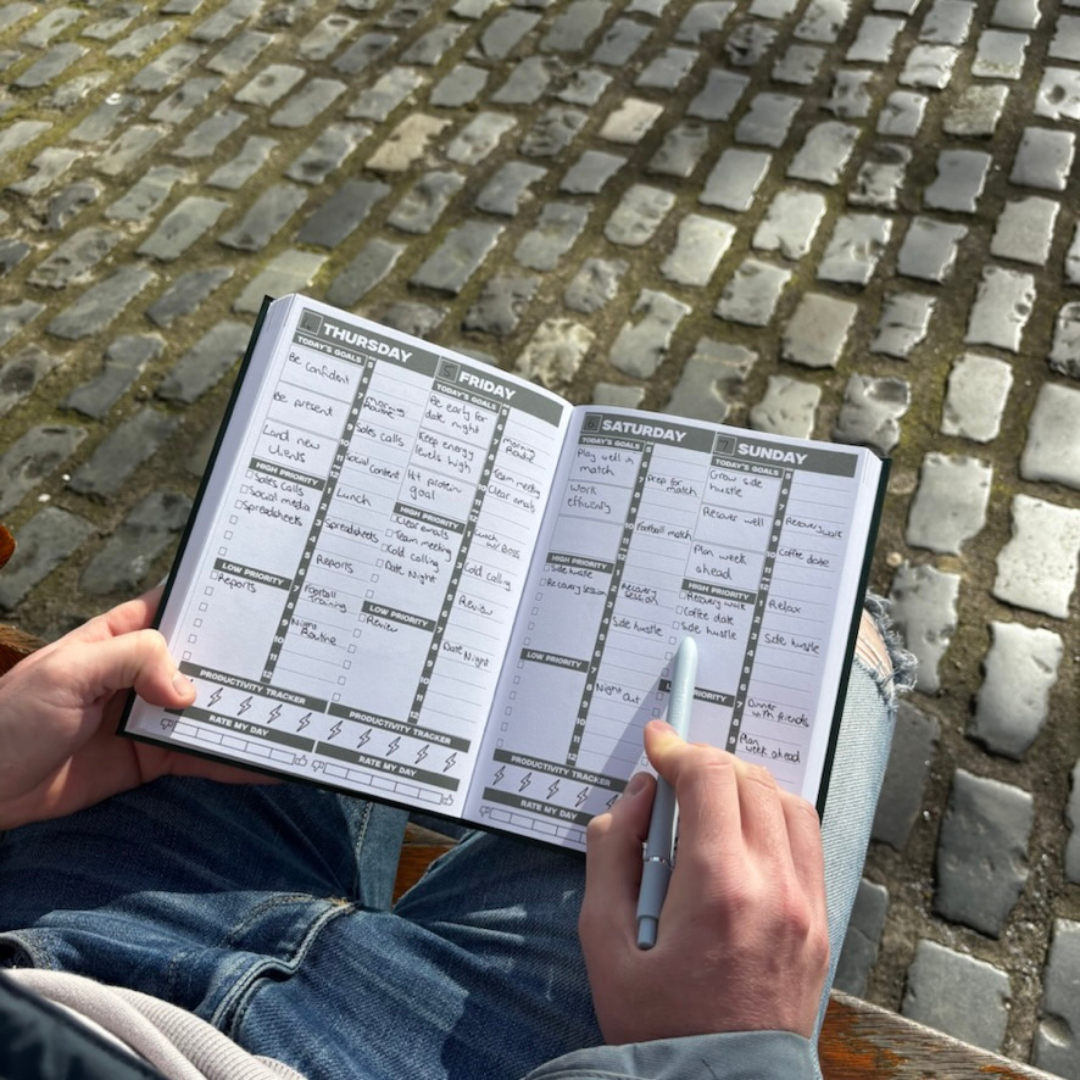
The Plan Your Growth undated weekly agenda is built around this principle. Its weekly layout gives you a single view of the full week so you can see your blocks before the week starts and adjust them deliberately rather than reactively. Planning on paper also forces a clarity that a digital calendar rarely produces. When you write a block by hand, you commit to it differently. The act of writing is a small act of ownership.
The rule is simple: if it is not on the plan, it does not exist. If it is on the plan, you show up for it with the same reliability you would show up for a meeting with your most important client.
Step 4: Protect the Blocks With Boundary Systems
A time block is only as strong as the boundaries around it. If your deep work block is 8 a.m. to 10 a.m., that means notifications off, door closed, phone on airplane mode. It means the people around you know that window is unavailable. It means you do not check messages at 8:47 a.m. just quickly, because there is no such thing as quickly when it comes to context switching.
This requires deliberate social infrastructure. Tell your team or colleagues when you are and are not available. Set an out-of-office auto-reply that runs until your admin block opens. If you have calendar visibility with colleagues, fill your deep work blocks so they cannot be booked over by default.
The friction here is real. Some environments will push back on this. People who are used to your immediate availability will notice the change and some will resist it. Hold the line anyway. Every man who has implemented genuine deep work boundaries reports the same experience within four to six weeks: people adapt, output increases, and the initial awkwardness disappears entirely.
The men who cannot hold the boundary are usually the ones whose identity is tied to being available. Being immediately reachable feels like value-add. In most cases it is the single biggest cost to your output. Recognise the pattern and do not let it own your schedule.
Step 5: Run a Weekly Review to Recalibrate the System
Time blocking without a weekly review is a static system in a dynamic life. The review is where you close the loop. Every Sunday, or in the last hour of Friday, spend 25 to 30 minutes doing the following:
First, look at what was scheduled and what actually happened. Do not judge. Understand. The gap between plan and reality contains the most valuable information you have about how your week actually functions.
Second, identify the blocks that were hit and the ones that slipped, and understand why each one slipped. Was it an external interruption? Poor planning? An energy mismatch? A task that was harder than expected and ran long? The reason changes the fix.
Third, carry forward incomplete high-leverage tasks. Do not abandon them. They belong to the next week's plan, placed early in the schedule, not at the end where they will be squeezed again.
Fourth, set the three non-negotiable outcomes for the next week before you block anything else. Build next week's deep work blocks around those three outcomes. Only then fill in the rest.
This is the mechanism that makes time blocking a compounding system rather than a one-week experiment. Without the review, drift accumulates. With it, every week is slightly better calibrated than the last.
The Bottom Line
Time blocking is not time management. It is time ownership. The five steps are audit, energy mapping, scheduling internal commitments with the same weight as external ones, building hard boundaries around deep work blocks, and running a weekly review that keeps the system calibrated. None of them are complicated. All of them require consistency. The men who benefit most from this system are not the most disciplined by nature. They are the ones who built the structure first and let discipline follow as a natural consequence. Start with the audit this week. Do not move to step two until you know exactly where your hours are currently going.
If you want a single tool that makes this system stick week after week, the Plan Your Growth undated weekly agenda gives you the weekly layout to plan your blocks, track your outcomes, and run your review in one place. No subscription. No app. Just a structured system that works every week, undated so you can start it any Monday of the year without waiting for January or a new month to begin.