Journaling for Men: The Thinking Tool High Performers Actually Use
The men who built Rome, won wars, and created some of the most significant intellectual frameworks in history kept journals. Marcus Aurelius's private notes became Meditations. Darwin journaled across five years of fieldwork before writing On the Origin of Species. Churchill, Eisenhower, and Patton all maintained detailed written records of their thinking. The practice was not incidental to their performance. It was part of the mechanism. Journaling for men is not a self-help habit for people who struggle to process their feelings. It is a structured thinking tool that externalises the mind's contents, reveals patterns invisible to internal reflection, and produces better decisions through the discipline of having to write a thought clearly rather than just holding it vaguely. The research and the historical record point in the same direction. The question is whether you will use it.
What Journaling Actually Does to the Brain
The mechanism behind journaling as a performance tool is not mystical. It is neurological and cognitive. Writing requires the brain to translate fluid, often ambiguous internal states into linear, explicit language. That translation process forces a level of clarity and precision that internal rumination rarely achieves. You cannot write "it feels off" and leave it there. You have to write what feels off, why it feels off, and what you are going to do about it. The act of specifying is the act of understanding.
James Pennebaker, a psychologist at the University of Texas at Austin whose research on expressive writing is documented at liberalarts.utexas.edu, has published decades of research demonstrating that writing about challenging experiences and complex thoughts reduces their psychological impact, improves cognitive clarity, and produces measurable improvements in decision-making in the period following the writing. The mechanism is not emotional release. It is the cognitive reorganisation that structured externalisation forces.
For men running complex professional situations, this cognitive reorganisation is practically valuable in specific ways. A problem that has been circling unresolved for three days often resolves within the first twenty minutes of focused written analysis. Not because the writing produces new information, but because the act of specifying the problem, its components, the constraints, and the options available forces a level of structured analysis that internal cycling does not.
The second mechanism is pattern recognition. A man who journals consistently across six months has a written record of his thinking, decisions, and outcomes that internal memory cannot replicate accurately. Memory is reconstructive and subject to significant distortion. Written records are not. The quarterly review of a six-month journal will reveal patterns in decision-making, recurring obstacles, and consistent strengths that are invisible to the man who relies only on his recollection of how things went.
Three Journaling Formats That Produce Results
Not all journaling produces the same output. The format should match the purpose, and the purpose should be clear before you begin.
The daily reflection format is the most widely used and the most variable in quality. At its best, it is a ten-minute structured reflection at the end of the working day that answers three specific questions: what happened today that is worth noting, what decision or action did you make that you want to revisit, and what is one thing you will do differently tomorrow. At its worst, it is a stream of consciousness that covers the same ground as yesterday's stream of consciousness and produces nothing actionable.
The difference between high-quality daily reflection and therapeutic venting is the specificity of the questions. Questions that demand specific answers produce specific insights. "How did today go?" produces a general answer. "What was the single most important thing that happened today and what does it tell me about how I am operating?" produces something worth writing.
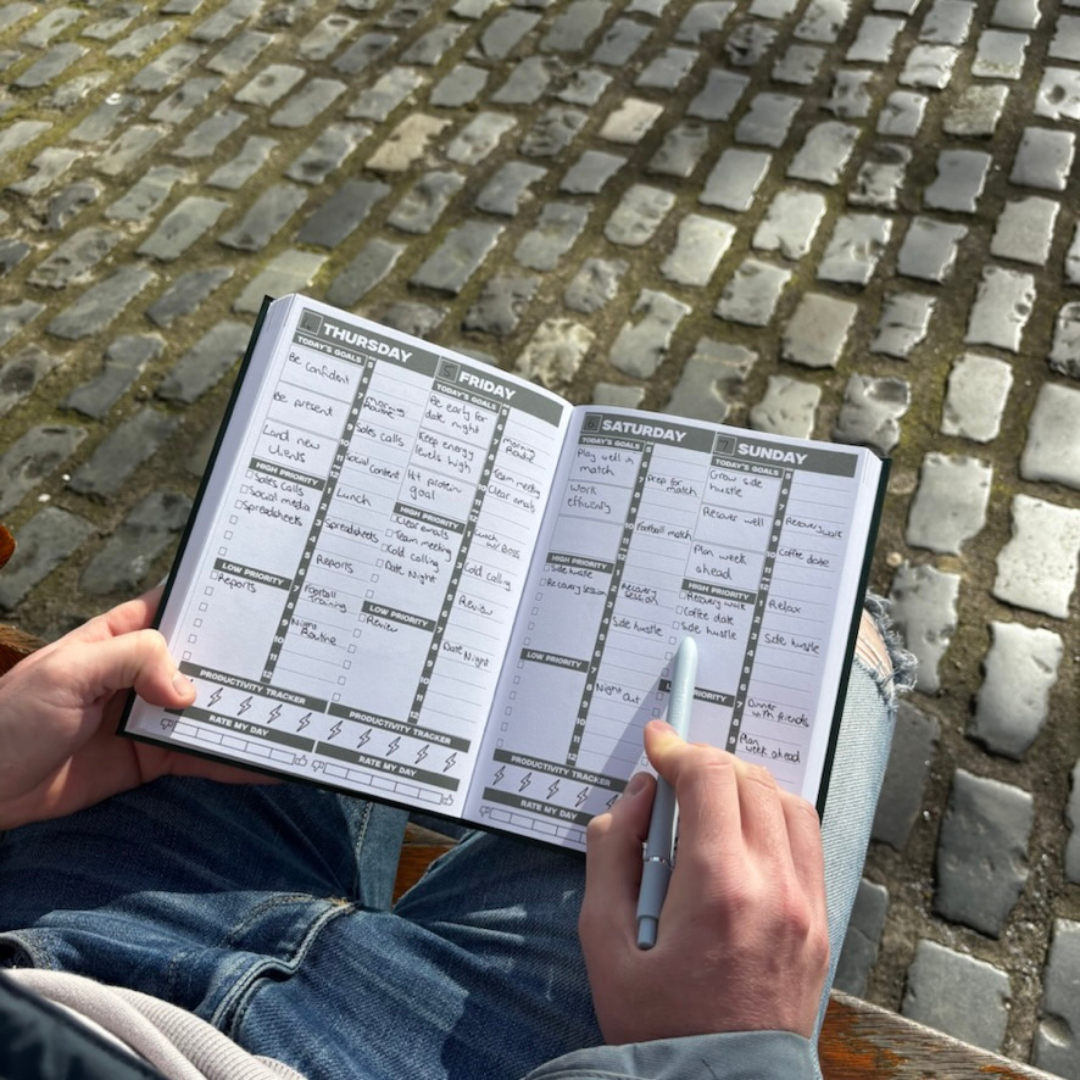
The weekly review journal integrates with the planning session and covers the gap between what was planned and what actually happened. Why did the gap exist? What patterns are emerging? What needs to change in the next week's plan? This is the journaling format most directly connected to execution, and it is where the Plan Your Growth undated weekly agenda and a journaling practice work together most effectively. The planner captures the plan and the execution. The journal processes the gap between them.
The decision journal is the highest-leverage format for men in positions where decisions have significant consequences. Before making a major decision, you write down the decision being made, the information you have, the information you do not have, the options you are considering and their trade-offs, and what you predict the outcome will be. After the outcome is known, you return to the entry and compare what you predicted with what happened. Across a year of this practice, the pattern in your decision-making, where you are systematically overconfident, where you consistently underestimate certain variables, where your risk assessment is well-calibrated, becomes visible and improvable.
How to Build a Journaling Habit That Survives Contact With Real Life
The most common reason men abandon journaling is the same reason they abandon most habits: the practice was set up to require motivation rather than system. They decided to journal and bought a nice notebook and wrote for three days before the novelty expired. There was no anchor, no minimum viable version, and no clarity about what the journal was for.
The anchor is the most important structural element. Journaling attached to an existing daily habit, the morning coffee, the end of the working day, the five minutes before the evening shutdown routine, is significantly more likely to persist than journaling scheduled as a standalone activity requiring its own activation energy. The existing habit provides the cue. The journaling follows it.
The minimum viable version is the insurance policy for hard days. On a day where ten-minute structured reflection is not going to happen, the minimum is one sentence: what was the most significant thing that happened today? One sentence is enough to maintain the habit and the streak. It is also sometimes enough to surface something worth expanding when the full time is available.
The format should be as frictionless as possible. Some men journal well in a physical notebook because the tactile separation from screens is part of the value. Others work better in a dedicated app or a private document. The format is a personal variable. What matters is that it requires minimal setup before the writing begins. If accessing your journal requires more than thirty seconds, the friction will accumulate into avoidance over time.
What to Do With What You Find
The greatest waste in journaling is writing consistently and never reading back. The output of a journaling practice is not the writing itself. It is the pattern recognition that only becomes possible when you review the accumulated entries across time.
Schedule a monthly journal review of fifteen to twenty minutes. Read back across the last four weeks. Look for recurring themes: problems that appeared more than once, decisions that produced unexpected outcomes, emotional states that correlate with specific contexts, times when your output was highest and what conditions surrounded them. This review is where the return on the journaling investment is realised.
The quarterly review is deeper. You are looking at the arc across twelve weeks. Have the goals you set at the start of the quarter moved forward? What did you consistently overestimate your capacity to do? Where did you perform better than you expected and what drove that? The honest quarterly review of a genuine journaling record is one of the most accurate performance assessments available, because it is drawn from data you generated in real time rather than from memory that has been distorted by hindsight.
One specific application: use the quarterly review to update the self-knowledge that informs your goal-setting. If the last twelve weeks show consistently that you overcommit in certain domains, the next quarter's goals should account for that pattern. If they show that you consistently underestimate how long specific types of tasks take, your scheduling should reflect that. Journaling without this feedback loop is a diary. Journaling with it is a performance system.
The Bottom Line
Journaling for men who want to perform at a high level is not an introspective practice. It is a structural thinking tool that forces cognitive precision, builds pattern recognition across time, and produces better decisions through the discipline of explicit analysis. Choose a format that matches your purpose: daily reflection for operational clarity, weekly review for execution gap analysis, decision journal for high-stakes choices. Anchor it to an existing habit. Define the minimum viable version for hard days. Review the accumulated entries monthly and quarterly. The practice is not the writing. It is the thinking that the writing demands, and the pattern recognition that only becomes visible when you review what you have written across time.
If you want a structured tool that works alongside a journaling practice, the Plan Your Growth undated weekly agenda holds the plan and the execution record that the weekly review journal analyses. The planner is the operational system. The journal is the thinking system. Run both and they compound each other.