Mental Strength: How to Build It When It Matters Most
Mental strength is not the absence of doubt, fear, or difficulty. It is the capacity to act well in spite of them. Most men have this the wrong way round. They assume that mentally strong men do not feel the resistance, do not notice the fear, do not experience the pull toward avoidance. They do. The difference is not the absence of those feelings. It is a trained, deliberate response to them. Research from sports psychologist Jim Loehr, whose work with elite performers across professional sport and high-pressure business has influenced how performance psychology approaches resilience, consistently shows that mental strength is not a fixed trait but a trainable capacity. Like physical strength, it is built through repeated exposure to difficulty, progressive overload, and intentional recovery. The men who appear mentally tough are not born different. They have built something, deliberately, over time.
What Mental Strength Actually Looks Like in Practice
Mental strength gets confused with a few things it is not. It is not emotional suppression. The man who buries every difficult feeling and calls it toughness is not mentally strong. He is running a short-term strategy with significant long-term costs. It is not aggression or dominance. Performing hardness for an audience is not the same as having the internal resources to hold the line when things are genuinely difficult.
Mental strength in practice looks quieter than most men expect. It is the ability to sit with discomfort without immediately acting to relieve it. It is the capacity to tolerate uncertainty across a long project without needing premature resolution. It is the discipline to keep running your system on the days when motivation has completely left the building. It is the ability to receive a significant setback, whether professional, personal, or physical, process it without catastrophising, and return to forward movement within a reasonable time.
That last element is particularly important. Resilience is not the absence of being knocked down. It is the speed and quality of recovery. The mentally strong man gets knocked down like everyone else. He just spends less time on the floor, and when he gets up, he gets up with some clarity about what happened and what comes next.
None of that is innate. All of it is built.
The Foundation: Voluntary Discomfort as a Daily Practice
One of the most evidence-backed routes to building mental strength is the deliberate, regular exposure to voluntary discomfort. This is the mechanism underneath cold showers, hard workouts, fasting, and early mornings, not that those specific practices are magic, but that the repeated act of choosing something difficult when the easy option is available trains the neural pathways associated with self-regulation.
The science here draws on research into self-control and ego resilience. Each time you choose the difficult option voluntarily, you are reinforcing the circuit that says: I am the kind of man who does hard things when he has chosen to. Over time that circuit becomes a default rather than an exception. The pull toward avoidance decreases. The capacity to act in the presence of resistance increases.
The key word is voluntary. Difficulty imposed on you by circumstance builds endurance. Difficulty chosen by you builds agency. Both are useful. But the deliberate choice, the alarm at 6am you did not have to set, the workout you did not have to do, the difficult conversation you could have avoided, these are the ones that compound into the kind of internal strength that holds when things outside your control go wrong.
You do not need to make this dramatic. Identify one voluntary discomfort to practise daily. Run it consistently for 30 days. Then raise the floor.
Mental Strength and the Way You Talk to Yourself
The internal voice most men carry is not neutral. For the majority of men, that voice has a significant critical component, calibrated somewhere between a tough coach and a harsh judge. Some degree of self-criticism is functional. It keeps standards honest and drives correction after failure. But the version most men run is significantly beyond what is functionally useful, and it actively undermines mental strength rather than building it.
Here is the mechanism. When the internal voice responds to failure or difficulty with global character judgments ("you are lazy," "you always do this," "you are not cut out for this"), it produces helplessness rather than correction. Helplessness is the psychological state in which effort feels pointless, which is the opposite of what mental strength requires. Self-criticism that stays specific and behavioural ("that approach did not work, here is what to do differently") produces learning and forward movement. The distinction matters enormously over a long period.
The practice of reframing the internal voice is not about positive affirmations or pretending things went better than they did. It is about maintaining the precision of self-assessment without allowing it to tip into global self-condemnation. Mentally strong men are honest about their failures. They are not gratuitously cruel about them.
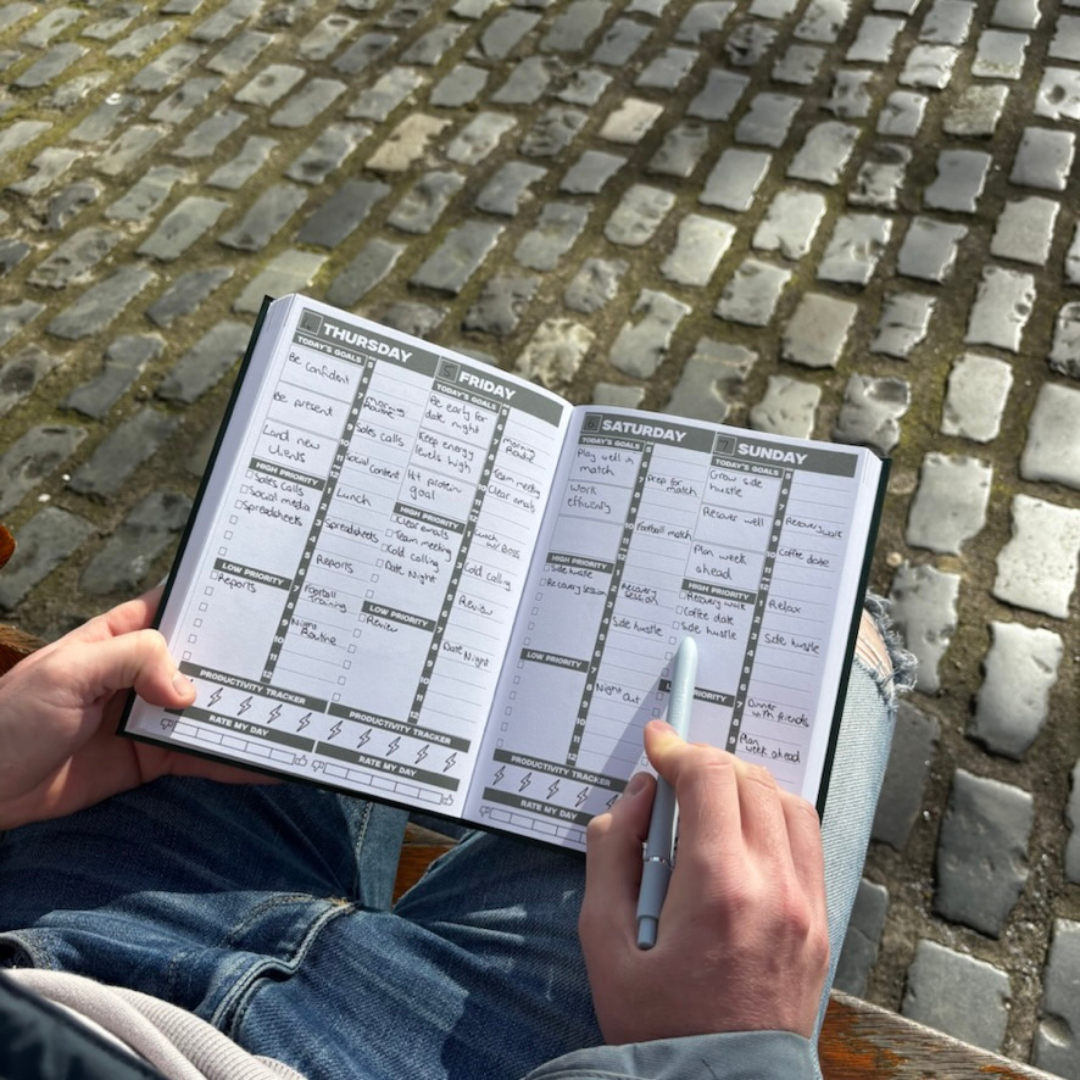
The weekly review is one of the most practical tools for this. Rather than letting a difficult week accumulate into a vague sense of personal inadequacy, you sit down, look at what actually happened, identify the specific patterns that produced the outcomes you did not want, and make specific adjustments for next week. A structured weekly review gives that process a concrete home: a clear space to assess the week honestly and plan the next one with intention, without the narrative spiralling into something less useful.
Pressure, Recovery, and the Performance Cycle
Elite performance research consistently shows that high output is not produced by sustained maximal effort. It is produced by a deliberate oscillation between high-intensity performance periods and genuine recovery. Jim Loehr and Tony Schwartz, whose work on the energy management of high performers is among the most practically applicable in the field, make the case at theenergyproject.com that mental and emotional energy, like physical energy, requires recovery to regenerate. The man who runs at full output continuously without structured recovery does not become more resilient over time. He becomes more brittle.
This is counterintuitive for men who have been told that the route to mental toughness is simply more, harder, longer. It is not. The route to mental toughness includes deliberate rest, recovery practices, and the capacity to switch off fully between performance periods. A man who cannot genuinely rest is not mentally strong. He is mentally stuck in one gear, and single-gear machines are fragile.
Building recovery into your week is not softness. It is performance engineering. A sleep protocol, physical recovery, at least one evening per week that is genuinely off, these are the maintenance practices that keep your mental and emotional capacity high enough to perform when it matters. Skip them long enough and the capacity degrades. Build them in and the capacity compounds.
Planning as a Mental Strength Practice
Most men think of planning as a productivity tool. Get more done, organise your week, stop forgetting things. Those are real benefits. But there is a deeper function that rarely gets named: planning is one of the most effective mental strength practices available, because it systematically removes two of the biggest drains on psychological resilience.
The first drain is decision fatigue. Every unmade decision sitting in your head carries a cognitive cost. What are you working on today? What matters most this week? What are you doing about the thing you have been avoiding? When these questions live unresolved in your mind, they create a constant low-level noise that erodes the clarity and composure that mental strength depends on. A man who plans his week on Sunday evening, assigns his priorities before Monday begins, and knows exactly what he is doing and why has already made the critical decisions before the pressure of the week arrives. His cognitive resources are available for execution and for handling the unexpected, not for managing the anxiety of an unclear agenda.
The second drain is loss of control. One of the most consistent predictors of psychological distress across research in occupational and health psychology is perceived loss of control, the feeling that things are happening to you rather than being shaped by you. A planning practice does not give you control over outcomes. It gives you control over your response and your direction. That distinction is the difference between a man who is buffeted by his week and a man who navigates it. The week will still bring surprises. The plan will still get disrupted. But the man who planned has an anchor to return to. The man who did not is starting from scratch every time something shifts.
There is also a third, less obvious benefit. Consistently following through on a plan you made for yourself is one of the most reliable ways to build self-trust. And self-trust is the foundation of mental strength. The man who repeatedly sets intentions and does not follow through does not just fall short on output. He accumulates evidence, week by week, that he cannot rely on himself. The man who plans, executes against the plan, and recovers it when it breaks builds the opposite evidence base. That compounding self-trust is what allows him to take on harder goals, hold the line under more pressure, and back himself in high-stakes situations.
This is why the Plan Your Growth undated weekly agenda sits at the centre of this system rather than at the edge of it. The weekly planning session, the daily priority setting, the structured review are not administrative tasks. They are the reps that build the mental architecture underneath everything else.
When Mental Strength Is Tested: Responding to Significant Setbacks
Everything above is built in ordinary circumstances. The test of it arrives in extraordinary ones. The business that fails. The relationship that ends. The health diagnosis. The professional humiliation. The sustained period of nothing working. These are the circumstances where mental strength either holds or it doesn't, and where the gap between men who have built it deliberately and men who have relied on things being good enough becomes visible.
A few things are worth naming about responding to significant setbacks.
First, the response that looks most like mental strength in the short term, immediate stoicism, no acknowledgment of difficulty, returning to full output within days, is often not strength at all. It is avoidance with good optics. Processing a significant setback takes time and some degree of honest emotional engagement. Men who skip this step tend to find it waiting for them six months later in a less convenient form.
Second, the quality of recovery from a setback is heavily influenced by the system you are running when it arrives. A man who has a weekly review practice, clear priorities, and a structured routine has something to return to after a destabilising event. A man who was relying entirely on momentum has nothing to fall back on when the momentum stops. This is one of the least discussed arguments for building a planning system: it is not just a productivity tool. It is a stability infrastructure.
Third, the question to ask in the aftermath of a significant setback is not "why did this happen to me" but "what does this change and what does it not change." The first question produces rumination. The second produces a decision-making framework.
The Bottom Line
Mental strength is a built capacity, not a fixed trait, and it is built through specific, repeatable practices: voluntary discomfort chosen daily, a self-assessment practice that stays honest without tipping into self-condemnation, a performance and recovery cycle that includes genuine rest, and a planning system that removes decision fatigue, restores a sense of control, and compounds self-trust week by week. None of this is complicated. None of it is quick. The resistance does not disappear across 90 days of running these habits. You just get considerably better at moving through it, and the system gives you somewhere solid to stand while you do.
Mental strength built on a clear planning practice holds longer than mental strength built on grit alone. The grit gets you through the hard day. The system gets you through the hard year. If you want the tool that anchors the planning side of this framework, the Plan Your Growth undated weekly agenda is built for exactly that: weekly review, daily priorities, and the structure to keep executing when motivation has nothing left to offer.