Morning Routine for Men: The First Hour Blueprint
Seventy percent of your best cognitive output is available in the first four hours after you wake up. That is not an opinion. It is what neuroscience research on cortisol and alertness rhythms consistently shows. Most men spend those hours in reactive mode, checking phones, scrolling feeds, firing off emails before they have had a single clear thought. By the time they sit down to do anything that actually matters, the best part of their brain is already spent. Your morning routine is either a leverage point or a liability. There is no neutral.
Why the First 60 Minutes Determine the Whole Day
The first hour of your day is not just the start of the day. It is the template for it. The behaviours, the emotional tone, and the cognitive state you establish in hour one tend to persist. Not because of some mystical momentum principle, but because habits compound within a day the same way they compound across months. A reactive first hour primes a reactive morning. A focused first hour primes focused work.
This is not about becoming a 5 a.m. monk. Wake time matters less than what you do with the time once you are awake. The goal is to build a repeatable first-hour structure that puts you in the right physiological and psychological state to execute. Not inspired. Not motivated. Ready.
The difference between motivation and readiness is worth naming. Motivation is a feeling that comes and goes. Readiness is a state you can engineer through behaviour. A morning routine is the engineering process.
The Architecture of a Useful Morning Routine
There are three functional zones to a morning routine that actually serves ambition, not just wellness content.
Zone 1: Physiology (0 to 20 minutes). Before you open a screen, before you speak to anyone, before you consume any information, do something physical. This does not have to be a full workout. Twenty minutes of walking, ten minutes of mobility work, or a cold shower serves the same purpose. You are raising core temperature, activating your nervous system, and signalling to your body that the passive phase of the day is over. Research from neuroscientist Andrew Huberman at Stanford has documented how morning light exposure combined with movement accelerates the cortisol peak that drives alertness earlier in the day, which means you get to your best cognitive state sooner.
Zone 2: Orientation (5 to 10 minutes). This is where the planner lives. Before you do any work, you spend five to ten minutes reviewing the day. What are your three non-negotiables today? Which deep work block is first? What did yesterday leave unfinished? This is not journaling. It is not affirmations. It is a tactical briefing you give yourself. An officer does not walk into the field without a situational picture. You do not walk into your day without one either.
Zone 3: Execution (the rest of the first hour). The single most valuable move you can make in the morning is to begin your most important work before any reactive input reaches you. No email. No social media. No news. Open the project that matters most and work it for thirty to forty-five minutes. Even partial progress in this window compounds across a week in ways that afternoon work rarely matches, because you are working at peak cognitive capacity with no accumulated decision fatigue.
The Phone Is the Problem You Are Not Addressing
A morning routine conversation that skips the phone is incomplete. The average person checks their phone within three minutes of waking. For men who are already oriented toward achievement, the phone often presents itself as useful, checking messages, scanning the news, scanning the market. This feels productive. It is not.
Every notification you process in the first hour is a task your brain has now opened. Open tasks create cognitive load. Cognitive load reduces the bandwidth available for deep thinking. By the time you sit down to the work that actually matters, you are operating on a partially occupied brain, not a clear one.
The structural fix is simple and ignored by most men because it requires admitting the phone has more control than they thought. Keep it out of the bedroom. Set a firm rule: no phone for the first 60 minutes of the day. Use an analogue alarm. Use a watch. Use whatever you need to, but create a physical separation between you and the device during your highest-value cognitive window.
This is not about hating technology. It is about understanding where your leverage is and protecting it.
Building Consistency When Motivation Disappears
The morning routine works over time, not on any individual morning. The enemy of the long-term system is the expectation that you should feel like doing it every day. You will not. There will be mornings you are tired, stressed, or genuinely unable to run the full sequence. This is where most men abandon the routine entirely rather than running a reduced version.
The rule to apply here is: never miss twice. One disrupted morning is variance. Two consecutive disruptions is the start of a new habit, one that runs in the wrong direction. If you wake up with forty minutes less than you planned, compress the sequence. Cut Zone 1 to five minutes of stretching, Zone 2 to two minutes of reviewing three priorities, and still begin with thirty minutes of real work before opening reactive input. The full routine is the goal. A compressed version of it is infinitely better than nothing.
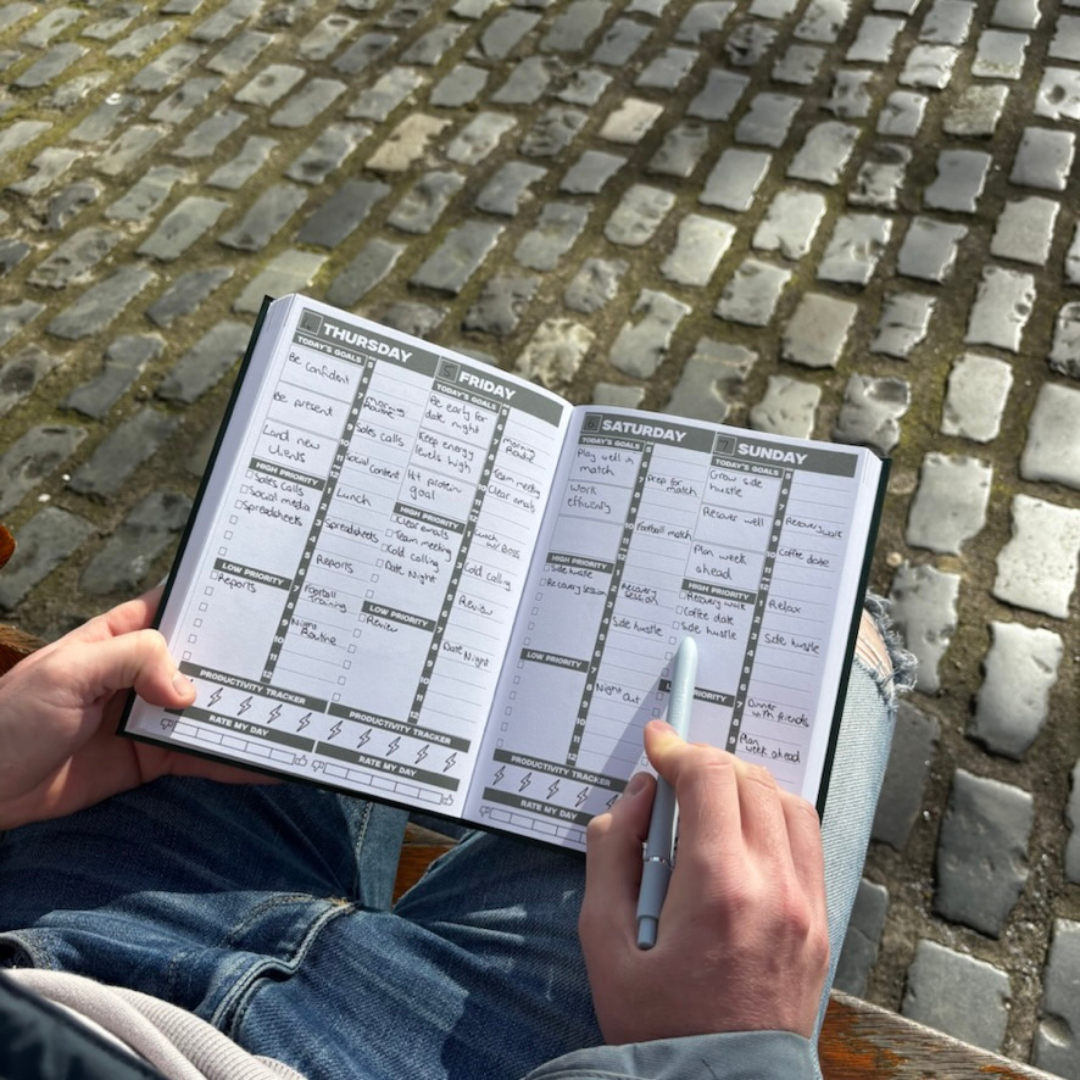
The Plan Your Growth undated weekly agenda is built to support Zone 2 of this system. The daily layout gives you a structured space to identify your three priorities and your first task before you open anything else. That ten-minute orientation has a home instead of being a vague mental habit that drifts when the morning gets busy.
How Long Before the Morning Routine Becomes Automatic
Habit research suggests most behaviours require somewhere between 60 and 90 days to become genuinely automatic, though the range varies by complexity of the behaviour and the individual. A morning routine involving multiple steps sits at the complex end. Expect resistance in the first three weeks. Expect it to feel like effort through week six. By week ten, the sequence runs with significantly less friction.
The lever that shortens this runway is specificity. A routine that says "exercise, plan, work" is vague enough to be sabotaged at any point. A routine that says "7:00 to 7:20: walk or stretching, no phone; 7:20 to 7:30: review planner, write three priorities; 7:30 to 8:15: deep work on the lead project, no email" is concrete enough to actually run. Specific cues, specific durations, specific actions. The brain habituates to precision faster than it habituates to approximations.
The Bottom Line
The first hour of your day is the highest-leverage window you have. It determines your cognitive state, your emotional tone, and whether you approach your most important work from a position of momentum or deficit. Build the zone structure: physiology, orientation, execution. Keep the phone out of the first hour. Run a compressed version when the full version is not possible, and never miss twice. The morning routine is not a wellness practice. It is a performance protocol, and the men who run it consistently are the ones who actually close the gap between what they intend to build and what they actually produce.
The Plan Your Growth undated weekly agenda gives your Zone 2 orientation a repeatable home every morning. No more improvising your priorities on the back of a receipt. Structure the first hour once and run it every day.