No Excuses Mindset: How to Close the Gap Between Intent and Action
The excuse is never really about the excuse. The meeting that ran long, the bad night's sleep, the week that got away from you, none of these are why the important work did not happen. They are the explanation that fills the gap after the fact. A no excuses mindset is not the decision to punish yourself more harshly when you fall short. It is the decision to build a system that removes the structural gaps the excuses fill. When the system is tight enough, the excuse has nowhere to live because the decision about what to do was already made before the obstacle arrived. The gap closes not because you became tougher but because you designed the conditions where toughness is rarely required.
The Excuse Is a Symptom, Not the Problem
Most men who want to eliminate excuses from their behaviour try to address the excuse directly. They get harder on themselves after a missed session, set more aggressive targets, or use negative self-talk as a motivator. This produces short-term compliance and long-term resentment. The underlying problem, the gap in the system, remains untouched.
The excuse appears when there is a decision to be made at a moment when the conditions for making a good decision are worst. You are tired at 9pm. The meeting ran over and cut into your workout time. The week was difficult and the energy for the planned work is not there. These are real conditions, not fabrications. The problem is not that the conditions existed. The problem is that the system left a decision point open at exactly the moment when the conditions were most likely to produce the wrong answer.
Carol Dweck, whose research on mindset at Stanford University is documented at mindsetonline.com, distinguishes between fixed and growth-oriented responses to challenge. What matters here is the structural application of that research: men who attribute failure to unchangeable conditions (not enough talent, wrong circumstances, bad luck) stop building. Men who attribute failure to systems that can be improved keep building. The no excuses mindset is not about denying that conditions are difficult. It is about identifying the structural failure that allowed the difficult conditions to produce an avoidable outcome, and fixing the structure.
Closing the Gap With Pre-Made Decisions
The most reliable mechanism for eliminating the decision gap that excuses fill is pre-commitment: making the decision at a time when your conditions are good, before the moment of temptation or difficulty arrives.
This is why the Sunday planning session is not optional for a man who wants to operate at a high level. On Sunday evening, when the week is quiet and your cognitive state is relatively clear, you decide what happens on Monday, Tuesday, Wednesday, and beyond. You allocate the specific tasks to the specific blocks. You name the non-negotiables and you commit to them before the week's pressure exists.
When Thursday arrives and the meeting runs long and the energy is low, the decision about whether to do the evening workout or the deep work session has already been made. There is no open decision point for the excuse to occupy. The question is not "should I do this?" but "what is the minimum viable version of this I can still complete given the conditions?" That is a productive question. The excuse never gets a vote because the vote was already cast.
The specificity of pre-commitment matters enormously. A vague plan is a plan with multiple decision points embedded in it. "Work on the project this week" is not a commitment. "Work on the proposal from 9:00 to 10:30 on Tuesday before I open email" is. The specificity closes the gap. The vaguer the plan, the more decision points exist for the excuse to enter.
Building the Minimum Viable Standard
The no excuses mindset does not demand perfection. It demands consistency. The distinction is important because men who hold a perfectionist standard often become men who stop entirely rather than deliver a reduced version. An all-or-nothing frame produces a lot of nothing.
The minimum viable standard is the lowest acceptable version of the commitment. Not the ideal version. Not the version you deliver on your best day. The floor. The version that keeps the habit alive, the streak intact, and the identity coherent even on the hardest day.
For a training habit, the minimum viable standard might be twenty minutes of movement rather than the planned sixty. For a writing habit, it might be two hundred words instead of the planned thousand. For a planning habit, it might be the two-minute daily priority review rather than the full ten-minute shutdown sequence. These reduced versions are not failures of the no excuses mindset. They are expressions of it. The man who shows up and does the minimum on a bad day is the man who shows up fully on a good one, because he has never given himself the evidence that not showing up is acceptable.
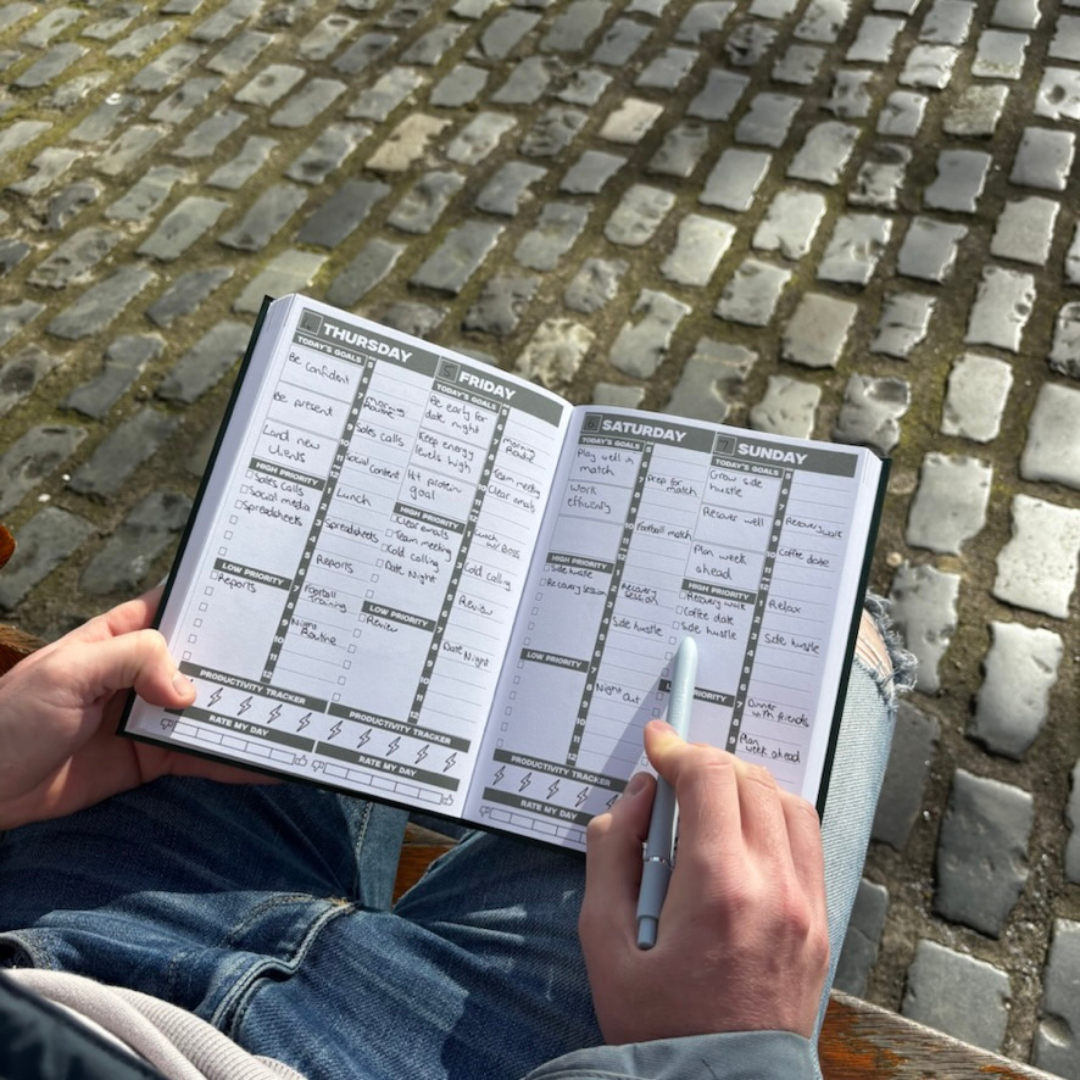
The Plan Your Growth undated weekly agenda is where the minimum viable standard has a home. The daily layout keeps the commitment visible and the two-minute morning check-in, even on the worst days, keeps the planning habit alive when the full session is not available. The habit lives because the floor is always there, always reachable, always easier than not doing it at all.
The Identity That Makes the System Hold
Systems close the gap in normal conditions. Identity closes it when conditions are genuinely extreme. A man who has decided he is the kind of man who does not quit on his commitments operates differently from a man who is trying hard not to make excuses. The first has made a decision about character. The second is having a repeated negotiation with himself about behaviour.
This is not abstract. The identity frame changes the internal language of the difficult moment. For the man trying not to make excuses, Thursday evening sounds like "I know I said I would do this but the week has been brutal and I deserve a break." For the man with a no excuses identity, it sounds like "what is the minimum version I can run tonight?" The second internal question is the productive one and it comes from identity rather than willpower.
Identity is built through evidence. Every time you close the gap between what you said you would do and what you actually did, you build one piece of evidence for the identity "I am the kind of man who does what he says." That evidence compounds. By week twelve of consistent execution, the identity is strong enough to carry you through conditions that would have derailed you in week two. The no excuses mindset is the habit of closing the gap, not the ambition to never face a gap.
What to Do When You Miss
You will miss. The no excuses mindset is not a promise of perfect compliance. It is a framework for how you respond when you fall short. The response matters more than the miss.
Three rules for the miss. First, do not compound it. One missed session is variance. Two consecutive missed sessions is a pattern. The only rule that matters is never miss twice. On the morning after a miss, the commitment runs, even in minimum viable form, without exception.
Second, do not over-explain. The internal story about why the miss happened becomes the justification for the next one. Acknowledge it, learn from it structurally (what gap in the system produced it?), and move on. The miss is not a verdict on your character. It is data about your system.
Third, do not wait for the right conditions to restart. The right conditions are now. The next planned session is when the system continues. Not Monday. Not after the project finishes. Now.
The Bottom Line
A no excuses mindset is not a personality trait you either have or you do not. It is a designed system that removes the decision gaps the excuses fill, a minimum viable standard that keeps commitments alive on the hardest days, and an identity built through the repeated evidence of closing the gap. Build the system on Sunday. Execute the minimum on Thursday. Never miss twice. Learn from the misses without dwelling on them. Do that consistently for 90 days and the gap between who you say you are and how you actually behave will be smaller than it has ever been.
The Plan Your Growth undated weekly agenda is the structural home for the pre-committed decisions that close the gap before the difficult moment arrives. The week is planned. The minimum is visible. The excuse has nowhere to live. That is the system.