Procrastination: What It Actually Is and How to Beat It
You do not have a time management problem. You have an emotional regulation problem. That is not opinion. That is what thirty years of research into procrastination consistently concludes. Tim Pychyl, a psychology professor at Carleton University whose work on procrastination is among the most rigorously documented in the field, has spent decades demonstrating that procrastination is not the prioritisation failure most men assume it to be. It is the short-term management of negative emotion at the expense of long-term goals. The task gets avoided not because it is unimportant but because beginning it produces an uncomfortable feeling, uncertainty, boredom, self-doubt, frustration, and avoidance provides immediate relief. Understanding this mechanism is the first step to building something that actually works against it.
Why Willpower Is the Wrong Tool for Procrastination
The standard advice for procrastination is some variation of "just do it." Push through the resistance. Use more willpower. Be harder on yourself. This advice fails consistently because it misdiagnoses the problem.
Willpower is a finite resource. Research by Roy Baumeister at Florida State University established the concept of ego depletion: the finding that self-regulatory capacity decreases across a day of decisions and demands. By the time a man who has been fighting the urge to procrastinate all morning finally forces himself to sit down and start, he is doing so on a depleted tank. The output is worse than it would have been if he had started fresh, and the experience is aversive enough that the avoidance behaviour is reinforced for next time.
Willpower is not the solution to procrastination because willpower does not address the emotional trigger. The task still feels the same way it did before you forced yourself to sit down. All willpower does is override the avoidance long enough to begin. For simple tasks, that is sometimes enough. For complex, high-stakes, or open-ended tasks, it is rarely sufficient to sustain the work.
The correct tool is a combination of environmental design, task decomposition, and structured commitment that reduces the emotional barrier to starting rather than relying on willpower to overcome it. These are system-level solutions, not character-level ones.
The Procrastination Mechanism and How to Interrupt It
Tim Pychyl's research at procrastination.ca identifies a predictable cycle underlying most procrastination. The task activates a negative affective state, some version of anxiety, boredom, self-doubt, or overwhelm. The person avoids the task to escape the negative state. The avoidance produces short-term relief followed by guilt, which adds to the negative affective load. The task becomes more aversive, not less. The next attempt is harder.
Understanding this cycle reveals exactly where to intervene. The intervention point is not "force yourself to do it." It is "reduce the emotional barrier to starting so that the avoidance response is not triggered in the first place."
The three most effective interventions at this point are as follows.
Task decomposition: most procrastination happens around tasks that are too large, too vague, or too open-ended to have a clear starting point. "Work on the report" is an invitation to stall. "Write the executive summary in 400 words" has a specific finish line. The smaller and more specific the task, the lower the emotional barrier to beginning it. Decompose every large project into the smallest possible concrete next step and only ever engage with the next step.
Implementation intentions: research by Peter Gollwitzer at New York University shows that specifying in advance exactly when, where, and how you will perform a task dramatically increases follow-through. Not "I'll work on this later" but "I will work on this from 9:00 to 10:30 at my desk before I open email." The specificity converts intention into a conditional plan, which the brain processes differently from a vague commitment.
Starting rituals: a consistent pre-work ritual that signals the transition from avoidance to engagement reduces the emotional friction of beginning. This might be making a specific drink, clearing the desk, writing the task at the top of a blank page, and setting a timer. The ritual is not magic. It is a conditioned response that your brain learns to associate with the shift into focused work.
The Planning System That Makes Procrastination Less Likely
Procrastination is significantly less likely when the task has a clear place in the schedule and a clear definition of what completion looks like. Most men's task management is too vague to provide either of these things.
A task list that reads "project X, emails, admin, gym" gives you no information about when any of these things will happen, how long they will take, or what done looks like. Every time you look at the list, you have to make a series of micro-decisions about priority and sequencing, and those decisions carry their own avoidance potential.
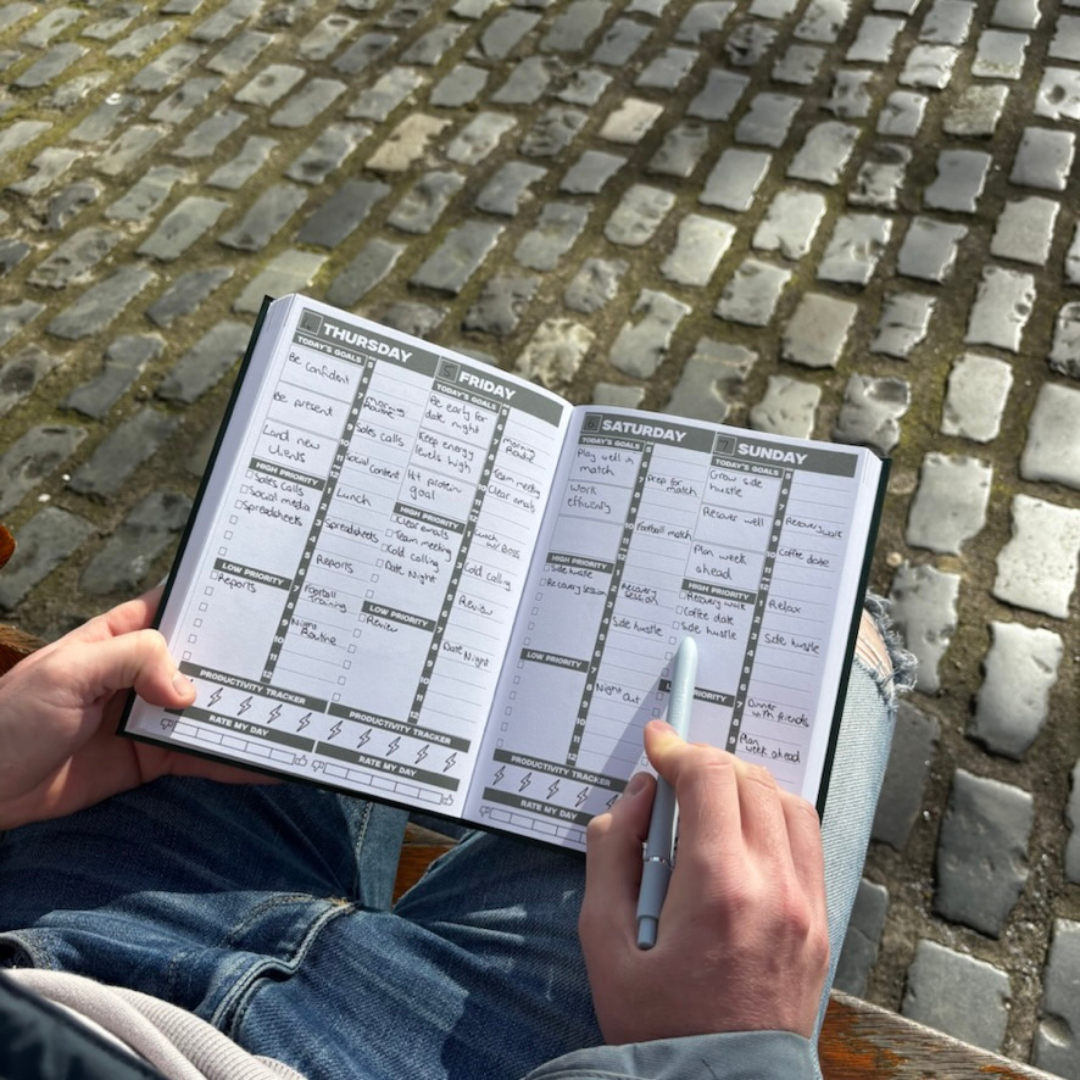
The Plan Your Growth undated weekly agenda is designed to solve exactly this problem. The weekly layout forces you to assign tasks to specific days and time blocks, which converts vague intentions into scheduled commitments. When 9:00 to 10:30 on Tuesday has a named task in it, the decision of what to work on at 9:00 on Tuesday has already been made. Decision fatigue is removed from the equation. Avoidance has less purchase because there is no ambiguity to shelter in.
This is the structural argument for a weekly planning system as a procrastination tool. It does not address the emotional mechanism directly. But it removes the vagueness that the emotional mechanism exploits.
Self-Compassion as a Performance Strategy (Not What You Think)
This section will feel counterintuitive for men who have been told that being hard on themselves is the route to higher performance. The research suggests otherwise.
Kristin Neff, a professor of educational psychology at the University of Texas at Austin, has published extensively on the performance effects of self-compassion, specifically in the context of failure and procrastination. Her findings are consistent: men and women who respond to procrastination with harsh self-criticism procrastinate more over time, not less. The shame and guilt that follow an episode of avoidance add to the negative emotional load associated with the task, making the next attempt harder.
Self-compassion in this context is not softness. It is accuracy. It means responding to a procrastination episode with honest assessment rather than global self-condemnation. "That session did not go well. Here is what got in the way and here is what I'll do differently at 9am tomorrow" produces better outcomes than "I always do this, I'm useless with hard work." The first is information. The second is noise that makes the problem worse.
Hard self-assessment is valuable. Self-flagellation is not. Know the difference.
Building the Anti-Procrastination System
Combining the interventions above into a workable system produces the following daily structure.
The night before, you write down the three tasks that must happen tomorrow and decompose the hardest one into its smallest concrete next step. You assign each task a specific time block.
In the morning, before any reactive input, you begin with the hardest task. Your pre-work ritual runs first: the specific drink, the desk cleared, the task written at the top of the page, the timer set. You work the block without switching context. When the timer ends, you take a genuine break before the next block.
When procrastination occurs anyway (and it will), you note it without drama. What was the emotional trigger? Was the task too large? Was the block too long? Was the environment too distracting? You make one specific adjustment for the next session.
That cycle of design, execution, honest review, and small adjustment is the anti-procrastination system. It is not a character transformation. It is a structural upgrade that makes avoidance less automatic and forward movement more frictionless over time.
The Bottom Line
Procrastination is an emotion regulation problem, not a laziness problem. The fix is not more willpower. It is task decomposition that removes the vagueness avoidance hides in, implementation intentions that convert tasks into scheduled commitments, starting rituals that reduce the emotional friction of beginning, and honest assessment without self-flagellation when sessions go badly. Run those four elements consistently for 90 days and the baseline level of procrastination drops significantly. Not because the hard tasks become easy, but because you have built a system that makes starting them the path of least resistance.
If you want the planning tool that holds the scheduling and task structure this system runs on, the Plan Your Growth undated weekly agenda turns vague task lists into named time blocks with specific outputs. That structural clarity is where the anti-procrastination system lives.