Single-Tasking: The Focus Skill That Changes Your Output
Multitasking is not a productivity asset. It is a productivity deficit masquerading as competence. Research from the American Psychological Association confirms at apa.org that task-switching, the actual mechanism behind what most men call multitasking, produces measurable time costs every time the brain changes context. Those costs compound. A man who switches tasks forty times in a working day is not doing forty things. He is doing forty things badly and spending an invisible portion of every hour paying the cognitive tax of the transition between them. Single-tasking is the corrective. It is not a slower way of working. It is the way of working that produces more in less time by eliminating the loss that switching creates.
What Multitasking Actually Does to Your Brain
The human brain cannot simultaneously perform two cognitively demanding tasks. This is not a limitation of certain men. It is a structural feature of how the prefrontal cortex allocates attention. What the brain can do is switch between tasks very quickly, which feels like doing two things at once and produces none of the efficiency of actually doing either one fully.
Every task switch carries what researchers call attention residue: the mental threads of the previous task that remain active in working memory while you attempt to engage with the new one. When you close the email tab and open the proposal document, part of your brain is still processing the email. That residue reduces the cognitive bandwidth available for the proposal. The proposal is shallower, slower, and less creative than it would have been if you had come to it with a clear working memory rather than a partially occupied one.
This is why the man who works with his email permanently open in the background does not just lose the time he spends reading emails. He loses quality across everything else he does during that session. The presence of the inbox as a background variable is itself a cognitive load, even when he is not actively reading it.
Single-tasking eliminates this. One task, one open window, one objective for the session. The full cognitive resource goes to the one thing. The output quality improves and the session takes less time because there is no tax being paid on transitions.
How to Build Single-Tasking Into Your Working Day
Single-tasking is not a preference. It is a practice with a specific architecture. Here is how to build it.
First, define the task before the session begins. Not "work on the project." Specifically: "complete the competitor analysis section of the market report, approximately 600 words, before 10:30." The specificity matters because vague tasks invite context-switching. When you are not sure exactly what you are working toward, the brain searches for direction, and that search is often satisfied by switching to something that feels more defined, which is usually email or messages.
Second, close everything unrelated to the task. Not minimised. Closed. Every open tab is a potential context switch. The notification badge on the email client is an attentional pull that costs you even when you do not act on it. The phone face-up on the desk is a visual distraction. Remove them from the environment, not through willpower but through physical and digital closure. The cost of reopening them at the end of the session is trivial. The cost of having them present during it is not.
Third, set a time boundary. Single-tasking does not mean working on one thing indefinitely. It means working on one thing for a defined block, typically 45 to 90 minutes, with a genuine break at the end before shifting context. The time boundary creates urgency that focuses the session and gives you a legitimate off-ramp when the block ends.
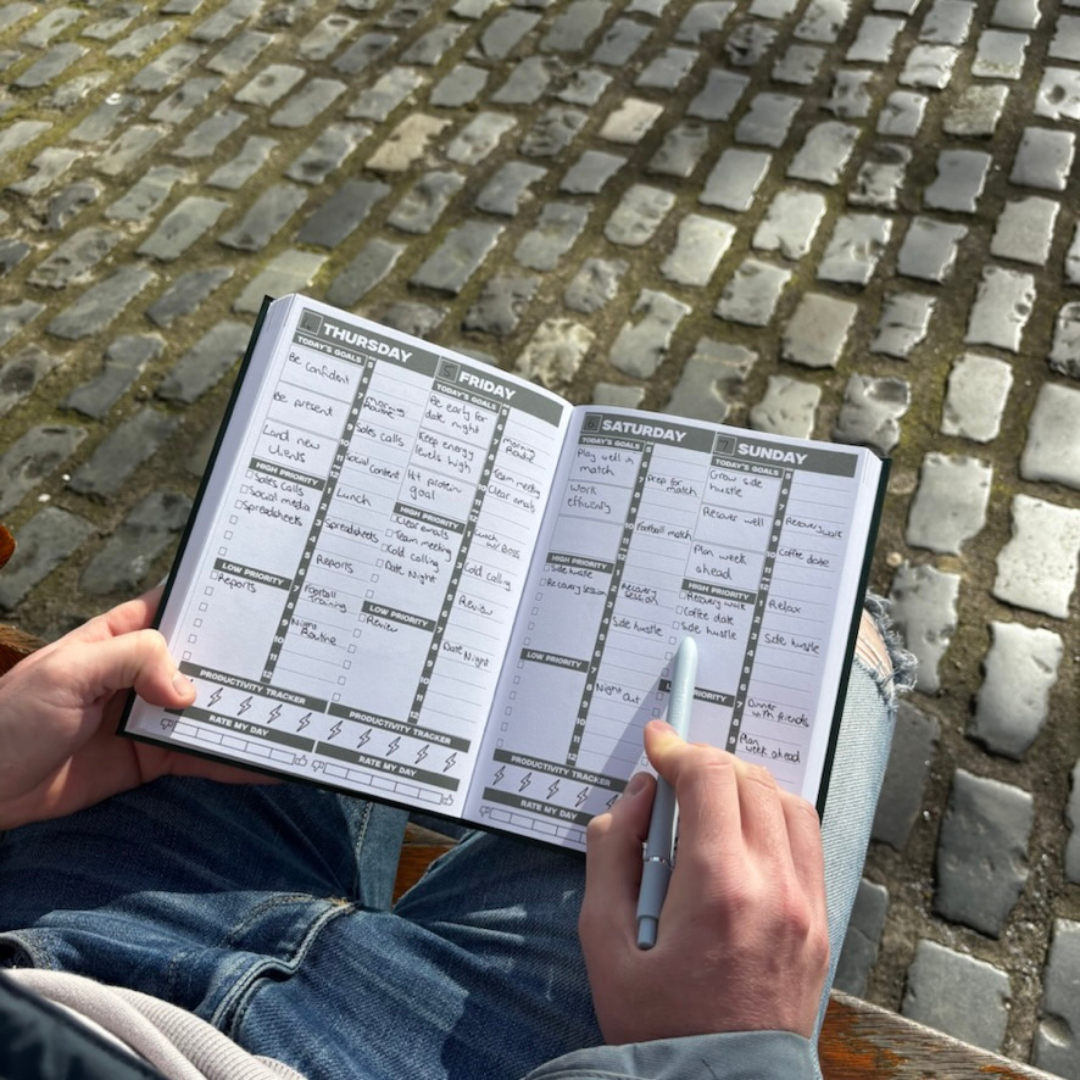
The Plan Your Growth undated weekly agenda supports this architecture at the weekly level. The daily layout gives you the space to name the task for each block before the day begins, which means the single-tasking decision is made in the planning session, not improvised at the desk when the session starts and the inbox is already pulling at you.
The Single-Tasking Stack: What to Do With Everything Else
The practical objection to single-tasking is always the same. What about everything else? The emails, the messages, the requests, the things that pile up while you are focused on one thing. The answer is not that those things do not matter. It is that they belong in their own time blocks, not embedded inside the blocks reserved for your most important work.
The single-tasking stack is simple. Your day has a defined structure. Tier 1 blocks, your highest-energy hours, are reserved for the most cognitively demanding tasks. These are single-tasked: one task per block, everything else closed, no interruptions. Tier 2 blocks are for reactive work: email responses, messages, quick tasks, calls. These are also single-tasked in the sense that you batch them together rather than spreading them across the day. One reactive block in the mid-morning and one in the late afternoon covers most professional obligations without allowing reactive work to contaminate your deep focus time.
The man who runs this structure is not less responsive than the man who monitors his inbox continuously. He is differently responsive. He responds in two defined windows rather than constantly, and the quality of his responses is higher because he is not writing them from a brain that is simultaneously trying to execute a project.
Single-Tasking and the Phone Problem
The phone is the single largest single-tasking barrier in most men's working lives, and it deserves its own treatment. The average smartphone contains every interruption vector in one device: email, messages, social media, news, calls. It is engineered to break focus. The notifications are not accidental. The badge counts are not coincidental. These are features designed by the most sophisticated attention-engineering teams on earth, and they work.
The single-tasking response to the phone is structural, not motivational. During a focus block, the phone is not on the desk. It is in another room, face-down, on silent. Not because you are weak-willed enough to check it otherwise, but because its mere presence on the desk has been shown to reduce available cognitive capacity even when you do not touch it. A study at the University of Texas at Austin found that the presence of a smartphone on a desk, even face-down and silent, measurably reduced participants' available working memory compared to those who had left the device in another room.
This is not about being anti-technology. It is about understanding that a device whose revenue model depends on capturing your attention is poorly placed on the desk while you attempt to direct that attention elsewhere. Put it in another room. Retrieve it when the block ends. The world will still be there.
Protecting Single-Tasking in a Meeting-Heavy Environment
Not every man has full control over his working environment. Open-plan offices, always-on Slack cultures, and heavy meeting schedules create structural obstacles to single-tasking that cannot be solved by closing a browser tab. Here is how to build single-tasking into environments that are not designed for it.
Identify the one or two windows in your working day that are most consistently uninterrupted. For most men this is the first hour after arriving or the period immediately after lunch when meeting density tends to drop. Protect those windows as non-negotiable single-task blocks. They do not need to be two hours. Even one 60-minute single-task block per day, run consistently, produces a meaningful increase in output over a working week.
Communicate availability windows explicitly. "I am unresponsive between 9 and 10 every morning" is a professional statement, not an antisocial one. Most colleagues, once they understand the pattern, adapt to it. The ones who cannot are usually asking for things that do not require immediate responses.
Use physical and audio signals to reinforce the block. Headphones on is a widely understood signal in most professional environments. A closed office door or a chosen location away from the main workspace does the same job remotely. The environmental signal reduces the number of interruptions that require you to say no directly.
The Bottom Line
Single-tasking is the mechanism underneath every productivity system that actually works. Deep work requires it. Time blocking requires it. The 12-week year requires it. Without the ability to direct your full attention at one thing for a defined period, every other planning tool you use is running at a fraction of its potential. Build the practice: define the task before the session, close everything else, set a time boundary, put the phone in another room, and batch reactive work into its own windows. Run that structure consistently for 30 days and the output difference is not subtle.
If you want a planning tool that turns single-tasking into a structured daily habit rather than a daily intention you have to rebuild from scratch, the Plan Your Growth undated weekly agenda gives you the daily layout to name your single-task blocks before the day starts. The decision is made in the planning session. The execution just has to follow it.