Saying No: The Productivity Skill Nobody Talks About
Every commitment you accept is a commitment made against a finite budget of time and attention. That budget does not expand when you say yes to another meeting, another favour, another project that is not yours. It stays the same, and everything you have already committed to competes with the new addition for the hours that remain. Most men manage this badly not because they lack discipline but because they have never treated their time as a truly scarce resource, one that requires the same deliberate allocation as money. Saying no is not a personality trait. It is a skill, and it is one of the highest-leverage productivity skills an ambitious man can build, because every strategic no protects a yes that actually matters.
Why Men Say Yes When They Should Say No
The psychological pull toward saying yes is strong and well-documented. In social environments, yes is associated with cooperation, likeability, and team contribution. No carries a social cost: the risk of appearing unhelpful, difficult, or arrogant. For men in professional environments particularly, the pressure to appear capable and available compounds this. Saying yes to an additional commitment signals competence. Saying no risks looking like you cannot handle it.
The result is a calendar full of obligations that were accepted for social reasons rather than strategic ones, and a set of real priorities that are chronically under-resourced because there is no time and attention left for them after the socially-driven yeses have been honoured.
The shift required is a change in the frame through which you evaluate incoming requests. The default frame is "is this something I can do?" Almost everything is something you can do if you rearrange your schedule enough. The correct frame is "does accepting this serve my actual priorities, and what does it cost from the budget that serves them?" Evaluated through that frame, most of the requests that currently get an automatic yes reveal themselves as neutral to negative trades.
This is not about being unhelpful or antisocial. It is about being honest with yourself and with the people making requests about what you actually have available to give.
The Real Cost of an Unstrategic Yes
The cost of a yes is not just the time the commitment takes. It is everything downstream of it.
A one-hour meeting costs one hour of time. But if it sits inside your Tier 1 deep work window, it costs the cognitive state that window would have supported. If it is not the right type of meeting for your energy level at that time of day, it costs more recovery time than the hour itself required. If it introduces new obligations and follow-up tasks, those carry their own time cost. A single unstrategic yes can cost three or four times its face value.
This is the calculation most men never make. They see an hour meeting and compare it to an hour of availability. They do not compare it to what that hour would have produced if protected, or to the carry-on obligations it creates. When you start making that full calculation, the apparent cost of a strategic no shrinks dramatically and the apparent cost of an unstrategic yes grows.
Research from Gloria Mark at UC Irvine, whose work on attention fragmentation has been widely cited across productivity literature, shows that every significant interruption to focused work costs approximately 23 minutes of full recovery time. A one-hour meeting that breaks a deep work session does not cost one hour. It costs the meeting plus the recovery time on both sides plus the quality deficit of working in a fragmented state for the rest of the session. That real cost, calculated honestly, changes the economics of most yes decisions.
How to Say No Without Damaging Relationships
The concern most men have about saying no more often is not that it will hurt their output. They know it will help their output. The concern is the social and professional cost. Saying no to the wrong person or in the wrong way can damage a relationship, create a reputation problem, or generate professional friction that causes more problems than the time saved.
The good news is that most of those fears are overstated, and there is a learnable approach to saying no that minimises the social cost.
The first principle is speed. A slow no is worse than a fast no. When you take three days to decline a request, you have occupied the other person's planning for those three days and then declined anyway. A fast, clear no respects their time and gives them more time to find an alternative.
The second principle is specificity without over-explanation. You do not owe most people a detailed account of why you are unavailable. "I do not have the capacity for this in the timeframe you need" is complete. Over-explaining invites negotiation and implies that with the right argument, the no might become a yes.
The third principle is the partial yes where genuinely appropriate. If a request is from someone important to you but the full commitment is not feasible, identify the smallest version of it that you can genuinely deliver and offer that. "I cannot take that on as a project but I can give you thirty minutes to talk through the problem" is a partial yes that maintains the relationship without over-committing.
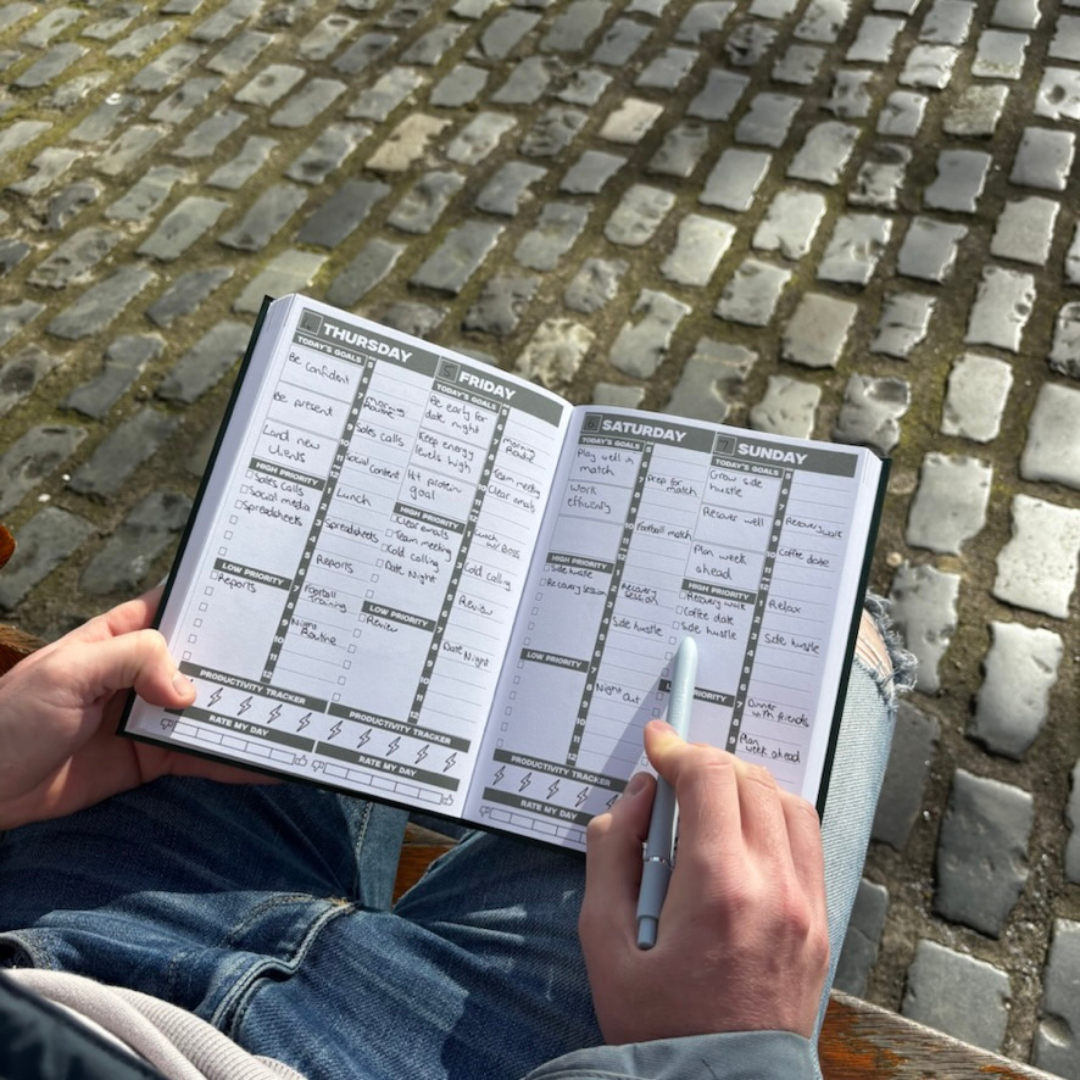
The Plan Your Growth undated weekly agenda is the reference point that makes the no decision easier. When you can see clearly what your week already holds and how your time blocks are allocated, the question of whether to accept a new commitment has an objective answer. You are not making a vague judgment about whether you are busy enough. You are looking at a concrete picture of your week and making a factual assessment.
Building the No Muscle Through Practice
Saying no is a skill that atrophies without use and strengthens with practice. Men who have spent years defaulting to yes find the early nos genuinely uncomfortable, not because the decision is wrong but because the habit of yes is strong and the social discomfort of breaking it is real.
The way to build the muscle is through progressive use, starting with lower-stakes situations and building toward the more difficult ones. Say no to the optional meeting before you say no to the senior colleague. Say no to the social obligation that does not serve your priorities before you say no to the professional request. Each successful no that does not produce the feared consequences reduces the anticipatory anxiety of the next one.
Track what you say no to for four weeks. Write it in your planner alongside the priority it was protecting. Seeing the direct relationship between a no and the protected time it created makes the trade explicit and reinforces the decision framework.
What to Prioritise With the Time You Protect
Saying no without a clear sense of what you are protecting the time for is a hollow exercise. The strategic no is only valuable if what it protects is more valuable than what it declines.
This points back to the goal-setting and priority work that should sit upstream of your calendar. If you know your three priorities for this quarter, every incoming request can be evaluated against them. The requests that serve your priorities or the people who are critical to them get serious consideration. Everything else goes through a tighter filter. The man who has clear priorities has a natural and honest reason to say no that does not require willpower or social hardness. It is simply not the right deployment of his available capacity.
The Bottom Line
Saying no is not a personality type. It is a productivity skill, and it is the one that protects all the others. Your time budget is finite. Every unstrategic yes is a deduction from the budget available for your actual priorities. Build the framework: evaluate requests against your real commitments and real priorities, not against your available hours. Decline fast and clearly. Offer the partial yes where it genuinely serves the relationship. Track what you are protecting and connect it visibly to the goals it serves. Do this consistently and your calendar starts to look like a reflection of your actual priorities rather than a record of everyone else's needs.
The Plan Your Growth undated weekly agenda gives you the weekly picture that makes strategic no decisions factual rather than emotional. See what your week holds. Protect what matters. Everything else gets the honest answer it deserves.