How to Stop Procrastinating: A Man's Guide to Actually Getting Things Done
You don't have a time problem. You have an emotional regulation problem. That's not opinion. It's what thirty years of research into why humans procrastinate actually says. Dr. Tim Pychyl at Carleton University, who has studied this for most of his career, puts it plainly: procrastination is primarily an emotional-avoidance behaviour, not a time-management failure. The task in front of you makes you feel something uncomfortable (boredom, frustration, inadequacy, fear of doing it badly), so your brain delays to protect you from that feeling. Five minutes on your phone later, you feel fine again. That's the loop. And no amount of colour-coded task apps fixes it until you understand the mechanism and put a structure around it.
Why You Actually Procrastinate (It's Not Laziness)
Lazy men don't feel guilty. You do. That difference matters, because it tells you what you're actually dealing with. You're not short on motivation in some deep sense. If you were, you wouldn't be reading this. You're short on the ability to sit with a momentary unpleasant feeling long enough for the work to begin.
The task you're avoiding triggers a specific emotional response. Writing the proposal makes you feel like a fraud. Making the sales call makes you feel exposed. Opening the spreadsheet makes you feel bored and mentally tired before you even start. Your brain, which is wired to minimise immediate discomfort, offers you an escape valve: just check your phone for one second. You take it. The discomfort goes away. Your brain learns that avoidance works. And every time you repeat the loop, the habit cements.
This is why discipline advice like "just start" doesn't move you. "Just start" assumes willpower is the missing ingredient. It isn't. The missing ingredient is a structure that lets you begin the task before the emotional circuit fires. That's what the rest of this guide builds.
The Two-Minute Rule: Start Smaller Than You Think You Should
When you procrastinate, you don't procrastinate on the whole task. You procrastinate on starting the whole task. Once you've written the first sentence, made the first cold call, or done the first set, the emotional resistance collapses. That's a consistent finding in behavioural psychology: the activation energy of a task is concentrated in the first 120 seconds.
So you cheat the system. You don't commit to writing the report. You commit to opening the document and typing one sentence. You don't commit to going to the gym. You commit to putting on your shoes. The commitment is so small that your brain can't generate enough resistance to block it.
Here's what this looks like when you actually use it. Say you're avoiding a difficult email to a client. You tell yourself: I'm going to sit down, open the draft, and type one line, even "Hi Mark." That's it. That's the whole contract with yourself. Nine times out of ten, once you've typed "Hi Mark," the rest of the email comes out. The one time it doesn't, you close the laptop and go back later. No guilt, no downward spiral. You kept the contract. You'll keep the next one.
The men who use this consistently are almost never the ones who look disciplined from the outside. They just built a system that makes starting automatic.
Time Blocking: The Simplest Structural Fix for Procrastination Habits
An open calendar is an invitation to procrastinate. A calendar with named, bounded blocks is an instruction. The difference is enormous, and it's the single biggest leverage point you have in your week.
Time blocking is what it sounds like: you take your to-do list and, instead of leaving it as a list, you assign each important task to a specific block of time on a specific day. Not "work on the proposal today." Instead: "proposal draft, 9:00 to 10:30, Tuesday." The task has a home. It also has a stop time, which matters more than most men realise. A two-hour block that ends at 10:30 forces you to start at 9:00 because you know you've only got one shot. An endless afternoon does not.
Three rules make this work and stop it from becoming another complicated productivity theatre.
First, protect the morning. Your first two hours after waking are your highest cognitive performance window, confirmed by decades of chronobiology research. Put your hardest task there. Not email. Not meetings. The hardest thing.
Second, never schedule more than 60 to 70 percent of your working day in blocks. Leave room for what will actually happen: a call that runs over, a colleague who needs you for fifteen minutes, the unexpected. If you block every minute, one slip breaks the whole day and you abandon the system by lunch.
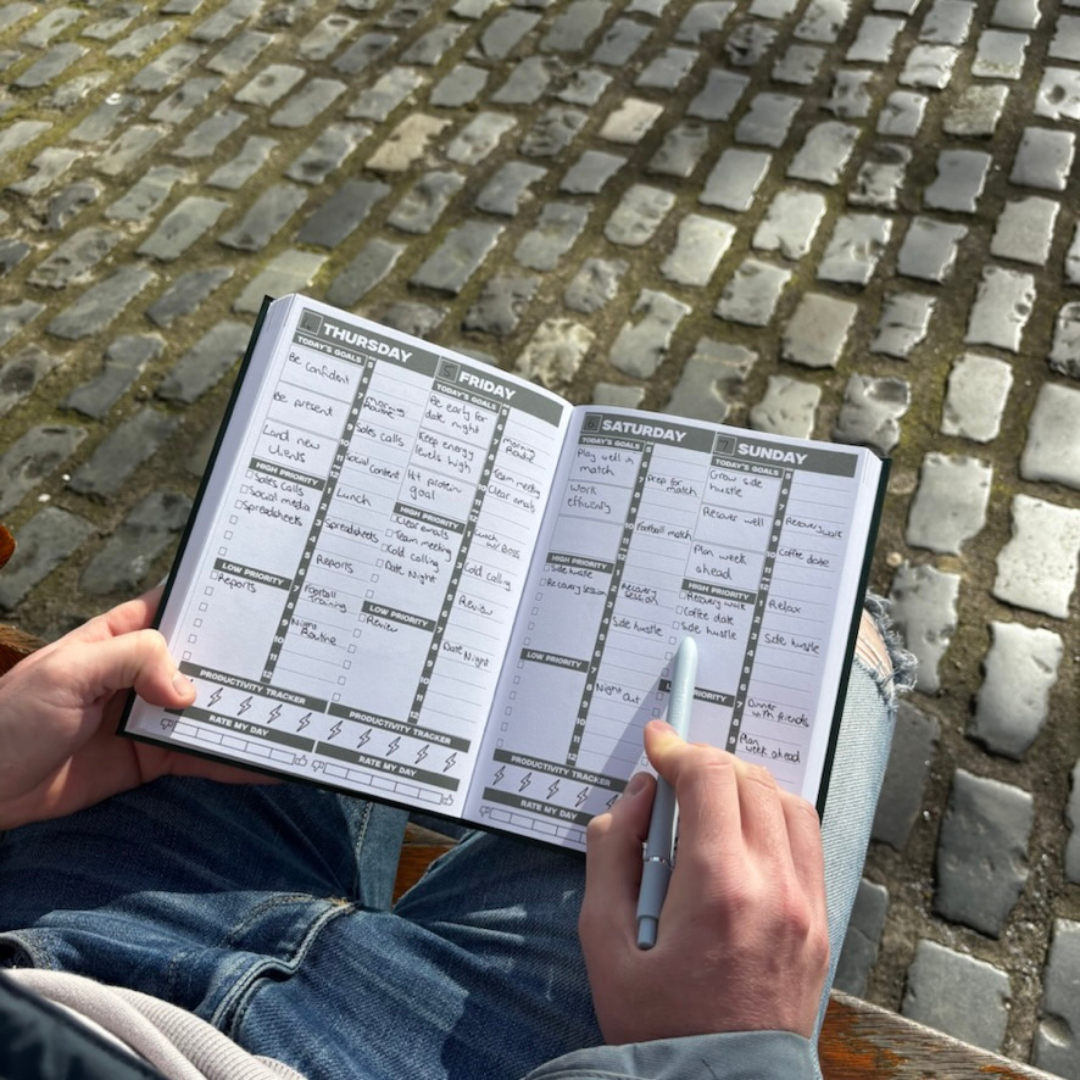
Third, write the blocks somewhere physical, not just in a calendar app. Men who time-block on paper (the weekly layout of the Plan Your Growth undated agenda is built for exactly this) stick with the habit far longer than men who do it in Google Calendar. The act of writing creates commitment. A calendar entry is easy to drag.
How to Stop Procrastinating When the Task Is Vague
Most of what you procrastinate on isn't well-defined. You're not avoiding "write the Q2 report." You're avoiding a foggy blob that in your head reads as "deal with the Q2 report thing." Your brain, confronted with a foggy blob, does nothing. It can't. There's nothing to begin.
The fix is called task decomposition, and it's the most underused productivity tool on the planet. You take the foggy blob and you break it down into component actions until each component is something you could physically start in the next ninety seconds. "Write Q2 report" is not startable. "Open last quarter's report and copy the table structure into a new doc" is startable. The specificity itself unlocks action.
When you sit down to plan your week, don't write a task as a noun. Write it as a verb with an object. "Proposal" is a noun. "Draft proposal intro section, three paragraphs" is a verb-object. One you'll stare at. The other you'll do.
A lot of men resist this because it feels like over-planning. It isn't over-planning. It's the planning that was missing when you thought you were being decisive. Five minutes spent decomposing tasks on Sunday night buys you the entire following week. Skip it and you pay for it every single morning.
Beat Procrastination by Building a System, Not Another Resolution
Here's the hard truth about willpower research: willpower runs out. It's a finite daily resource, and by the time you've used it to get out of bed, choose a decent breakfast, and not pick a fight in traffic, you don't have enough left to force yourself into deep work at 2 p.m. Men who seem to have unlimited discipline don't have more willpower than you. They've built systems that require less of it.
A system is any structure that makes the right action the path of least resistance. Your gym bag packed by the front door is a system. A standing 7 a.m. calendar block for writing is a system. Keeping your phone in another room during your deep work hours is a system. The whole point is to move the decision out of the moment, because in the moment, you will lose.
The best single system you can build right now is a weekly review. Thirty minutes, same time every week (most men do it Sunday evening or Friday afternoon), where you:
- Close out the week you just finished. What got done, what didn't, what needs to roll over.
- Pick the three outcomes that matter most for the week ahead. Not thirty. Three.
- Decompose those three outcomes into startable tasks and assign each to a time block.
That's it. No dashboards, no elaborate frameworks, no apps. Thirty minutes of thinking once a week, written down somewhere you'll actually look at it, which is why most men find that paper works and apps don't. The review is the system. Everything else downstream of it (the time blocks, the two-minute rule, the task decomposition) gets easier the moment the weekly review is locked in.
The Role of Your Planner in the Procrastination Loop
You probably already own a planner. You probably use it for the first two weeks of every year, then stop. That's not a character flaw. It's because most planners are designed to make you feel behind the second you miss a day. Dated pages. Preprinted weeks. Miss a Tuesday and the planner becomes a visual record of your failure, so you close it and never open it again. That's the procrastination loop applied to the tool that was supposed to stop procrastination.
The fix is a planner that doesn't punish you for being a human. Undated pages mean there is no Tuesday to fall behind on. There's just the next page, whenever you open it. That sounds like a small detail. It is not. It is the difference between a tool you use for forty-eight weeks a year and a tool you abandon in February.
The planner is also where the two-minute rule, time blocks, and task decomposition all live. Writing the week's three outcomes at the top of the weekly spread. Blocking your deep work mornings in ink. Listing the decomposed tasks under each block. The paper doesn't do the work for you, but it forces you to make the structure visible, and visible structures are what beat the emotional avoidance circuit your brain is running in the background.
The Bottom Line
Procrastination isn't a discipline failure. It's an emotional-avoidance habit reinforced every time you reach for your phone instead of sitting with a moment of discomfort. You don't fix it with more willpower, because willpower is not the input the loop is reading. You fix it by making the start of every important task so small it can't trigger the avoidance response, by time-blocking the week so your calendar tells you what to do next, by decomposing vague tasks into startable verbs, and by running a weekly review that turns all of that into a system instead of a hope. None of this takes longer than the time you already lose to procrastination on a normal Wednesday. Start with the next thing on your list. Make it two minutes. Begin.
If you want the structure on paper so you stop trying to keep it in your head, the Plan Your Growth undated weekly agenda was built specifically for this kind of system. Undated so you can't fall behind, weekly layout so your outcomes and time blocks live next to each other, durable enough to survive a year of actual use. Pick a colour, pick a start date, and put the first weekly review on the calendar for this Sunday.