Stress Management for Men Who Cannot Afford to Break Down
Stress is not the problem. Stress is a performance signal. The cortisol spike that sharpens your focus before a high-stakes presentation, the urgency that accelerates execution when a deadline is real, the physiological activation that prepares you for a difficult conversation are all stress responses and they are adaptive. The problem is chronic, unresolved stress that runs continuously without recovery, which degrades cognitive performance, suppresses immune function, impairs decision-making, and eventually produces the kind of breakdown that costs far more than the pressure it was generated by. Stress management for men who perform at a high level is not about reducing pressure. It is about building the capacity to absorb it, process it, and recover from it so that the next high-pressure moment finds you operational rather than depleted.
What Chronic Stress Actually Does to Performance
The distinction between acute and chronic stress is the most important one in this conversation. Acute stress, short-duration and high-intensity, produces the cortisol and adrenaline response that sharpens performance. This is the well-documented fight-or-flight mechanism and it is functional. Chronic stress, the low-grade continuous activation that comes from sustained pressure without recovery, does the opposite.
The American Psychological Association's research on stress and health, documented at apa.org/topics/stress, consistently identifies chronic stress as a primary driver of cognitive decline, emotional dysregulation, and physical health deterioration. The mechanism is prolonged cortisol elevation: whereas acute cortisol spikes are adaptive, chronically elevated cortisol impairs hippocampal function (memory and learning), reduces prefrontal cortex activity (decision-making and impulse control), and suppresses the immune response. A man running on chronic stress for six months is not the same cognitive performer he was six months ago, regardless of how hard he is working.
The specific performance cost that most men fail to recognise is the decision-making impairment. Chronic stress narrows the cognitive field, making it harder to consider options, weigh trade-offs, or think beyond the immediate threat. This is adaptive in a genuine survival context, where broad thinking is a liability. It is catastrophically maladaptive in professional or business contexts, where exactly the opposite is required. A man making strategic decisions from inside chronic stress is making them with a compromised instrument.
Building Stress Capacity Rather Than Avoiding Stress
The goal is not to operate in a low-stress environment. Most men who read this will not have that option, and the ones who create it by avoiding challenge and pressure are paying a different kind of cost. The goal is to build the physiological and psychological capacity to absorb high-pressure periods and recover from them effectively.
Stress capacity is built the same way physical fitness is built: through controlled exposure to demand followed by structured recovery. Men who never experience significant stress develop lower tolerance for it. Men who experience significant stress without recovery burn out. The high-capacity operator is the one who moves deliberately between high-demand periods and genuine recovery, building tolerance across cycles.
The practical architecture of this is a periodised approach to workload. Identify the periods in your professional year that are reliably high-pressure: launch periods, reporting periods, major project phases. Plan for these explicitly. Build in additional recovery before and after them rather than treating recovery as something that happens if there is time. The man who arrives at a high-pressure period already depleted will perform at a fraction of his capacity and recover slowly. The man who arrives rested and has recovery scheduled immediately after will outperform him substantially.
This is planning as a stress management tool, and it is one of the most underused applications of a weekly review system. Looking at the next four weeks and identifying where the pressure is concentrated allows you to front-load recovery into the calendar rather than hoping the pressure does not catch up with you.
The Physiological Tools That Actually Work
There is a category of stress management advice that is physiologically meaningless: vague recommendations to "relax," "take time for yourself," or "practise mindfulness" without any mechanism attached. There is a smaller category of tools with actual physiological evidence behind them.
Sleep is first and non-negotiable. This has been covered in the energy management context, but in the stress context the mechanism is specific: sleep is when cortisol drops to its lowest levels and the nervous system conducts the maintenance and repair that chronic wakefulness prevents. Six hours a night for a man under sustained pressure is not a sacrifice that produces more output. It is a mechanism that produces worse performance and slower recovery. The investment in seven to eight hours is a performance decision, not a lifestyle preference.
Exercise is second. The cortisol-reducing effect of moderate aerobic exercise is well-established and substantial. A thirty-minute run or a forty-five-minute weight session reduces cortisol, increases BDNF, improves emotional regulation, and produces better sleep quality. Men who cut exercise during high-stress periods to free up time are making the worst possible exchange: losing the primary tool that would allow them to manage the stress in favour of a marginal time gain.
Controlled breathing is third, and it is the most immediately deployable tool in this list. The physiological sigh, a double inhale through the nose followed by a long exhale through the mouth, activates the parasympathetic nervous system faster than any other voluntary action. Two minutes of this type of breathing before a high-stakes situation or during a stress spike is not meditation. It is a mechanical override of the stress response, and it works.
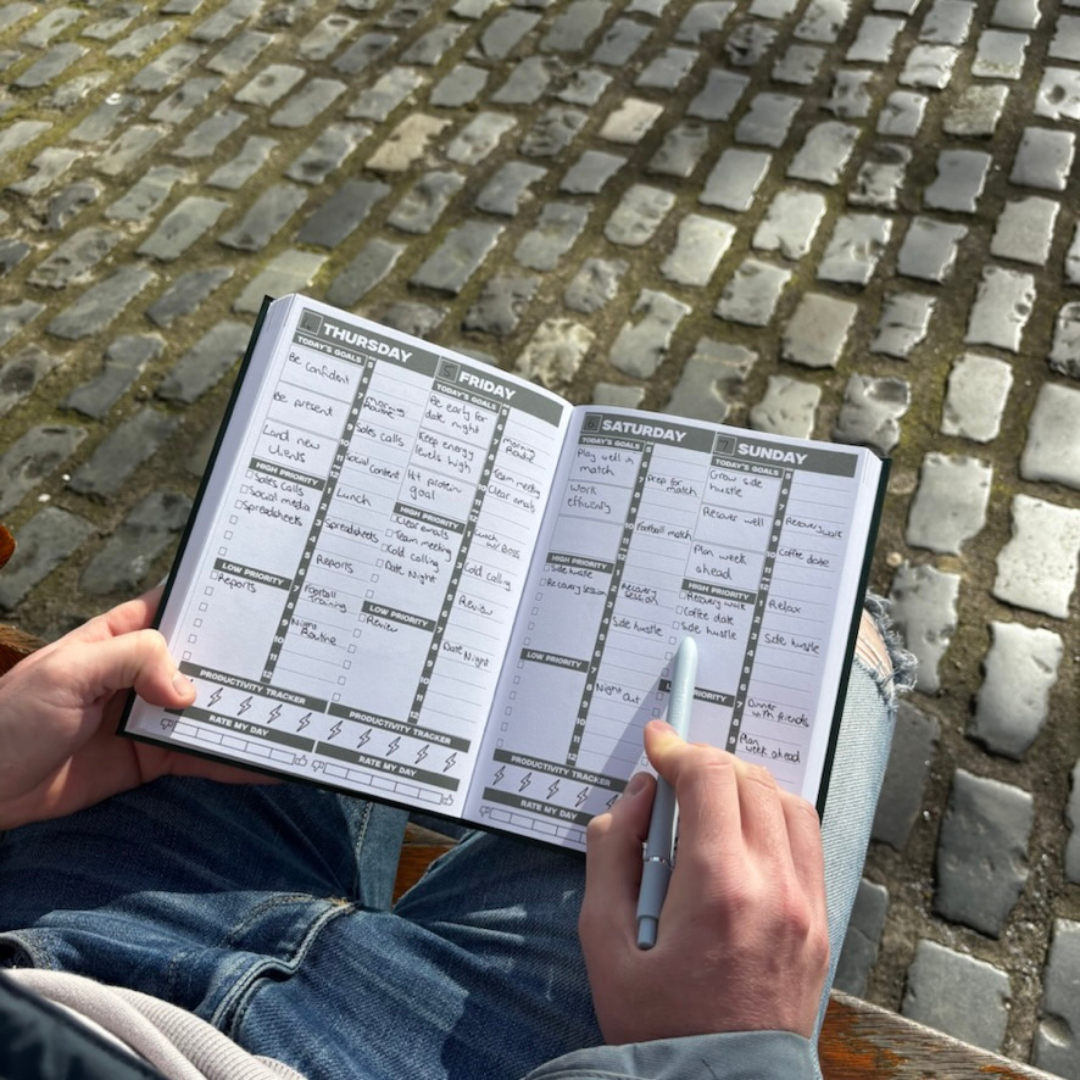
The Plan Your Growth undated weekly agenda is the structural tool that holds the stress management architecture in place across the week: the sleep window written in as a non-negotiable, the movement block protected in the schedule, the recovery buffer built into the days around high-pressure commitments. The system works when it is in the calendar. It does not work when it is a good intention.
The Cognitive Dimension: Managing the Mental Loop
Physiological tools address the body. The cognitive dimension of stress management addresses the mental loops that run continuously and amplify the physiological response.
Most men's stress is not just the direct pressure of the situation. It is the mental amplification of the situation: catastrophising about outcomes, running worst-case scenarios, ruminating on past failures, anticipating future problems that may not materialise. This amplification is not irrational given how the brain processes threat, but it is often disproportionate to the actual situation and it sustains the cortisol response long after the acute stressor has passed.
The most effective cognitive tool for this is structured externalisation: getting the mental loop out of your head and onto a page where it can be examined rather than just experienced. Write down what you are most worried about. Write down the actual probability of that outcome. Write down the worst realistic case and what you would do if it happened. This process, sometimes called cognitive defusion in psychology, reduces the emotional intensity of the worry by converting it from a felt threat into an analysable problem.
This is distinct from positive thinking. You are not telling yourself everything will be fine. You are examining what you are actually worried about and what you can actually control, which produces a more accurate assessment and a lower emotional activation than the unexamined loop provides.
Knowing When to Get Support
Stress management has a ceiling. There are levels of stress, particularly involving major life events, health crises, bereavement, or chronic professional situations, that exceed the capacity of self-management tools and require professional support. Recognising this ceiling is not weakness. It is accurate self-assessment.
The signals that professional support is appropriate include: persistent sleep disruption for more than two to three weeks despite good sleep hygiene; difficulty concentrating that is affecting professional performance significantly; emotional responses that feel disproportionate or out of control; persistent physical symptoms without clear medical cause; and the sense that the strategies that used to work are no longer touching the problem.
Most men delay seeking support significantly longer than is in their interest, for reasons that are understandable but not useful. The delay compounds the problem. A man who addresses a developing stress response at eight weeks will recover faster and more completely than the man who waits six months for the same intervention. Professional support is a performance resource. Using it appropriately is a sign of sophistication, not inadequacy.
The Bottom Line
Stress management for men who operate under sustained pressure is not about creating a low-stress life. It is about building the capacity to absorb high-pressure periods and recover effectively from them. Understand the difference between acute stress, which is adaptive, and chronic stress, which degrades everything it touches. Build stress capacity through controlled exposure and structured recovery. Use the physiological tools that work: sleep, exercise, and controlled breathing. Address the cognitive amplification loop through structured externalisation. Plan the high-pressure periods in your year explicitly and build recovery before and after them. And recognise the ceiling of self-management. The men who perform consistently at a high level over years are not the ones who feel the least stress. They are the ones with the most robust systems for absorbing and recovering from it.
The Plan Your Growth undated weekly agenda is where the stress management system lives in practice: sleep windows, movement blocks, recovery buffers, and the weekly visibility to see when pressure is concentrated and plan accordingly. The system does not remove the pressure. It keeps you operational inside it.