The Sunday Reset: How High Performers Start Monday Right
Most men show up to Monday already behind. Not because Monday is brutal by nature, but because Sunday was treated as a full stop rather than a launchpad. The highest-performing men in any room share one habit that rarely gets discussed: they do not let the week begin without having already decided what it is for. The Sunday reset is the 60-minute ritual that makes Monday a continuation of a deliberate plan rather than the start of a frantic scramble. It is not complicated. It is consistent. And the gap between men who do it and men who do not becomes visible by Wednesday.
Why Sunday Is the Most Underrated Hour of Your Week
There is a version of Sunday that feels earned. Sleep in, watch sport, eat well, decompress. That version is not wrong. Recovery is a genuine part of performance, not an indulgence. But there is a critical difference between recovery and drift, and most men spend Sunday in drift without ever consciously choosing it.
Drift is when Sunday passes without any intentional preparation for the week ahead. You wake Monday with no clear priorities. You open your inbox to find out what the day holds. You spend the first two hours reacting to what other people put in front of you. By noon you have lost the highest-quality mental hours of the day to other people's agendas. The rest of the day is spent trying to recover ground you should never have given up.
Research from Angela Duckworth at the University of Pennsylvania, who has studied high-achievers across disciplines for over two decades, consistently shows that the defining characteristic of gritty, high-output individuals is not talent or motivation in the moment. It is sustained effort directed at clear goals over time. The Sunday reset is the weekly moment where you reconnect your goals to the specific actions of the coming week. Without it, your effort is real but your direction is approximate. Approximate direction over 52 weeks produces approximate results.
The Sunday reset is not about perfectionism or having every minute of the week accounted for. It is about making sure the things that matter most to you have a place in the week before things that matter less to other people take that place instead.
What the Reset Is Not
Before the routine, clarity on what this is not saves you time.
The Sunday reset is not a three-hour planning session. It is not a full life audit. It is not a journalling ritual requiring a candle and extended reflection. It is a 45-minute to 60-minute work session with a specific agenda. It is efficient, practical, and forward-facing. If it takes you longer than 60 minutes, you are doing too much of the wrong thing.
It is also not a guilt exercise. Looking at last week's incomplete tasks is a data collection step, not a self-assessment. The question is not "why did I fail?" The question is "what does this tell me about how I should plan next week?" That reframe matters because men who turn the review into a guilt session either avoid it or do it badly. Both outcomes kill the habit.
And it is not optional on the weeks when it feels most inconvenient. The weeks where Sunday feels like the last time you want to think about work are almost always the weeks that most need the reset. Busyness without direction is not productivity. It is motion. The distinction matters to your results even when it does not feel like it in the moment.
The Five-Part Sunday Reset Routine
Here is the structure. Do it in this order. Do not skip parts because one is uncomfortable.
Part 1: Close last week (10 minutes). Look at what you planned to do last week and what actually happened. Not to judge yourself but to understand the gap. Every incomplete task needs a decision: carry it forward, delegate it, or drop it entirely. Clear the decks completely before planning anything new. Carrying unfinished work mentally into a new week is one of the largest drains on focus most men underestimate. The unfinished task sits in your working memory even when you are not actively thinking about it, occupying cognitive space that should be available for the present.
Part 2: Brain dump (10 minutes). Get everything out of your head and onto paper. Every task, worry, commitment, idea, and obligation that is currently living in your working memory. Projects you have been meaning to start. Calls you need to make. Things you promised people. The goal is an empty mental inbox. Research consistently shows that incomplete tasks and unmade decisions occupy cognitive space whether or not you are actively thinking about them. Externalising them onto a list frees that space for the coming week.
Part 3: Set the three outcomes (5 minutes). From your brain dump and your broader goals, identify the three outcomes that, if achieved by Friday, would make the week a genuine success. Not a list of tasks. Three meaningful outcomes. A task is "write the first draft of the proposal." An outcome is "complete and send the Q3 proposal to the client." The distinction matters because outcomes are tied to results in the world, not just activity on your part. This is where most men find the discipline hard, because it forces you to choose and to give up on the other seven things you also want to do this week.
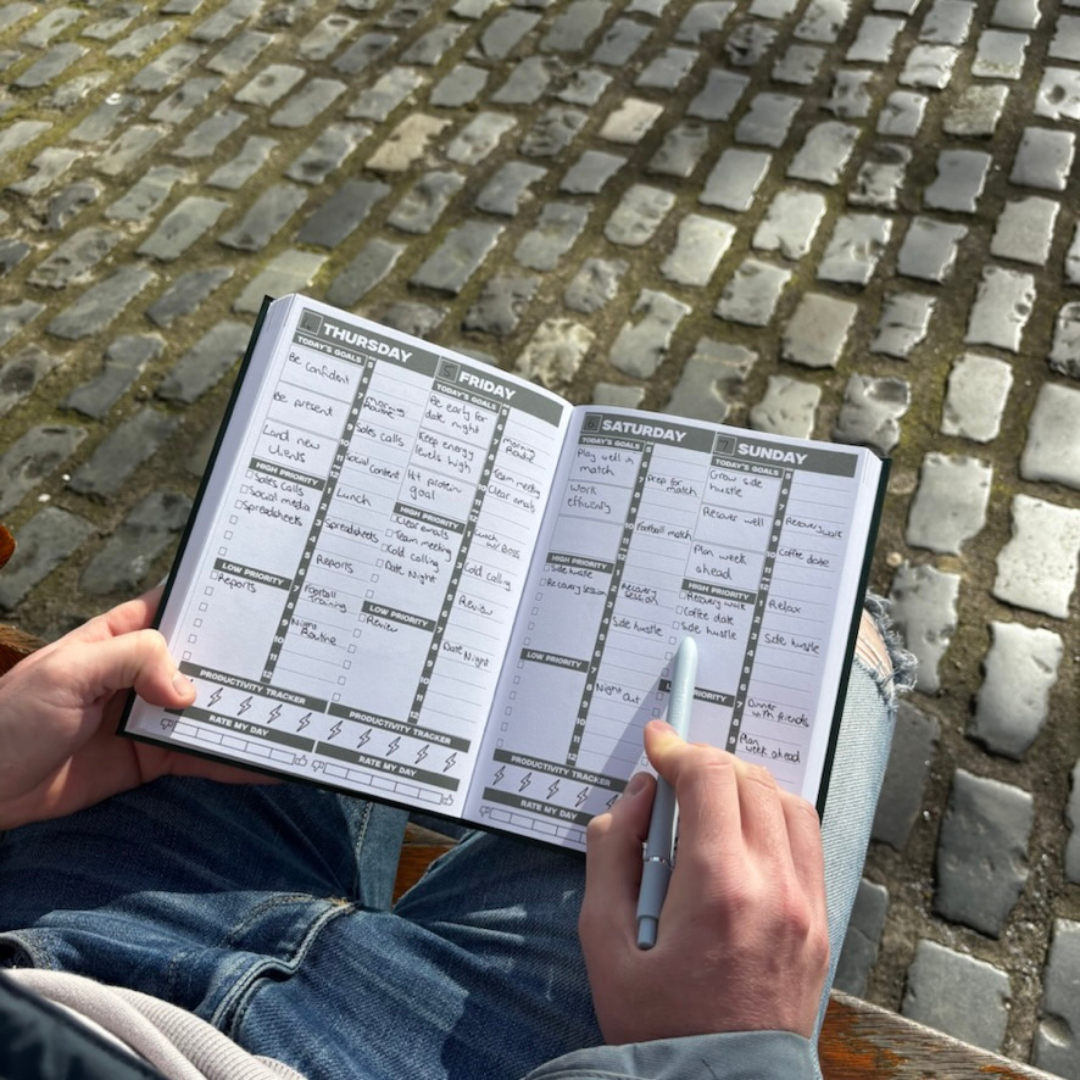
Part 4: Build the week (20 minutes). Open your calendar or the Plan Your Growth undated weekly agenda and lay out the week. Block time for the three outcomes first. Then place your meetings, obligations, and commitments. What is left is discretionary time. If the three outcomes cannot physically fit in the week as it stands, something else has to move. This is where real prioritisation happens, not in theory but in the concrete structure of a weekly layout. The plan becomes a visual commitment that you can look at across the week when the inevitable distractions arrive.
Part 5: Set Monday's first task (5 minutes). Before you close the planning session, decide exactly what you will do in the first working hour of Monday morning. Not roughly. Specifically. Name the task and name the output you expect from that hour. This eliminates the start-up cost of Monday morning entirely. You sit down and execute rather than sit down and decide. The decision is already made. The hour is already claimed.
The Physical Ritual Makes the Habit Stick
Where and how you do the Sunday reset matters more than it should. Environment drives behaviour. A man who does his reset at the kitchen table with a phone face-up, kids nearby, and television audible is not doing a reset. He is performing the motions of one. The output will reflect the environment.
Build a physical ritual around it. Same chair, same time, same tools. Most men who maintain the habit over time do it at the same hour every Sunday. For some it is Sunday morning with coffee before the family wakes. For others it is Sunday evening after dinner when the house is quiet. The specific time matters less than the consistency of it.
Use paper. There is a reason high performers across disciplines still plan with pen and paper despite having access to sophisticated digital tools. The act of writing engages a different kind of thinking. It slows you down in a productive way. It forces complete thoughts rather than the shorthand of a typed list. It creates a physical artefact of your intentions for the week that you can reference without unlocking a device or opening an app. That reference point matters on Wednesday when the week is pulling you sideways.
How to Handle the Sunday You Do Not Want to Do It
This will happen, and it will happen regularly. The week was brutal and Sunday feels like the one day you should not have to think about work. You are tired. You would rather anything else. The reset feels like homework.
Here is the truth: the weeks that feel most chaotic, where Sunday seems like the last time you want to plan, are exactly the weeks that most need the reset. Fatigue is real but it is rarely so total that 45 minutes of planning is impossible. It is usually that the mental cost of starting feels higher than the actual cost of doing it, which is a well-documented cognitive bias, not an accurate read of your capacity.
Give yourself permission to do a shorter version on hard weeks. A 20-minute abbreviated reset is infinitely better than none at all. Set the three outcomes. Block Monday. Move on with your Sunday. The full version can return the following week. The minimum viable version keeps the system alive across the rough weeks, and it is the rough weeks that determine whether a habit survives or not.
The Bottom Line
The Sunday reset is a 45-minute to 60-minute ritual divided into five parts: close last week, do a brain dump, set three outcomes, build the week visually, and lock Monday's first task specifically. It is not motivational. It is mechanical. Men who do this consistently do not just feel more prepared on Monday. They are more prepared, and that preparation compounds into measurably better weeks over the course of a quarter. Build the habit this Sunday. Pick a time, protect it, and run the five parts without skipping the uncomfortable one.
If you want a planning tool built specifically for this kind of weekly structure, the Plan Your Growth undated weekly agenda gives you a clean, focused layout for every week of the year. No filler pages. No motivational quotes. Just the space to plan, execute, and review with the clarity every ambitious man's week deserves.