Time Blocking for Men: The Complete Guide to Deep Work
Your day isn't crowded. Your attention is. Research from Dr. Gloria Mark at UC Irvine, who has spent twenty years studying how humans actually use their attention at work, shows that the average knowledge worker switches tasks every 47 seconds and loses roughly 23 minutes to fully refocus after each interruption. Do the maths on a normal eight-hour workday and you are looking at around 2.5 hours evaporating into the gap between what you meant to do and what your attention let you do. Time blocking is not a productivity optimisation. It is the structural recovery of hours you already lost. This is the complete guide to doing it properly.
What Time Blocking Actually Is (And What It Isn't)
Time blocking is the practice of assigning every meaningful task in your week to a specific, bounded window of time on a specific day. Not "work on the proposal Tuesday." Instead: "proposal draft section one, 9:00 to 10:30 Tuesday." The task has a home. It has a start time. It has a stop time. It has nothing to do with the other 112 items on your loose task list, because right now, between 9:00 and 10:30 Tuesday, that proposal section is the only thing that exists.
What time blocking is not: a to-do list with timestamps bolted on. A to-do list is a pile of intent. Time blocking is the forced decision about which intents actually fit into the finite day you have. That forced decision is the entire point. Men who keep long to-do lists feel productive because the list is long. Men who time-block feel productive because three things got finished.
Here is the other thing it is not: a rigid schedule for a robot. You are not supposed to block every minute. You are supposed to block the four to six hours of your day where real output is generated. The rest stays flexible so the actual shape of your day (a meeting that runs over, a colleague who stops by your desk, a delivery at the door) does not break the system.
Why Time Blocking Beats a To-Do List for Ambitious Men
Two things happen when you stop using a to-do list and start using a time block schedule. The first is that you stop overcommitting. A to-do list has no physical limit. You can write fifteen things on it without blinking. A time-block schedule has a limit the size of your working hours. You physically cannot fit fifteen serious tasks into one day because there are not fifteen ninety-minute blocks in one day. The scarcity forces prioritisation. You look at the fifteen items and you pick the three that actually deserve a block. The rest gets parked.
The second thing that happens is that you stop procrastinating on starting. A task without a time assigned to it is a task that can be postponed indefinitely. A task assigned to 10:00 this morning is a task your brain starts preparing for at 9:58. That two-minute on-ramp matters more than most men realise. It is the difference between sitting at your desk wondering what to do next and sitting at your desk knowing exactly what to do next.
There is a third, quieter benefit. Time blocking teaches you what your work actually costs. You will discover that the proposal you thought was a two-hour task is really a six-hour task. You will discover that email takes far more of your week than you believed. You will discover that the "quick call" with your co-founder never lasts fifteen minutes. Time blocking makes the gap between your estimate and reality visible, and you start getting better at estimating. Within a month, you will plan your week with an accuracy you did not have a year ago.
The Deep Work Block: Protecting Your Best Hours
The single highest-leverage block in your week is the first one of every day. Chronobiology research is consistent on this: your cognitive performance peaks in the 90 to 120 minutes after you fully wake, and declines steadily from there. That window is the most expensive real estate you own. Most men give it away to email, Slack, and the morning news. That is a catastrophic misallocation.
The deep work block is your first work block of the day, reserved for the hardest, most cognitively demanding task you are responsible for. Writing the proposal. Coding the hard part of the feature. Building the model. Whatever it is, it goes first, and nothing else touches that window. Email does not exist between 8:30 and 10:30 on a deep work day. Slack does not exist. Phone goes face down in another room or, better, in a drawer.
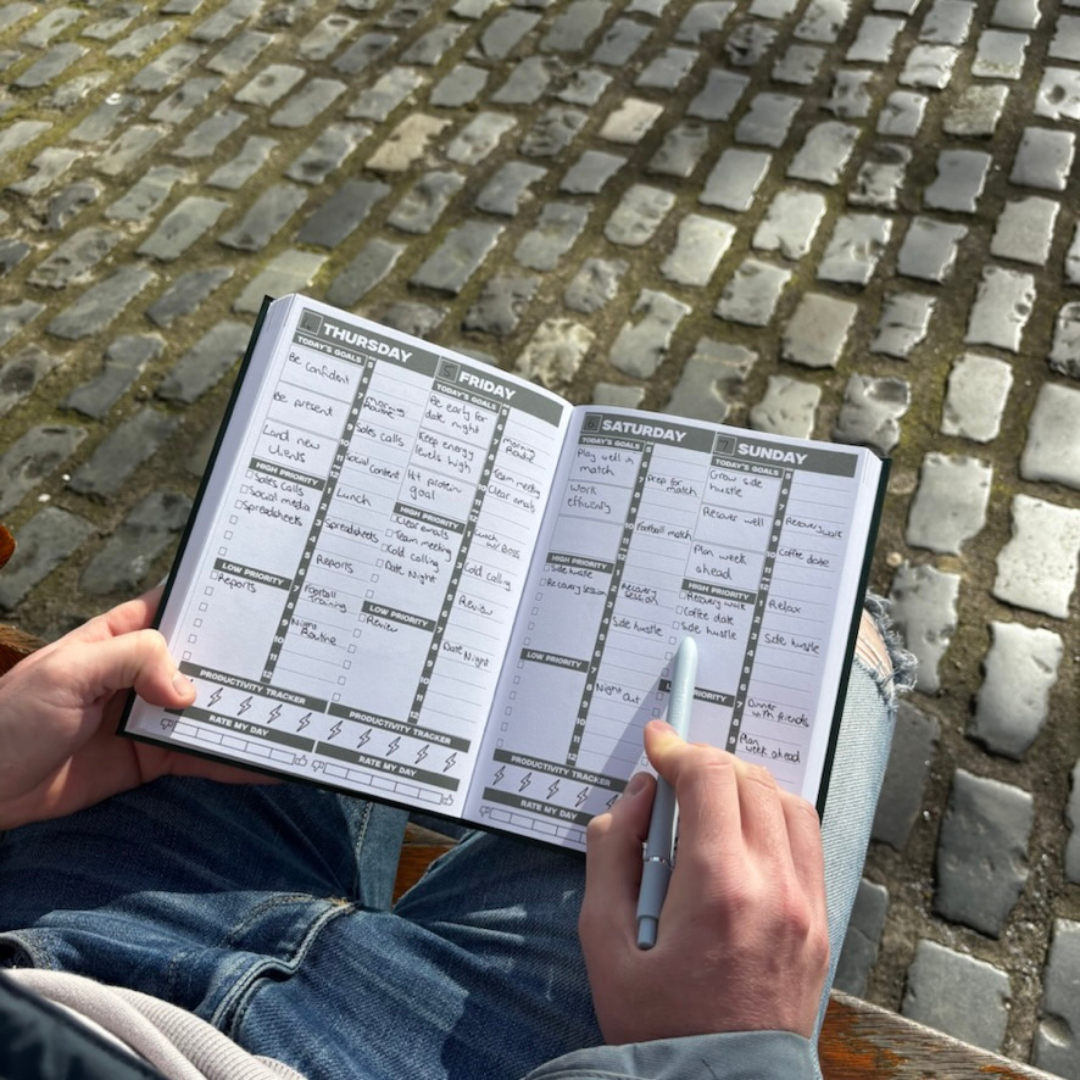
Two practical rules make deep work blocks survive first contact with reality. First, protect them in ink, not in apps. Calendar entries are trivial to drag or delete; a weekly spread written in pen on a paper planner is a committed decision you have to physically cross out to break. Second, protect them from yourself. The threat to deep work is rarely a coworker. It is your own hand reaching for the phone at minute twelve. Leave the phone somewhere you have to stand up to reach, and the default flips.
How to Build Your First Time Blocking Schedule
You do this on Sunday evening, once, in thirty minutes. Do not build it on Monday morning, because on Monday morning you are already reacting to the week instead of shaping it.
Start with three questions on the top of the page. What are the three outcomes that actually matter for this week? What would make this week a clear win even if nothing else got done? What is the single highest-leverage thing in front of me right now? Write those three outcomes at the top of your weekly spread. Everything else will be structured to make those happen.
Next, find your deep work hours. For most men this is the 90 to 120 minutes right after they start work, though night owls sometimes do their best thinking after 9 p.m. Mark those blocks across Monday through Friday and assign each one to the most demanding task connected to your three outcomes. These are sacred. Nothing else touches them.
Then add your shallow work blocks. Email once or twice a day, each time inside a clearly defined 30 to 45 minute block. Meetings clustered together wherever possible so your day is not sliced into unusable fifteen-minute strips. Administrative tasks, financial admin, follow-ups, all batched. This is where most of the productivity gain comes from. Not the deep work blocks themselves, but the containment of the shallow work around them.
Finally, leave 30 to 40 percent of your working day unblocked. This is not laziness. It is the margin that absorbs what actually happens. If you block every minute, one slipped call destroys the whole plan and you abandon the system by Thursday. Margin keeps the system alive.
The Three Rules That Stop Time Blocking From Collapsing
Most men who try time blocking quit within two weeks. The reason is almost always the same: they made the system too rigid, too ambitious, or too digital. Three rules fix this.
Rule one. Plan to 70 percent of your capacity, not 100. The first time you time block, you will overestimate what you can do in a day. Resist the urge to stack blocks back to back from 8 a.m. to 6 p.m. Build for the day you will actually have, not the day you wish you had. Rule of thumb: if the schedule looks like it could be done by an industrial robot, you overplanned.
Rule two. Do a daily shutdown at the end of each working day. Five minutes, same time, non-negotiable. You look at what blocks got completed, what did not, what needs to move, and what tomorrow's top three blocks are. This is the habit that compounds over weeks. Without the shutdown, every Monday morning feels like starting from zero and the system never earns its keep.
Rule three. Review and adjust on Friday afternoon or Sunday night. Thirty minutes, honest look at the week that just passed. Which blocks hit? Which did not? What kept breaking? You are looking for patterns. If your 9:00 deep work block keeps getting interrupted by your partner's morning routine, you need an earlier block or a different room. If every Thursday collapses into unplanned meetings, Thursday becomes the meeting day and deep work moves elsewhere. The schedule is a hypothesis. The review is the test. The adjustment is the learning.
Making Time Blocking Stick Week After Week
The difference between men who time-block for a month and men who time-block for a decade is almost never discipline. It is the tool. Digital calendars make time blocking easy to start and easy to quit. Every drag, every snooze, every "reschedule for later this week" chips away at the commitment until the blocks are a suggestion rather than a plan.
Paper is harder to ignore. Writing the week in your own hand on a weekly spread creates a commitment that an app simply cannot replicate. There is research behind this, around the way physical writing engages working memory differently than typing, but you do not need the research to feel it. You will feel it the first week you try. The Plan Your Growth undated weekly agenda was built for this specific use case. Weekly spread with time blocks, space for the three weekly outcomes at the top, habit tracker at the bottom, all undated so a missed week does not make the book a record of your failure.
The other reason time blocking sticks is that you stop treating it as a diet and start treating it as a default. You are not "doing time blocking" like it is a temporary programme. You are running your week. The language matters. Men who think of it as a programme quit when the programme feels hard. Men who think of it as the way they work do not quit, because there is nothing to quit.
The Bottom Line
Context switching is eating hours out of your week that you would never consciously give away. Time blocking is how you take them back. You do it by assigning every meaningful task to a specific, bounded window of time. You protect the first 90 to 120 minutes of each day for deep work and block your phone out of it. You plan Sunday evening, you shut down each weekday in five minutes, and you review the full week once. You build at 70 percent capacity to survive the real world. And you do it on paper, because paper is the only medium that a distracted brain cannot casually override. Do that for four weeks and your relationship with your own time changes permanently.
If you want the structure built into a tool you will actually reach for, the Plan Your Growth undated weekly agenda is the weekly operating system for exactly this kind of work. Weekly time block layout, space for your three outcomes, undated pages so you can start this week instead of waiting for January. Pick a colour, start blocking next Sunday night, and let the structure do the heavy lifting your willpower was never meant to carry.