Time Blocking for Men Who Actually Want Results
Your day isn't crowded. Your attention is. Research from Gloria Mark at UC Irvine found that the average knowledge worker switches tasks every 47 seconds and loses roughly 23 minutes to fully refocus after each interruption. Most men read that stat and nod, then go straight back to bouncing between email, Slack, and a half-finished project. Time blocking is not a motivational hack. It is the structural recovery of the hours you are already haemorrhaging every single day. If your schedule currently reads "work on stuff," this post is the corrective.
Why Most Men's Schedules Fail Before the Day Starts
A to-do list is not a schedule. Writing down twenty things to do today is not a plan. It is a wish list, and wish lists do not account for time, energy, or the reality that every item you write down takes longer than you think.
The reason most men's days collapse by 11 a.m. is simple. They have allocated tasks but not time. They know what they need to do but have made no decision about when or for how long. Every task sits in a pile competing for the same undifferentiated "work time," and the one that wins is usually whichever one feels easiest or most urgent, not whichever one matters most.
This is the fundamental problem time blocking solves. Instead of maintaining a list of tasks and hoping you get to the important ones, you assign each task a fixed slot in your calendar. That task owns that time. Nothing else gets it.
The psychological shift that follows is significant. When 9:00 to 10:30 says "deep work on Q3 proposal," there is no decision to make at 9:00. You already made it. You sit down and execute. Decision fatigue is real, and every micro-choice your brain has to make during the day depletes the cognitive resource you need for actual output. Time blocking front-loads those decisions into a single planning session, so the execution is clean.
This is not about being rigid. It is about being intentional. Rigid schedules break. Intentional schedules flex but hold their structure.
The Three-Tier System: How to Build Blocks That Actually Hold
Not all time is equal. The biggest mistake men make when they first try time blocking is treating every hour the same. Your best creative thinking does not happen at the same time as your best administrative work. Your peak energy window, for most men, sits in the morning, typically within the first three to four hours of waking. That window is your most valuable asset, and most men spend it in their inbox.
The three-tier system structures your day around energy, not just tasks.
Tier 1: Deep Work Blocks. These are your two to three hour protected windows for cognitively demanding work. Writing, building, solving hard problems, strategic thinking. Nothing else gets in. No email, no calls, no Slack. These blocks sit in your peak energy window, non-negotiable. Cal Newport, whose work on deep work has influenced how high-performers across industries approach focused output, frames this as the ability to produce at your maximum cognitive capacity. Protect these blocks accordingly.
Tier 2: Reactive Blocks. Email, admin, meeting prep, quick replies, short calls. These belong in your lower-energy windows, post-lunch or late afternoon. Batching reactive work means you are not toggling context every ten minutes. You open email twice a day, handle everything, and close it.
Tier 3: Buffer Blocks. Thirty-minute gaps built into your day to absorb overrun. Every plan encounters friction. The man who builds in zero buffer spends his afternoon in triage. The man who builds in buffers spends it executing. Use them or let them roll into the next block.
Time Blocking and the Weekly Planning Session
Time blocking done day-by-day is half the system. Time blocking done inside a weekly planning session is the full one.
Once a week, usually Sunday evening or Monday morning, you sit down and build the week ahead. You look at your goals for the quarter, identify the three to five highest-leverage tasks you need to move forward this week, and assign each one a Tier 1 block in the calendar. Then you fill in your Tier 2 and Tier 3 slots around them.
This weekly session is what separates men who use time blocking as a tactic from men who use it as a system. The session takes thirty to forty-five minutes. In return, every morning you wake up knowing exactly what you are doing and why it matters. That clarity compounds. A man who enters each workday with that level of structural confidence moves faster, wastes less energy on indecision, and finishes his week having actually moved the needle.
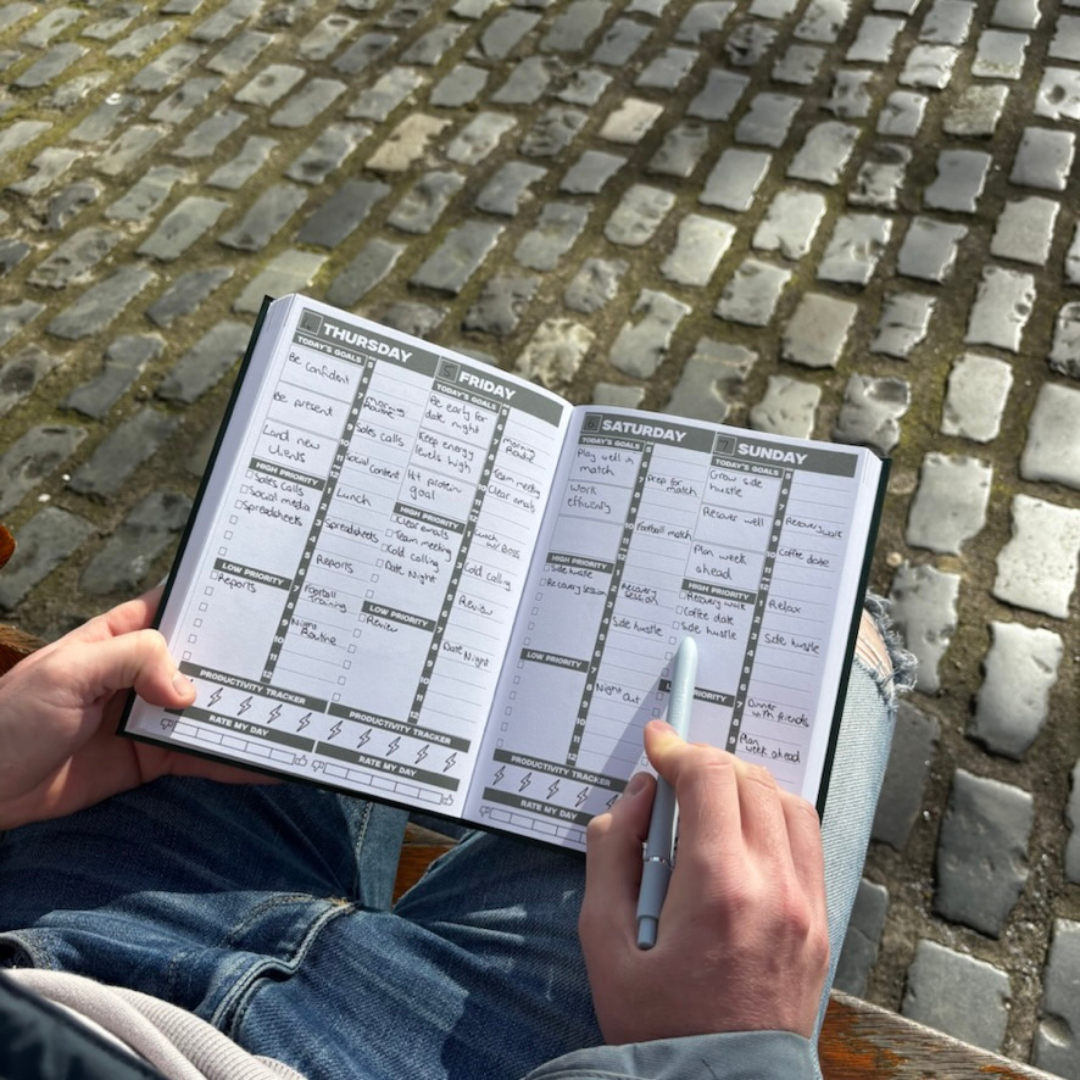
The Plan Your Growth undated weekly agenda is built around exactly this workflow. The weekly layout gives you a single view of your blocks, your priorities, and your three non-negotiables, so the planning session has a home and a structure instead of happening on a scrap of paper you lose by Tuesday.
What to Do When the System Gets Disrupted
It will get disrupted. A meeting lands in your Tier 1 block. An urgent client issue burns your buffer. Your afternoon collapses. This is not a failure of the system. It is a test of whether you know how to recover from one.
Most men abandon systems the moment they break down. That is the wrong response. The right response is the same move a good athlete makes after a bad quarter. You assess, you reset, and you continue.
When a block gets disrupted, do two things. First, protect the remainder. If a two-hour deep work block gets cut to forty-five minutes, take the forty-five minutes. Partial execution beats zero execution every time. Second, make a same-day decision about what did not happen. Either reschedule the lost block before the week ends or consciously deprioritise the task it contained. What you do not do is let it drift into a vague "I'll get to it" that never resolves.
The ability to reset without drama is a discipline skill, not a scheduling skill. Build it by practising the reset itself. Every time your schedule breaks and you recover it intentionally, you are training the muscle.
The Common Mistakes That Kill the System
A few specific errors come up repeatedly when men first implement time blocking.
Blocks too short. A twenty-minute block for a task that needs ninety minutes is not time blocking. It is wishful thinking. Underestimating task duration is one of the most documented cognitive biases in productivity research. The fix is to track actuals for two weeks. How long did that proposal actually take? How long did that deep-work session run before you needed a break? Ground your blocks in real data, not optimism.
No transition time. Back-to-back blocks with zero gap assume you can teleport between modes. You cannot. Build ten to fifteen minutes between significant blocks as a buffer and a mental reset.
Everything is Tier 1. If everything is high priority, nothing is. Men who block their entire day in red "urgent/important" slots are not disciplined. They are avoidant. They have not made the hard call about what actually matters this week. Making that call is the planning work. Do not skip it.
Protecting the wrong hours. Some men build their deep work blocks at 3 p.m. because their calendar happens to be free then. Your calendar being free is not the same as your brain being ready. Track your energy for a week. Find the two to three hours when your focus is sharpest. Those become your Tier 1 blocks, regardless of what the calendar says.
The Bottom Line
Time blocking works because it forces two decisions most men never make explicitly: what matters most this week, and when specifically it is going to happen. The calendar does not lie and neither does your output. If your best priorities have no Tier 1 block, they are not real priorities. They are intentions. Build the system once, run a weekly planning session to drive it, and recover without drama when it breaks. That cycle, repeated across 90 days, compounds into the kind of execution most men say they want but never build the structure to produce.
If you want a single tool that makes this system concrete every week, the Plan Your Growth undated weekly agenda gives you the weekly layout, the priority-setting structure, and the daily view to run your blocks from. It is the physical operating system the system needs to hold.