The 12 Week Year: A Better System Than Annual Goals
A year is too long to feel urgent and too short to actually plan around. That is the core problem with annual goal setting, and it explains why most New Year's resolutions are functionally dead by February. The 12 week year, a framework developed by Brian Moran and Michael Lennington, solves this by compressing the psychological weight of a full year into a 12-week sprint. Instead of one annual plan with twelve months of room to drift, you get four high-intensity execution windows a year, each one treated with the urgency of a deadline that is actually close enough to matter.
Why a Calendar Year Kills Urgency
The human brain is bad at sustaining urgency over long horizons. A deadline eleven months away does not trigger the same behavioural response as a deadline three weeks away, even when the eleven-month deadline is objectively more important. This is not a discipline failure. It is how time perception works under low pressure. January goals get real effort for two or three weeks, then the deadline recedes far enough into the future that the brain stops treating it as real.
The 12 week year exploits the opposite effect. When your "year" is only 12 weeks long, every week carries roughly 8 percent of your total annual effort. Falling behind in week 3 is immediately visible and immediately correctable, because there are not nine remaining months to vaguely promise yourself you will catch up. The compressed timeline forces the kind of weekly intensity that a 12-month plan structurally cannot sustain.
This is not just a motivational trick. It changes the granularity of your planning. A 12-month goal gets broken into vague quarterly milestones that are still abstract enough to ignore. A 12-week goal gets broken directly into weekly actions, which is the timescale where actual execution happens.
How to Build Your 12 Week Plan
Start by choosing 2 to 3 goals for the cycle, never more. The 12 week year fails the same way annual planning fails when you overload it with every ambition you have. Pick the goals that would make the next 12 weeks a genuine success if nothing else happened.
For each goal, write the specific, measurable outcome you are targeting by week 12. Not "improve fitness" but "deadlift 120kg" or "run a sub-25-minute 5k." Vague outcomes cannot be weekly-planned because there is nothing concrete to break down.
Now reverse-engineer the weekly actions. If the goal is a 120kg deadlift and you currently pull 95kg, what does progressive overload look like across 12 weeks to close that gap. Three sessions a week, a specific progression scheme, a deload week built in around week 8. This is where the plan becomes real: a 12-week goal without weekly actions attached is just a deadline with no mechanism behind it.
Write this plan down somewhere you will see weekly, not just at the start. A goal you wrote once on January 1st and never looked at again was never really a plan. It was a wish with a deadline.
The Weekly Execution Cycle
The 12 week year lives or dies on the weekly cycle, not the 12-week plan itself. Each week needs three things: a short plan at the start of the week, daily execution against that plan, and a score at the end of the week.
The weekly plan takes the 12-week actions and pulls out exactly what needs to happen this specific week. If the deadlift progression calls for three sessions this week, when are they. Put them in the calendar before Monday starts, not as a vague intention to "train this week."
Daily execution is where most men's plans actually break, and it breaks for a simple reason: the plan exists, but nothing forces daily contact with it. Pull your weekly plan back up each morning for thirty seconds. Not to redesign it. Just to remember it exists and to see what today specifically requires.
The weekly score, taken every Friday or Sunday, is the mechanism that prevents slow drift. Score yourself honestly: did you execute the actions you planned, yes or no, for each goal. A string of low scores two weeks in a row is your signal to adjust the plan, not abandon it. This single habit, repeated honestly, is what separates men who run this system for a full year from men who run it for three weeks and quietly stop.
What to Do at the End of Each 12-Week Cycle
When week 12 arrives, stop and actually evaluate before launching the next cycle. Did you hit the outcome. If yes, what made it work, and how do you carry that forward. If no, was the target wrong, was the weekly action insufficient, or did execution simply break down somewhere in the middle weeks.
This review matters because the 12 week year is not meant to run once. It is meant to run four times a year, and each cycle should be sharper than the last because you are learning something concrete about your own execution patterns. Men who run this system well for a full year typically describe the fourth cycle as feeling almost unrecognisable compared to the first, not because the framework changed but because they finally understand their own actual capacity.
Use this checkpoint to also rest deliberately for a few days before starting the next cycle. Twelve weeks of high-intensity execution without any recovery window burns out even committed men. The system works in cycles for a reason: sprint, then a short reset, then sprint again.
Making the System Visible Every Week
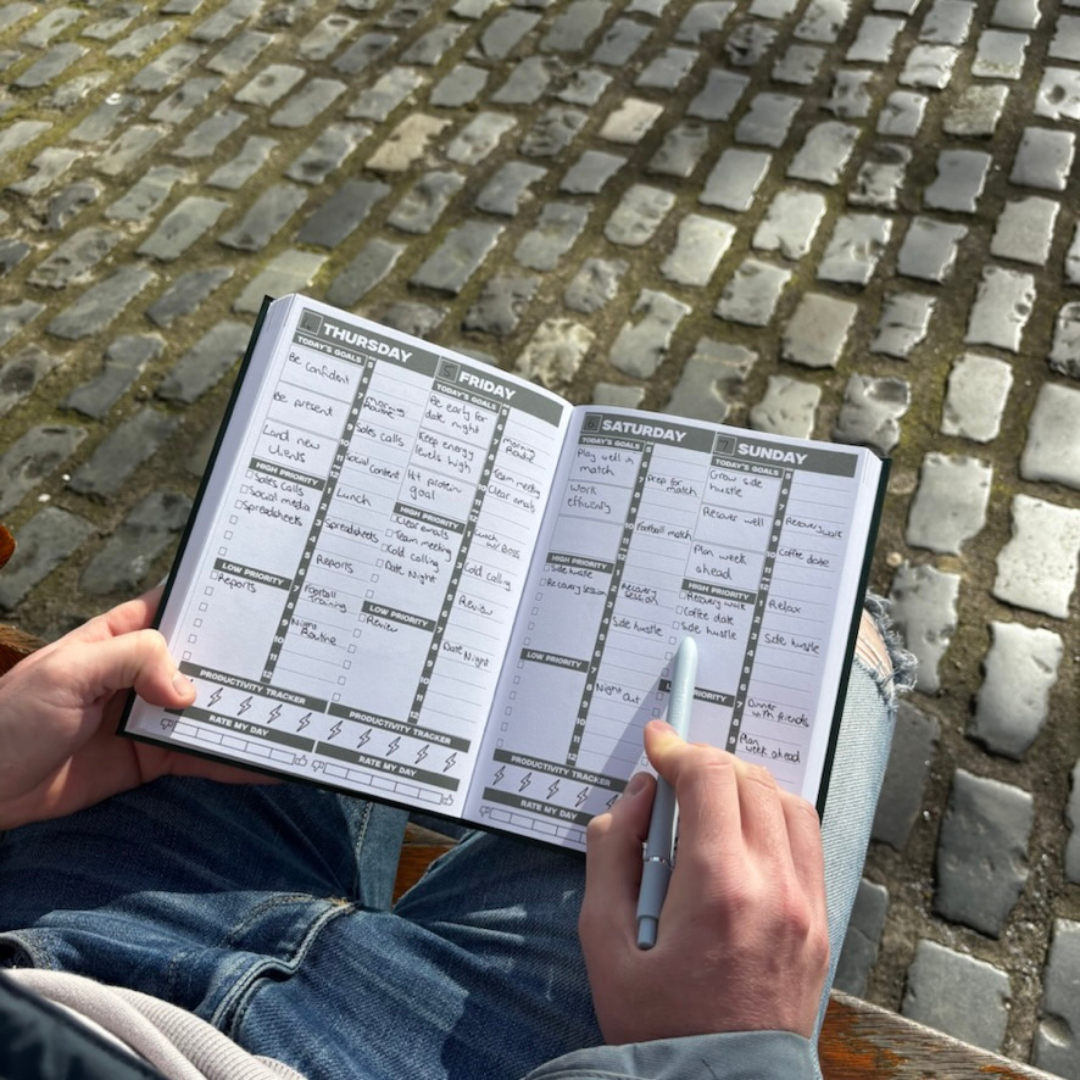
None of this works if the plan lives only in your head. The 12 week year depends on a physical or written structure you return to constantly: the quarterly outcomes at the top, the weekly actions broken out below them, and a place to log your weekly score.
This is exactly the structure the Plan Your Growth undated weekly agenda is built to hold. Each week gets its own spread, which means your 12-week goals stay visible every single week of the cycle rather than disappearing into a note you wrote once and never opened again. Research from Gloria Mark at UC Irvine on attention and task switching makes clear that anything not kept physically visible competes poorly against the dozens of other inputs fighting for your attention each day. A plan you cannot see is a plan you will not run.
The Bottom Line
The 12 week year works because it compresses a year of ambition into a window short enough to feel real and long enough to make actual progress. Pick 2 to 3 goals, reverse-engineer the weekly actions, execute daily against a visible plan, and score yourself honestly every week. Run the cycle four times a year with a short reset between each one. The system is simple. The discipline is in the weekly score, not the quarterly ambition.
If you want a tool built around exactly this weekly rhythm, the Plan Your Growth undated weekly agenda gives every week of your 12-week cycle a dedicated spread to plan, execute, and score against. Twelve weeks at a time is how real progress actually gets made.