The 12-Week Year: Execute More in Less Time
Annual planning is one of the most widely practised and least effective planning habits a man can have. You set goals in January with real conviction. By March the urgency has evaporated because you have nine months left. By June the goals feel like last year's version of yourself talking. By December you are planning again, quietly carrying the same targets forward with minor adjustments. The 12-week year is the structural fix for this. Developed by Brian Moran and Michael Lennington, whose work is documented at 12weekyear.com, the framework compresses the annual planning cycle into a 13-week period: 12 weeks of execution, one week of review and reset. The result is that the deadline is never abstract. It is always twelve weeks away. And twelve weeks away is close enough to stay urgent.
Why Annual Goals Fail (and What the 12-Week Year Fixes)
The core problem with annual goals is the time horizon. Twelve months is long enough for any man to tell himself he has time to get to it later. January urgency exists because January is new. It does not persist because February is not. By mid-year most annual plans are operating on hope rather than structure, and hope is not a planning strategy.
The 12-week year solves this by treating twelve weeks as the year. Not a quarter of a year. The year. Within that frame, there is no time for deferral. A goal you have not started by week three of a 12-week year is already running behind. That urgency is productive. It forces the decisions that annual planning lets you avoid.
The other failure mode of annual planning is the distance between vision and action. An annual goal is often too far from the daily task to create consistent forward movement. The 12-week year forces you to work backwards from the 12-week target to weekly milestones and then to specific daily actions. Every week of the plan has outputs attached to it. Every day of the plan has tasks attached to those outputs. The chain from the goal to today's work is short and visible.
This is where the compounding effect comes from. Not from working more hours, but from maintaining clarity of direction across the full 12 weeks without the drift that kills most long-horizon plans.
Setting Up Your 12-Week Year: The Only Three Goals That Matter
The first move in a 12-week year is choosing your goals, and the constraint is the most important part: three goals maximum. Not ten. Not a complete life overhaul. Three.
Most men resist this constraint. They have twelve things they want to move forward and cutting to three feels like loss. It is not loss. It is focus, and focus is the mechanism that makes the 12-week year produce results that annual planning cannot. A man pursuing twelve goals simultaneously is not ambitious. He is scattered. A man pursuing three goals with the full weight of his weekly execution behind them will outperform the scattered man every time and will know why.
The three goals should span the areas of your life that matter most to you right now. One professional, one physical, one personal is a framework that works for many men. The specific areas are yours to choose. What matters is that each goal is specific, measurable, and genuinely achievable in 12 weeks. Not "get fitter." "Reduce body fat from 22 percent to 18 percent by week 12." Not "grow the business." "Generate 15,000 euros in new client revenue by week 12." The specificity is not pressure. It is precision. You cannot execute toward a vague target.
For each of your three goals, write the milestones at weeks 4, 8, and 12. These are your checkpoints. They are how you know by week 5 whether you are on track or whether the plan needs adjustment. Without them, you will only discover you are off track in week 11, which is too late to recover.
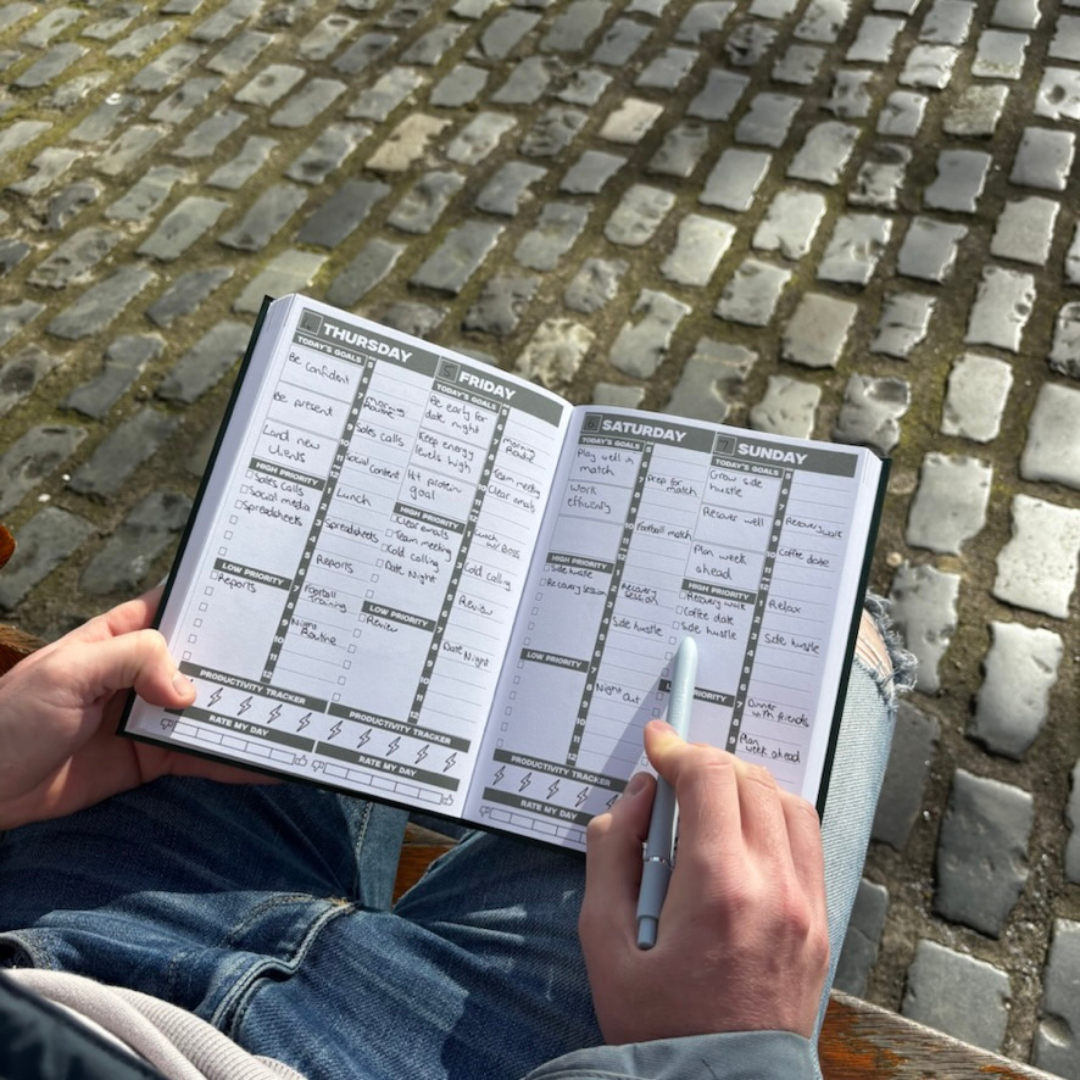
The Plan Your Growth undated weekly agenda is built to hold this kind of 12-week structure. The weekly layout gives you the space to track your three goals week by week alongside your daily execution, so the plan stays visible throughout the cycle rather than sitting in a notebook you open once and close.
The Weekly Plan: How the 12-Week Year Runs Day to Day
The 12-week year does not change how you spend each day as much as it changes how you set up each week. The weekly planning session, done before the week begins, is where the 12-week plan connects to the daily work.
Every Sunday, you open your planner and answer three questions. What does this week need to produce to keep the 12-week plan on track? Which of the tasks this week are directly connected to my three goals and which are general work? And what specifically am I doing on Monday morning when I sit down to begin?
The first question keeps you honest. A week where none of your significant outputs connect to your 12-week goals is a week of drift regardless of how busy it was. The second question is how you protect your deep work. Tasks directly connected to your goals go into Tier 1 blocks, your highest-energy hours, before everything else. General work fills the lower-energy windows. The third question eliminates the Monday morning decision cost. You know exactly what you are starting with. You sit down and begin.
This weekly connection between the 12-week goal and the daily task is the mechanism. It is why the 12-week year outperforms annual planning. The plan is not reviewed once a year. It is lived every week. That consistency of contact with the goal is what drives execution rather than drift.
The Week 13 Buffer: Review, Reset, Recover
Week 13 in the 12-week year is not execution. It is the buffer between one cycle and the next. You use it to do three things.
First, the full cycle review. Did you achieve each of your three goals? If yes, what drove that? If not, at what point in the cycle did execution break down and why? This is not a performance review designed to produce guilt. It is data collection. The men who run multiple 12-week years in a row improve dramatically across cycles because they use the week 13 review to identify the specific patterns that produced good weeks and the specific failures that produced bad ones. The pattern becomes clearer with each cycle.
Second, recovery. Week 13 is intentionally lighter. Most men have pushed hard for 12 weeks. The buffer absorbs the overrun from week 12, allows for genuine rest, and ensures you begin the next cycle from a position of capacity rather than exhaustion. A man who runs 12-week year after 12-week year without a buffer eventually runs into a wall. The buffer prevents that.
Third, the setup for the next cycle. Before the buffer week ends, you set the three goals for the next 12 weeks, write the milestone checkpoints, and do the week one planning session so Monday morning of the new cycle starts clean. The transition between cycles should be seamless from an execution standpoint, even if the goals themselves change.
What the 12-Week Year Demands From You
The 12-week year is not a passive system. It requires three things from you that most planning frameworks do not explicitly ask for.
First, commitment to the goal for the full 12 weeks. Not until it gets hard. Not until a better idea comes along. For 12 weeks. Men who change goals mid-cycle are not running the 12-week year. They are running an approximation of it that produces approximation results.
Second, honesty in the weekly review. The most dangerous response to a bad week inside a 12-week year is to be generous with yourself about why it happened. A week where you did not execute against the plan is a week where you did not execute against the plan. The reason matters for adjustment purposes. It does not change the outcome. Stay honest with the data.
Third, the willingness to protect the plan under social and professional pressure. The 12-week year will be disrupted. People will schedule meetings inside your Tier 1 blocks. Unexpected demands will arise. The discipline required is not grinding harder when this happens. It is recovering the plan quickly, protecting the deep work blocks that remain in the week, and arriving at the next Sunday planning session ready to continue rather than starting from scratch.
The Bottom Line
The 12-week year works because it makes the deadline real, connects your biggest goals to daily action through a weekly plan, and forces the honest assessment that annual planning lets you avoid. Three goals, twelve weeks, weekly milestones, a daily task chain that reaches back to the goal. Run the cycle, use week 13 as a buffer and reset, and start the next cycle. Four complete cycles in a year will produce more than any annual plan you have ever written, not because you worked more, but because you stayed in contact with what mattered across all twelve weeks instead of returning to it in December.
If you want the planning tool that holds the weekly structure the 12-week year runs on, the Plan Your Growth undated weekly agenda gives you the weekly layout, the goal visibility, and the daily execution space to run the system properly. Not as a concept. As a repeatable cycle.