5 Morning Routine Habits That Build Real Discipline
Discipline is not a personality trait. It is the compounding output of what you do in the first 90 minutes of your day, repeated without negotiation. The morning routine gets a lot of hype, most of it useless. Four a.m. wake-ups and cold plunges make for good content but poor systems. What actually builds discipline is far less dramatic and far more repeatable. These five morning routine habits are the ones that hold under pressure, because they are built around mechanism, not motivation.
Why the Morning Is the Right Place to Build Discipline
Willpower is not a fixed resource, but it is a depleting one across a day. Research from Angela Duckworth at the University of Pennsylvania on self-control and grit consistently points to the same underlying pattern: the men who maintain high execution rates are not the ones with more motivation. They are the ones who have removed the need to make decisions about how to spend their best hours.
The morning is the only part of the day you fully own. Before the inbox opens, before the messages stack up, before other people's priorities start crowding your time, you have a window. What you do with that window determines how the rest of the day runs. Use it reactively and you spend the day catching up. Use it deliberately and you spend the day executing.
The habits below are not about waking up earlier for the sake of suffering. They are about taking the first part of your day seriously enough to design it.
Habit 1: No Phone for the First 30 Minutes
This is the simplest habit on the list and the one most men resist most. The phone is a portal to other people's agendas. The moment you open it you are reactive. Someone needs something. There is a notification. A news headline fires a stress response before you have had one clear thought of your own.
The 30-minute rule is not about mindfulness or digital wellness framing. It is about who owns your attention in the first half hour of the day. You do, or the phone does. There is no middle ground. Leave it face-down in another room. Start your morning on your terms.
Habit 2: Write Down Your Three Outcomes Before Anything Else
Not a to-do list. Three outcomes. Specific, completable things that would make today a productive day if nothing else happened. "Reply to the contract email" is an outcome. "Sort the inbox" is not.
This habit takes three minutes. It forces you to distinguish between the urgent and the important before the day loads up with both. It also creates a measuring stick. At the end of the day, did those three things happen? If yes, the day was a success regardless of everything else that pulled at your attention.
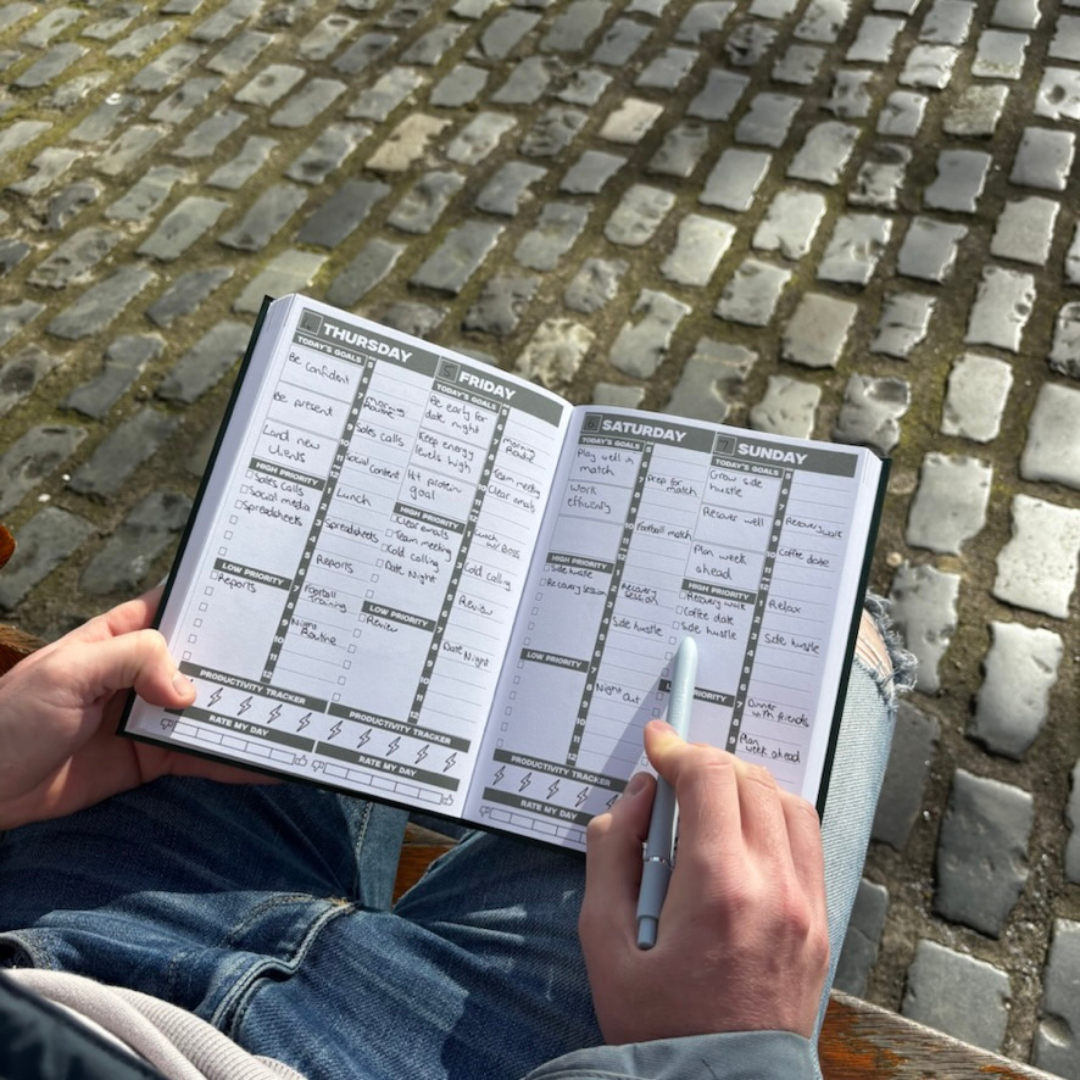
Write them by hand. There is a mechanical advantage to writing over typing: it slows you down enough to think. Use the daily planning section of the Plan Your Growth undated weekly agenda to make this a daily locked-in ritual rather than something you do when you remember.
Habit 3: Move Your Body Before You Start Work
Not for an hour. Not a complicated programme. Twenty minutes of physical movement before your first work task changes the chemistry of the rest of your morning. Elevated heart rate, increased blood flow to the prefrontal cortex, lower baseline cortisol. These are not wellness claims. They are documented physiological shifts that affect your cognitive performance for the next several hours.
Walk. Do a set of push-ups and pull-ups. Run 2k. The mode matters less than the consistency. If you have not moved your body before sitting down to work, you are starting with a handicap you gave yourself.
Habit 4: Do One Hard Thing First
Every man has a task on his list that he is avoiding. The proposal he does not want to draft. The conversation he keeps delaying. The project that requires real concentration. That task should be the first thing you open when you sit down to work, not the last.
Procrastination is an emotional regulation problem, not a time management problem. The avoidance is about discomfort, not complexity. When you do the hard thing first, two things happen. The rest of the day feels easier by comparison, because nothing ahead of you is as difficult as what you already finished. And you stop carrying the psychological weight of the avoided task, which drains far more energy than the task itself.
Habit 5: End the Morning Block With a Hard Stop
Your morning routine needs a defined finish, not just a start. Set a time. 9:00, 9:30, whenever your first obligation begins. When that time arrives, the morning block ends. No extensions. No "just five more minutes."
The hard stop creates a container. Containers create urgency. Urgency sharpens focus. When your morning block is open-ended, you will unconsciously slow down because there is no pressure to finish. When it has a wall, you move faster and produce more in the same time. This is Parkinson's Law running in your favour: work expands to fill the time available. Give it less time, and the work gets done.
The Bottom Line
These five habits do not require a personality overhaul. They require structure and repetition. No phone for 30 minutes. Write three outcomes before anything else. Move your body first. Do the hard task before the easy ones. End the morning block at a fixed time. Run all five consistently for 30 days and you will have built the daily discipline framework that most men are chasing through motivation they never seem to find. Discipline does not come before the routine. It is the product of it.
The men who execute most consistently are not the most talented. They are the most structured. If you want a tool that makes this structure visible and repeatable every day, the Plan Your Growth undated weekly agenda is built for exactly that purpose.