Deep Work: How to Build Focus in a World Built to Distract You
The ability to sit down, focus without interruption, and produce work that actually requires your full cognitive capacity is becoming rare. Cal Newport, who has written more rigorously on this topic than anyone, calls it deep work, and he argues it is the skill that will separate the high-output men of the next decade from the permanently busy but chronically underproductive ones. The barrier is not intelligence or talent. It is structure. Most men have never deliberately built a deep work practice because they have never had to. Now they do.
What Deep Work Actually Is (and What It Is Not)
Deep work is not "working without your phone nearby." It is sustained, uninterrupted concentration on a cognitively demanding task. The kind of work that produces something that did not exist before you sat down. A strategy document. A sales argument that actually holds. A complex problem solved with original thinking rather than a recycled template.
According to Cal Newport's research and writing, most knowledge workers spend the majority of their time in shallow work: email, meetings, low-stakes admin, tasks that could be done by someone less experienced or done while distracted. This is not because those tasks are unimportant. It is because shallow work is comfortable. It produces the feeling of progress without the cost of deep concentration.
The cost of concentration is real. It requires you to sit with discomfort, resist the impulse to check something, and stay on one thing long enough for your brain to actually get into the problem rather than skimming the surface of it. Most men have trained themselves out of this capacity by spending years in an always-on, always-available work mode.
The Two Things That Kill Deep Work Before It Starts
The first is availability signalling. The expectation, cultural in many workplaces and habits, that you will respond to messages quickly. This keeps you in a state of low-level vigilance even when you are technically "focused." You cannot do deep work while waiting for an interruption. The shallow-work mode and the deep-work mode require different neurological states. You cannot run both simultaneously.
The solution is protected time with clear signals to the people around you. A closed door. A calendar block marked unavailable. A message status set to do not disturb. This is not antisocial. It is professional self-management.
The second is a poor warm-up. Men sit down to do deep work and immediately encounter resistance. The task feels hard, the opening is unclear, and within three minutes they have opened a browser tab to check something "quickly." The quick check ends the deep work session before it started.
The fix is a pre-work ritual that signals to your brain the mode is changing. Two minutes of reviewing your outcome for the session. Phone out of reach. Browser closed. One document open. The same ritual every time so the brain learns the cue.
How to Build a Deep Work Schedule
Start with frequency. How many hours of genuine deep work are you capable of in a day? For most men starting from scratch, the honest answer is one to two hours. Not four. Not six. The goal over time is to extend that window, but starting with an honest number prevents the discouragement of setting two hours and producing ten minutes.
Block those hours on your calendar as untouchable. Early morning is ideal because it is before the day's friction builds up. But the specific time matters less than the consistency. The same block, most days, trains your concentration the way a training programme trains your body.
Within each deep work block, use a single task focus protocol. One task. One outcome. No tab switching. No task-switching. Set a timer if it helps. The brain adapts to the structure. Over weeks, the blocks that used to feel long start to feel short. That is the concentration building.
Keep a deep work log. Not a detailed diary. Just a record of the date, the task, and the duration. Seeing that log fill up over time is itself a form of accountability. Missing a day becomes visible. A streak becomes something worth protecting.
Structuring Your Week Around Deep Work Hours
Deep work does not happen in the margins. It requires prime real estate in your week: your best hours, protected from everything else. This means making hard decisions about where meetings live, when you check email, and what gets scheduled versus what gets done reactively.
The most effective structure for most men is a front-loaded deep work week. Monday and Tuesday carry the heaviest deep work load, when energy and cognitive freshness are highest. Meetings and collaborative work move to Wednesday afternoon and Thursday. Friday is for review, planning, and clearing administrative backlog.
This is not always possible depending on your role. But the principle holds wherever you have discretion: protect the mornings, batch the shallow, and never let a reactive task own your best hours.
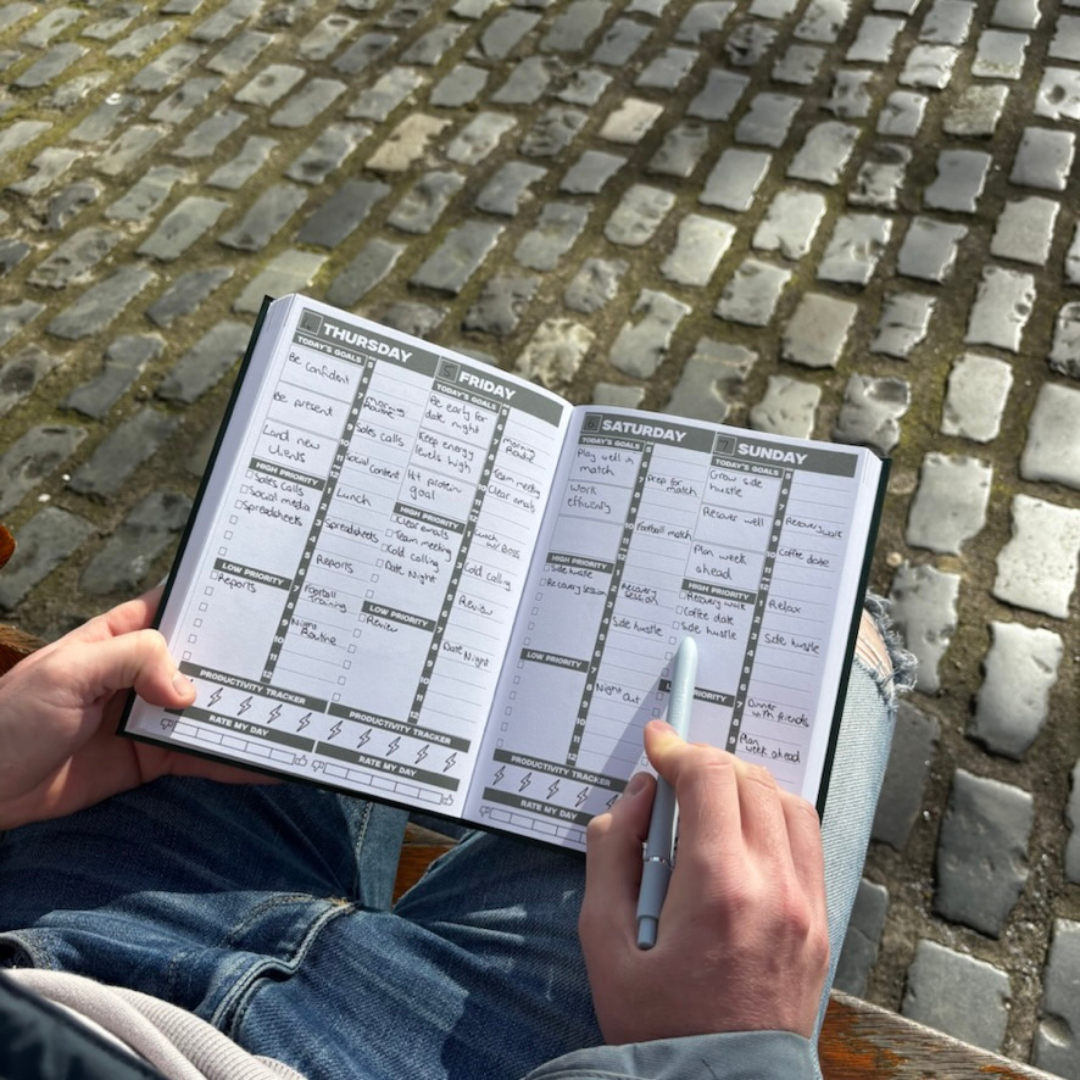
The Plan Your Growth undated weekly agenda is structured to support exactly this kind of intentional weekly layout, giving you a visual map of your week that makes the deep work blocks visible and easy to hold.
What Happens When You Build This Over 90 Days
The first two weeks are the hardest. The discomfort of sustained focus is real. The pull of distraction is strong. The work feels slower than you expected because you have not yet warmed up your concentration muscles.
By week four, something shifts. The blocks start feeling natural. You stop fighting the single-task requirement and start relying on it. Your output in two focused hours begins to exceed what you were producing in five scattered ones.
By week twelve, you have a different relationship with your work. You know what you are capable of when you are actually focused. You have built something, not just stayed busy. And you have the data: weeks of logged deep work sessions that prove to yourself that you can hold the line on concentration even when the world is engineered to break it.
The Bottom Line
Deep work is not a lifestyle preference. It is the primary mechanism by which ambitious men produce results that actually require their full capability. The barriers are structural: availability culture, poor session warm-ups, and a week designed around everyone else's priorities. The solution is equally structural: protected blocks, a consistent pre-work ritual, a single-task protocol, and a weekly design that puts your best hours to work on the things that matter most. Build it deliberately, hold it consistently, and compound it over 90 days. The output will not be subtle.
If you want a physical planning system to anchor your deep work blocks week by week, the Plan Your Growth undated weekly agenda is the tool that keeps your structure visible and your priorities from drifting.