How to Stop Procrastinating: The System That Actually Works
You do not have a laziness problem. Lazy men do not feel guilty about what they are not doing. You do. That difference matters, because it tells you exactly what you are dealing with. Procrastination is not a character flaw or a time management failure. According to Dr. Tim Pychyl, one of the world's leading researchers on procrastination at Carleton University, it is fundamentally an emotional regulation problem. You are avoiding the task because of how it makes you feel, not because you lack the time or the intelligence to do it. That reframe changes everything about how you fix it.
Why Willpower Is the Wrong Tool for Procrastination
Most men try to fight procrastination with willpower. They tell themselves to just get on with it, set aggressive deadlines, and feel genuinely confused when those tactics fail after day three. Willpower fails because it is trying to overpower an emotional response with a cognitive one. That is not how the brain works under stress.
The avoidance you feel before a difficult task is a real neurological response. The brain flags the task as a source of discomfort, anxiety, self-doubt, or boredom, and it steers you toward something that feels better in the short term. Checking your phone. Tidying the desk. Doing a smaller, easier task and calling it productivity. The relief is immediate. The cost is deferred. And the cost compounds.
The fix is not to feel differently about the task. It is to reduce the friction between you and starting it so that the brain does not have time to run the avoidance calculation. You do not overcome procrastination through motivation. You outmanoeuvre it through structure.
The Two-Minute Start Protocol
The single most effective anti-procrastination tactic is not a mindset shift. It is a mechanical one. Commit to two minutes on the avoided task. Not the whole task. Not a meaningful chunk of it. Two minutes. Open the document and write one sentence. Pull up the spreadsheet and fill in one cell. Send the first line of the email you have been drafting in your head for four days.
The reason this works is not motivational. It is neurological. Once you start a task, your brain activates what psychologists call the Zeigarnik effect: an intrinsic tension that makes incomplete tasks occupy mental bandwidth and pull you back toward completion. Starting is the hardest part because before you start, the task exists only as an abstract threat. Two minutes in, it is a concrete, manageable thing you are already doing.
The two minutes frequently becomes twenty. Not because you forced yourself but because starting changed the emotional valence of the task. It is no longer the looming thing. It is the thing you are already doing.
Redesigning Your Environment to Remove Avoidance Cues
Procrastination is also an environment problem. If your phone is on the desk, you will pick it up. If your browser has seventeen tabs open, one of them will pull your attention at the first moment of resistance. If your workspace is also where you relax, your brain has no clear signal that this time is work time.
Environment design is the practice of making the right action easier than the wrong one. Phone in another room, not face-down on the desk. Browser closed, not just minimised. One document open, not eight. A dedicated workspace that signals, through consistent use, that sitting down here means working.
This is not about discipline. It is about reducing the number of decisions your brain has to make correctly under pressure. Every piece of avoidance infrastructure you leave in your environment is a tax on your focus. Remove it before you sit down, not after you have already been distracted.
Breaking the Task Into a Smaller First Action
Procrastination spikes hardest on tasks that are large, vague, or both. "Write the business plan" is a procrastination magnet. It is enormous, it is unclear where it starts, and the gap between where you are and where it needs to be is wide enough to feel hopeless before you begin. The emotional response to that gap is avoidance.
The solution is task decomposition. Break the blocked task into the smallest possible first action. Not "write the business plan." Write the executive summary outline. Not "sort out the company finances." Open the spreadsheet and list the five categories of expenditure. The first action should be so small it feels almost embarrassingly easy.
This matters because the size of the first action determines the height of the emotional barrier. Small first action, low barrier. The brain does not activate the avoidance response for something that takes five minutes. It reserves that response for the overwhelming thing, and you have just stopped presenting it with something overwhelming.
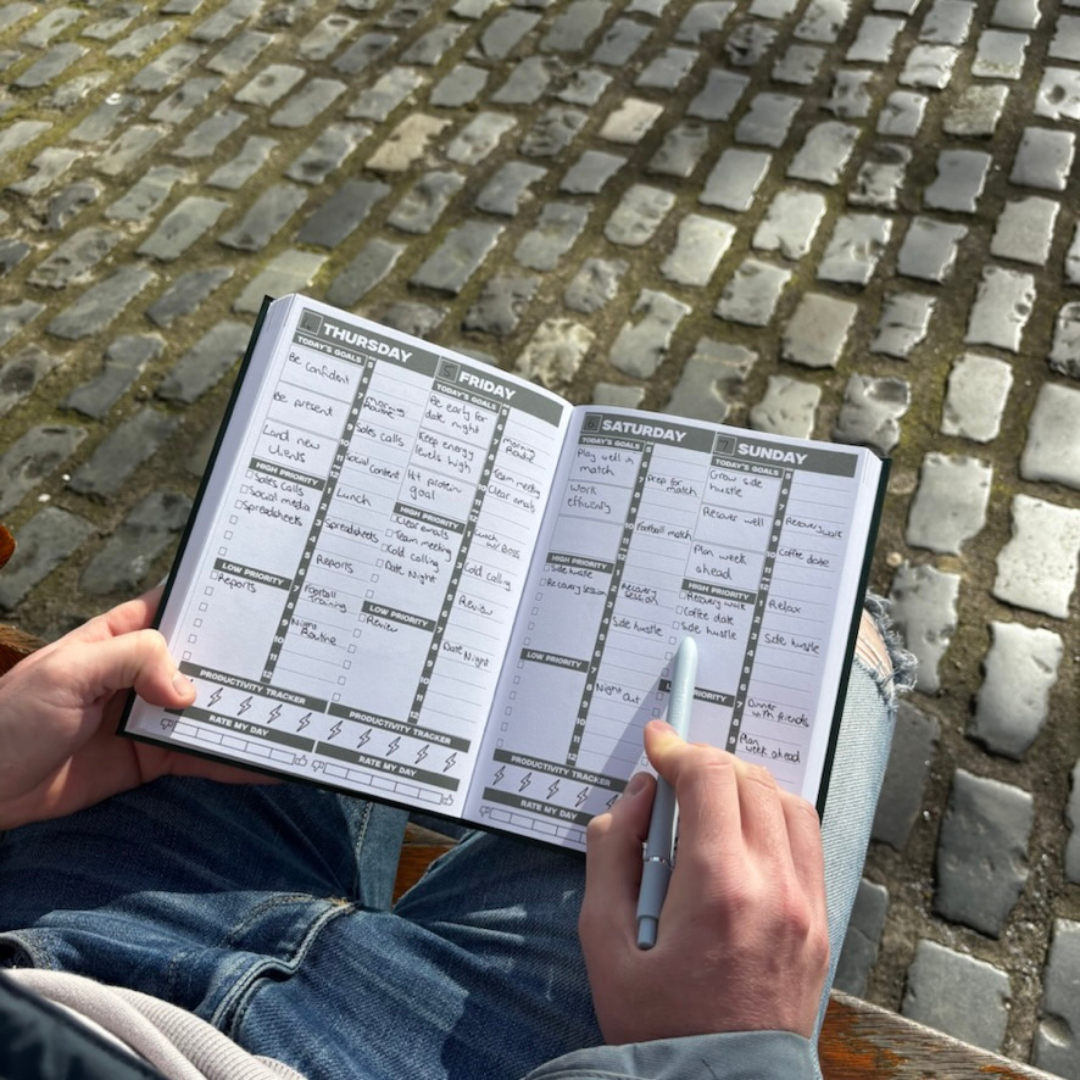
Use your Plan Your Growth undated weekly agenda to write the first action for every blocked task at the start of each day. Not the full task. The first action. That is what goes on the list. That is what you do when the avoidance hits.
The Accountability Structure Most Men Skip
Procrastination is also a visibility problem. When no one knows you are supposed to have finished something, there is no external pressure to hold the line when internal motivation drops. This is not a weakness. It is human. Even the most disciplined men execute better when someone else knows what they committed to.
Build a lightweight accountability structure. This does not require a coach or an accountability partner in the formal sense. It can be as simple as telling one person what you are going to complete this week and following up at the end of it. The act of stating a commitment out loud, to another person, changes the psychological weight of the task. Breaking a commitment you made only to yourself is easy. Breaking one you stated to someone whose opinion you respect is not.
For bigger goals and longer timelines, a weekly review session where you measure your completion rate against your intended lead measures does the same job. Not to judge yourself. To create visibility. You cannot manage invisible progress and you cannot fix invisible avoidance.
What Consistent Anti-Procrastination Practice Produces Over Time
The first 30 days of running this system are the hardest. The two-minute starts feel forced. The environment redesign is inconvenient. The task decomposition takes extra time upfront. Most men who quit do so here, which is the worst possible time to quit, because the system has not yet had time to produce results.
By day 45, the pattern changes. The two-minute start has become automatic. You no longer negotiate with yourself at the beginning of the session. You open the thing and begin. The avoided tasks that used to sit on your list for two weeks are getting done within 48 hours. The psychological weight of the backlog, that low-level guilt and anxiety that most men carry constantly, starts to lift.
By day 90, you have built something more durable than a tactic. You have built a different default response to difficult work. The tasks that used to trigger avoidance still feel uncomfortable. But uncomfortable no longer means avoidable. That shift is the foundation of real execution, and it compounds in every area of your life where you have previously stalled.
The Bottom Line
Procrastination is an emotional regulation problem dressed up as a time management problem. Willpower will not fix it. The fix is structural: a two-minute start that bypasses the avoidance response, an environment stripped of distraction cues, tasks broken into first actions small enough that the brain cannot justify avoiding them, and an accountability structure that makes your commitments visible. Run all four consistently for 90 days. The backlog clears. The guilt lifts. The execution rate climbs. None of that requires a personality transplant. It requires a system.
If you want a daily planning tool that makes your first actions visible and keeps your weekly commitments in front of you, the Plan Your Growth undated weekly agenda is built for exactly this. Structure is what closes the gap between knowing what needs doing and actually doing it.