The Sunday Reset: How High-Performing Men Plan the Week Ahead
Most men start Monday already behind. They walk into the week with a vague list of things that need doing, a backlog from Friday they never cleared, and no clear decision about what this week is actually for. By Tuesday they are reactive. By Thursday they are exhausted. By Friday they are wondering where the week went. The Sunday reset is the habit that breaks that pattern. One session, under an hour, that loads the week with intention before it starts. Here is exactly how to run it.
Why the Week Needs to Be Designed, Not Just Survived
A week without a design is not neutral. It has a design by default, and that default is other people's priorities. The inbox decides what you work on first. The loudest client gets the most time. The most emotionally urgent task crowds out the most strategically important one.
This is not a character flaw. It is what happens to any system that operates without a plan. You are not lazy for ending the week behind. You are managing a complex set of demands without a framework. The Sunday reset provides the framework.
The men who consistently outperform their peers are not smarter or more talented in most cases. They are better prepared. They walk into Monday knowing exactly what the week is for, what the first hour of each day is going to produce, and what they will say no to in order to protect that output. The Sunday reset is where that preparation happens.
What the Sunday Reset Is Not
It is not a two-hour life audit. It is not a journalling session. It is not a motivational exercise. Those things have their place, but the Sunday reset is a working session with a defined output: a week that is planned, prioritised, and ready to execute.
It is also not optional once you have decided to take your output seriously. The men who do this consistently do not skip the reset because the week is busy. They do it because the week is busy. The reset is not a luxury for calm weeks. It is the tool you need most when the pressure is highest.
Keep it under 60 minutes. If it runs longer than that, you are over-complicating it.
The Six-Step Sunday Reset Protocol
Step one: clear last week. Open your planner or task list and mark everything that was completed. Do not re-read it, do not assess it. Just close the loop on what is done.
Step two: carry forward. Identify anything that did not get done last week but still needs to happen. Move it forward deliberately. If something has been carrying forward for three weeks and you keep not doing it, it is either not actually important or it needs to be broken into a smaller first action. Decide which.
Step three: review your primary goal. You have one primary goal for the quarter. How did last week serve it? What does this week need to do to keep momentum? If last week was off-track, this is where you recalibrate, not Friday afternoon when it is too late.
Step four: identify your three to five must-complete outcomes for the week. Not tasks. Outcomes. Completable, specific, meaningful. These are the things that make this week a successful week regardless of everything else.
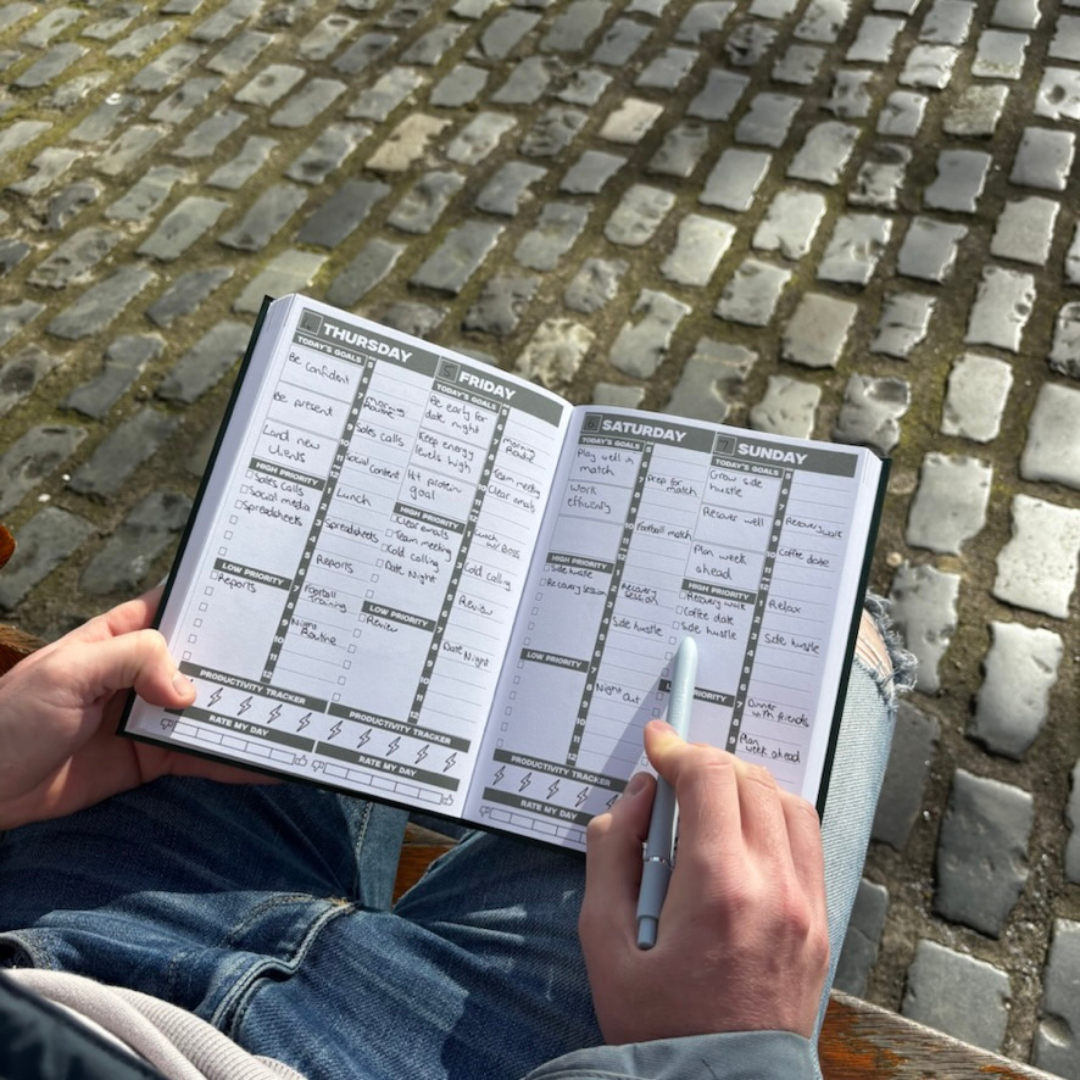
Step five: load the calendar. Open your week and assign each must-complete outcome to a specific block of time. If it does not have a time, it does not have a commitment. The Plan Your Growth undated weekly agenda is designed around this step, with a weekly planning spread that maps your priorities and daily time blocks in a single view.
Step six: identify your biggest threat to the week. What is the most likely thing to derail the plan? A difficult conversation you have been avoiding. A project that will take longer than expected. An external dependency that might not land on time. Name it now, not when it blindsides you on Wednesday.
The Mindset Shift That Makes the Reset Stick
The Sunday reset only works if you treat it as a commitment, not a good idea. Good ideas get skipped. Commitments do not.
Block it on your calendar. Same time every Sunday. Treat it the way you treat a non-negotiable meeting. Forty to fifty minutes, phone down, planner open, browser closed. When your brain wants to defer it to Monday morning because Sunday is technically a rest day, that impulse is the problem the reset is designed to solve.
Research from Dr. Gabriele Oettingen at New York University on mental contrasting and implementation intentions shows that people who form specific plans for when and where they will act on a goal are dramatically more likely to follow through than those who rely on general intention. The Sunday reset is the implementation intention for your entire week. It closes the gap between "I want to have a productive week" and "I know exactly when and how I will execute each key outcome."
What Changes After 8 Weeks of Consistent Resets
After two months of consistent Sunday resets, your relationship with Monday morning changes completely. You do not walk in blind. You do not spend the first hour figuring out what to work on. You open your planner, look at Tuesday's deep work block, and start.
Your completion rate on weekly goals increases substantially because you planned for them in advance rather than hoping they would happen in the margins. Your stress level at the end of a week drops because you have a clear record of what you accomplished versus what you intended, and the gap is much smaller than it used to be.
More subtly, the quality of your decisions throughout the week improves. You are not deciding what to work on while tired and reactive. You decided on Sunday when you were clear. Every time the week gets chaotic, and it will, you return to that Sunday decision and execute against it. The plan holds because it was built before the chaos arrived.
The Bottom Line
The Sunday reset is not a self-improvement ritual. It is a weekly planning system that loads your week with intention before it starts. Clear last week, carry forward unfinished business, review your primary goal, set three to five outcomes, load the calendar, and identify your biggest threat. Under 60 minutes, same time every Sunday, non-negotiable. Eight weeks of this and you will not recognise how you used to start your weeks. You will also not want to go back.
Build the reset around a tool that holds the structure for you. The Plan Your Growth undated weekly agenda is built for exactly this weekly workflow: a planning spread that maps your intentions and tracks your execution so the week you designed on Sunday is the week you actually live.