The 12-Week Year: Why Annual Goals Fail and Quarters Win
Ninety-two percent of New Year's resolutions fail. Not because men lack ambition, but because a year is too long a runway to feel urgent. By the second week of January the deadline is eleven and a half months away, which means it is functionally not a deadline at all. The 12-week year fixes this by treating twelve weeks as a full year. One quarter, one real deadline, one shot at execution instead of eleven months of vague intention followed by a scramble in December. This is not a productivity hack. It is a complete rebuild of how you structure ambition.
Why Annual Goals Collapse by February
Annual goals fail for a predictable, mechanical reason: the human brain does not respond to distant deadlines with urgency. A goal due in December feels, in March, like a goal due in "someday." Someday is not a date your brain can plan around, so it defaults to whatever is loudest today. Emails. Meetings. The next fire.
This is why gyms are packed the first week of January and empty by February. It is not a failure of character. It is a failure of time horizon. A year gives you so much runway that procrastination feels statistically safe. You tell yourself there is time to catch up, and for eleven months, you are technically correct. Then December arrives and there is no time left, and the goal quietly dies without ever being declared dead.
The 12-week year, a framework popularized by Brian Moran, solves this by compressing the entire cycle. Instead of a year with 365 days of slack, you get twelve weeks. Twelve weeks feels close enough that procrastination has nowhere to hide. There is no "catch up in Q4" because there is no Q4. There is only this week and the eleven that follow it.
The Core Mechanism: Treating 12 Weeks as a Full Year
The structural shift is simple to state and hard to actually run: you plan, execute, and review on a twelve-week cycle, as though December 31st were twelve weeks from today. This means your annual goal setting ritual, the one most men do once and then abandon, now happens four times a year. Each cycle gets its own vision, its own execution plan, and its own hard scoring.
Start each 12-week year with one to three goals maximum. Not ten. Not a vision board. One to three outcomes that would make the twelve weeks a genuine win if you hit them. More than three and you dilute focus across too many fronts, which research on goal pursuit consistently shows reduces completion rates on all of them.
From each goal, build a weekly action plan: the specific, repeatable actions that move you toward that outcome, done every single week of the twelve, not just when you feel like it. This is the part most men skip. They set the goal and then wing the execution. The 12-week year insists the actions are scheduled, tracked, and non-negotiable, the same way a workout program schedules sets and reps instead of leaving them to mood.
Scoring Yourself Weekly (The Part That Makes It Work)
The 12-week year lives or dies on weekly scoring. At the end of each week, you calculate an execution percentage: how many of your planned weekly actions did you actually complete? Not how you feel about the week. Not whether the outcome moved. Just the raw execution number.
This matters because outcomes lag behind execution, sometimes by weeks. If you only track outcomes, you get no useful feedback until it is too late to correct course. If you track execution weekly, you catch the drift in week three instead of discovering it in week eleven. A man scoring 60 percent execution in week two knows immediately that something in his plan or his schedule needs to change, while the outcome itself might not show any movement yet either way.
Research from the American Psychological Association on goal-directed behavior consistently finds that feedback frequency is one of the strongest predictors of goal achievement. Weekly scoring is that feedback loop, built directly into the calendar instead of left to memory or vague self-assessment at year's end.
Building Your First 12-Week Cycle
Here is how to run your first cycle, start to finish.
Week zero: set the vision. Before week one begins, spend thirty minutes deciding your one to three outcomes for the next twelve weeks. Be specific. "Get in better shape" is not a 12-week year goal. "Deadlift 140kg and drop to 15 percent body fat" is.
Build the weekly action plan. For each goal, list the specific actions that, done consistently, produce that outcome. Three gym sessions a week. Two hours of deep work on the side project every Tuesday and Thursday. Whatever moves the needle, made concrete and schedulable.
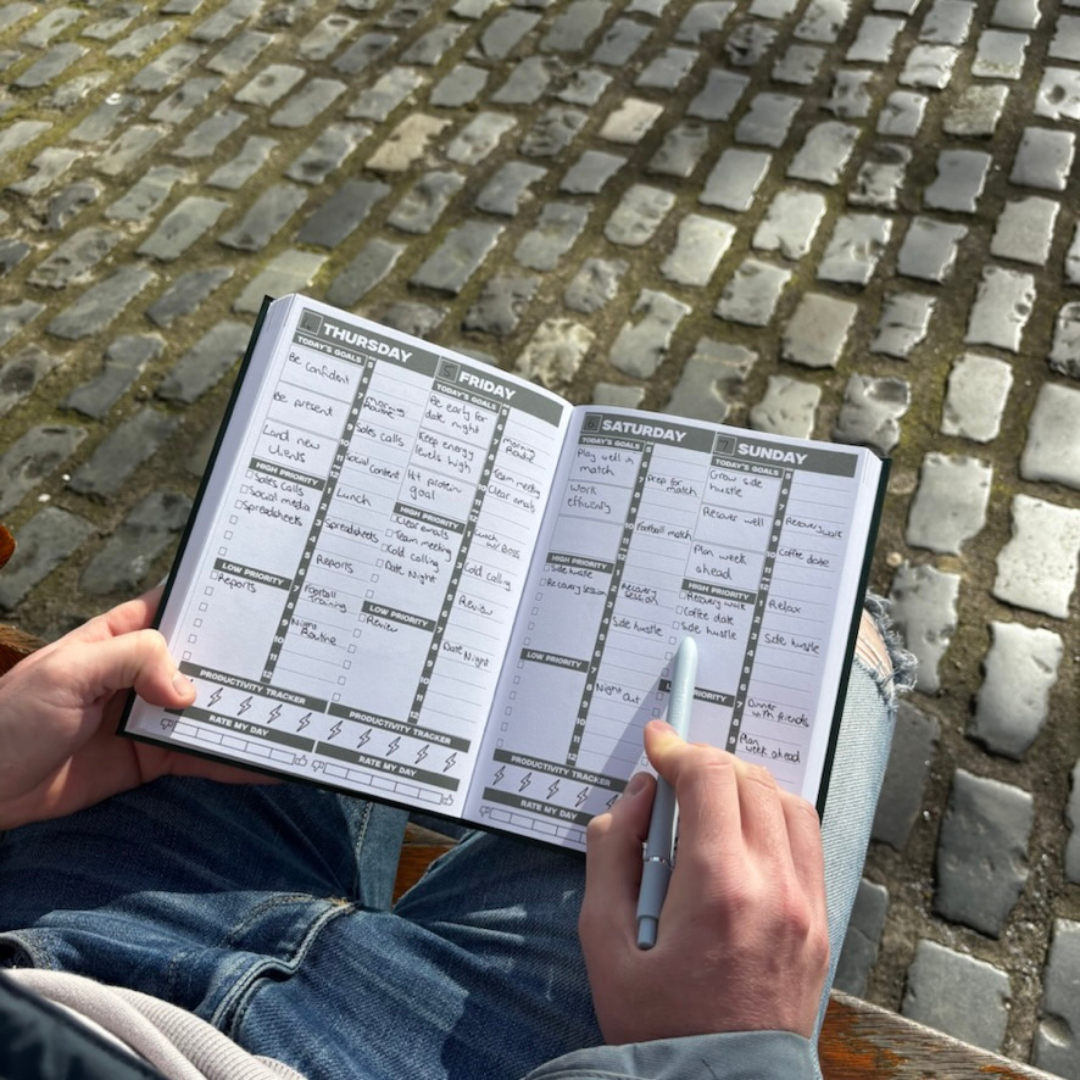
Put the actions in your calendar, not your head. A goal that lives only in your intentions gets crowded out by whatever is loud that day. A goal with a scheduled block on Tuesday at 6am survives contact with a busy week. The Plan Your Growth undated weekly agenda is built around exactly this structure: weekly spreads that hold your priorities, your habits, and your daily execution in one place, so the plan and the calendar are never two separate systems fighting each other.
Score every Sunday. Five minutes. What percentage of your planned actions did you actually complete this week? Write the number down. Do not rationalize it. The number is information, not a verdict on your character.
Run the full twelve weeks, then reset. At the end of the cycle, review what worked, what did not, and set the next twelve-week vision. Four cycles a year, each one a fresh shot at execution instead of a slow drift toward a distant December deadline.
Why This Beats Traditional Quarterly Planning
Most businesses already run on quarters. What the 12-week year adds is the emotional reframe: treating the twelve weeks as the entire year, not one-quarter of it. This sounds like semantics, but it changes behavior measurably. When a deadline is genuinely the end of your year, you do not push hard things into week nine because "there's still time." There is not still time. There are only twelve weeks, and you are already in week three.
This urgency without the burnout risk of constant sprinting is the balance the 12-week year strikes well. You get four fresh starts a year instead of one, which means four opportunities to correct course, four opportunities to feel the payoff of a completed cycle, and far fewer months where an abandoned January resolution quietly haunts you until the next New Year gives you permission to try again.
The Bottom Line
Annual goals fail because a year does not feel urgent until it is almost over. The 12-week year fixes that by compressing your entire planning horizon into twelve weeks, treated with the same seriousness as a full calendar year. Set one to three goals, build a weekly action plan, score your execution every Sunday, and reset every twelve weeks. Four real shots a year beats one vague resolution that dies in February. Start your first cycle this week. The next twelve weeks are already running whether you plan them or not.
The Plan Your Growth undated weekly agenda gives you the weekly structure a 12-week year actually needs, undated so you can start your first cycle today instead of waiting for a new notebook or a new year. Set the vision, block the actions, score the week, and run it back.