A Morning Routine for Men Who Actually Want Results
Ask any man what's holding him back from a strong morning routine and he'll usually say one of two things: he's not a morning person, or he doesn't have the willpower to stick with it. Neither is really true. What most men actually lack is a routine built on mechanism instead of motivation, one that works whether or not they feel like doing it, because motivation is unreliable and mechanism is not. A morning routine for men that survives a bad night's sleep and a rough week is built on structure, not inspiration.
Why Motivation-Based Routines Fail Within Two Weeks
Most morning routine advice leans on motivation: wake up early because you want to seize the day, journal because it will make you feel inspired. This works for exactly as long as the motivation lasts, which for most men is somewhere between three days and two weeks. Motivation is a mood, and moods fluctuate. A routine that only runs on a good mood collapses the first morning that mood does not show up, which is precisely why so many men cycle through morning routines every few months without ever building one that sticks.
The fix is a routine built on mechanism: fixed steps, done in a fixed order, regardless of how you feel about them that particular morning. Mechanism does not ask for enthusiasm. It asks for execution.
Mechanism Over Mood, in Practice
The distinction between motivation and mechanism is not abstract, it shows up in a specific, observable difference in behaviour. A motivation-based routine gets skipped the moment a man wakes up not feeling like doing it, because the entire routine was contingent on that feeling showing up first. A mechanism-based routine gets executed regardless, because the steps do not require enthusiasm, they require only that the fixed sequence begins. This is the entire reason mechanism-based systems outlast motivation-based ones across every domain, not just mornings. The feeling of wanting to do something is unreliable. A committed sequence, executed on autopilot once trained, is not.
The First Hour Rule
The single highest-leverage principle in any morning routine for men is protecting the first hour after waking from other people's demands. The first hour sets the tone the rest of the day builds on, and if that hour is spent reacting to email, news, or social media, the entire day starts in reactive mode rather than deliberate mode. Checking a phone within the first few minutes of waking means the day's first input is external noise before a single decision has been made under your own control.
The mechanism here is simple and non-negotiable: phone stays out of reach for the first hour. Not silenced, not face down, physically in another room. This single structural change does more for a morning routine's success than any other single step, because it removes the decision entirely rather than relying on willpower to resist a visible temptation.
Adjusting the Routine for Early Meetings and Travel
Not every morning offers a full 45-minute window, and a morning routine for men needs a realistic contingency for the days that start with an early call or travel. On these mornings, the five-step structure compresses rather than disappears entirely: hydration and a two-minute plan review remain non-negotiable, deep work gets pushed to the first available block later in the day rather than abandoned, and the physical reset shrinks to something as minimal as a short walk to the meeting itself. Having this compressed version pre-defined, rather than improvised under time pressure, prevents an early meeting from becoming an excuse to skip the routine altogether.
The Five-Step Structure
A morning routine for men that survives long-term needs to be short enough to execute even on the worst mornings, no more than 30 to 45 minutes total, broken into five deliberate steps rather than one vague intention to "have a good morning."
Hydrate and move, five minutes. Water before coffee, a few minutes of movement, even just stretching. This is not about a full workout, it is about signalling to the body that the day has started deliberately rather than being dragged into.
Review the day's plan, five minutes. Pull up yesterday's time-blocked schedule for today, confirm the priorities are still correct, adjust if something has changed overnight. This step alone eliminates the morning decision paralysis that costs most men their first productive hour.
Deep work or the hardest task, twenty minutes minimum if time allows. Willpower and cognitive capacity are both highest shortly after waking, before the day's decisions have started depleting them. Using this window for anything other than the highest-leverage task of the day is wasting the best resource of the entire 24 hours.
Brief physical reset, five minutes. A short walk, a cold shower, whatever genuinely shifts state from half-asleep to alert. This is individual, the mechanism matters more than the specific method.
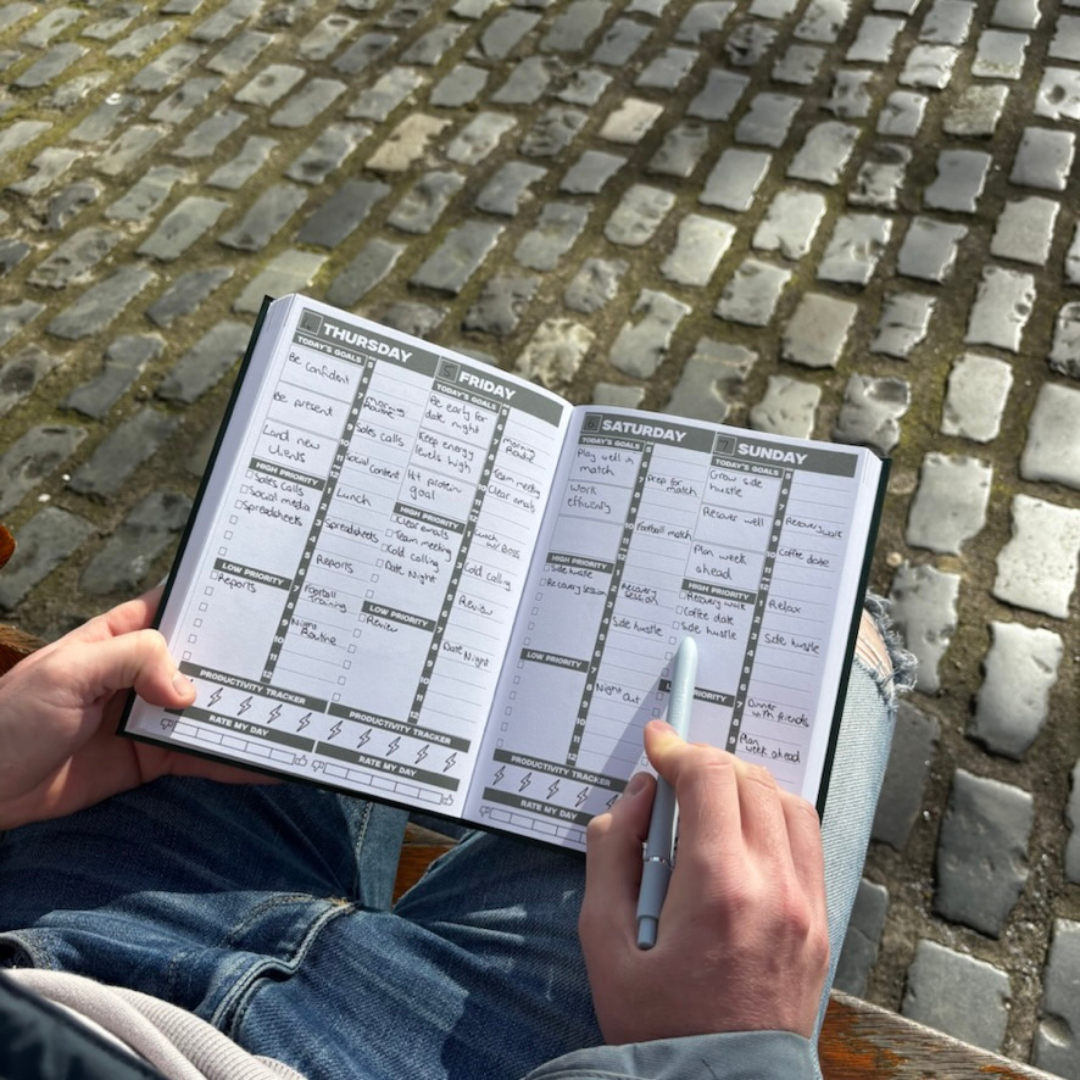
Confirm and commit, two minutes. A final glance at the Plan Your Growth undated weekly agenda to confirm the day's anchors are locked in before the first meeting or interruption arrives.
Tracking Consistency, Not Perfection
A morning routine for men should be tracked with a simple binary metric, did the core sequence happen or not, rather than a graded score attempting to measure quality each day. This matters because perfectionist tracking, rating each morning's execution on some scale, tends to produce discouragement on the inevitable off days and abandonment of the whole practice soon after. A simple checkmark for "executed" versus "skipped," logged weekly, keeps the focus on the only metric that actually matters for building the habit long-term: consistency of execution, not quality of any single morning.
Building the Routine Around a Bad Night's Sleep
A routine that only functions after a full eight hours of sleep is not a real routine, it is a best-case scenario. Build a scaled-down version for the mornings after a bad night: hydrate, five-minute plan review, straight into the hardest task, skip the extras. Having this smaller version ready in advance means a rough night does not mean skipping the routine entirely, it means running the compressed version and still getting the core benefit.
The First 90 Days Are the Hardest
Most men who abandon a morning routine do so within the first three weeks, before the sequence has become automatic enough to require minimal conscious effort. Behavioural research on habit formation generally suggests somewhere between two and three months of consistent repetition before a routine shifts from requiring deliberate willpower to running largely on autopilot. Knowing this timeline in advance matters, because the first month is expected to feel effortful. That effort is not a sign the routine is wrong for you, it is the normal, temporary cost of building any new mechanism, and it decreases substantially once the sequence becomes genuinely automatic rather than something actively decided each morning.
Making the Routine Non-Negotiable
The routine holds up long-term when it is treated as a fixed commitment rather than an optional nice-to-have. Write it into the Plan Your Growth undated weekly agenda the same way you would write in a client call, because a routine that exists only in your head competes against every other demand on your attention and usually loses within a month. A routine written down, with a specific structure and time, becomes something you execute rather than something you intend.
The Bottom Line
A morning routine for men works when it is built on mechanism instead of motivation: a protected first hour, a fixed five-step structure under 45 minutes, and a scaled-down version ready for the mornings that do not cooperate. Motivation gets you through the first two weeks. Mechanism is what makes the routine last two years. Build the structure once, execute it regardless of mood, and let the compounding effect of a controlled first hour carry the rest of the day.
Lock your morning structure into the Plan Your Growth undated weekly agenda and give it the same non-negotiable weight as every other commitment on your calendar.