Breaking Bad Habits Without Relying on Willpower Alone
Trying to break a bad habit through sheer willpower is like trying to win a tug of war using only one hand. Willpower is a real force, but it is also a limited, depletable one, and a strong, well-established habit loop will out-pull it eventually, usually on a stressful day when willpower reserves are already low. Breaking bad habits that actually stays broken requires a different mechanism entirely: understanding the loop driving the behaviour and replacing it, not simply trying to suppress it through repeated force of will.
Why the Reward Matters More Than the Routine
A common mistake in breaking bad habits is misdiagnosing what the habit is actually providing. A man trying to stop late-night snacking might assume the target is hunger, when the actual reward being sought is often stress relief or a signal that the workday is genuinely over. Attacking the wrong reward guarantees failure, because even a perfectly executed replacement routine will not satisfy a craving it was never actually aimed at. Spending real time identifying the true underlying reward, not the surface-level behaviour, before choosing a replacement is the step most attempts at breaking bad habits skip entirely, and it is usually the single reason an otherwise sensible replacement routine fails to actually stick.
Why Willpower Alone Fails So Predictably
Every habit, good or bad, runs on the same basic loop: a cue triggers a craving, the craving drives a routine, and the routine delivers a reward, which reinforces the entire loop for next time. A bad habit is not a random behaviour, it is a fully wired loop that has been reinforced dozens or hundreds of times, and trying to override it through willpower alone means fighting that entire wired loop from scratch every single time it fires, with no replacement routine to redirect the craving toward instead.
This is why willpower-only attempts at breaking bad habits tend to work for a few days and then collapse, usually during a moment of stress or fatigue when willpower is at its lowest and the old, well-worn loop is easiest to fall back into. The failure is not a character flaw. It is the predictable outcome of fighting a strong, reinforced loop with nothing but raw effort and no actual replacement mechanism in place.
Making the Bad Habit Genuinely Harder to Access
Beyond removing the immediate cue, adding real friction to the bad habit's routine itself provides another layer of defence for the moments willpower and environment design alone are not enough. If the target is excessive phone use, deleting the specific app rather than merely hiding it adds a genuine barrier, a few extra steps required to reinstall it, that buys enough time for the initial craving to pass before the old routine can execute. This friction does not need to be insurmountable, it only needs to be enough to interrupt the automatic, unthinking execution of the habit long enough for a more deliberate decision to take over instead.
The Cue Is Almost Never the Real Target
The instinct when breaking bad habits is to focus entirely on the routine itself, the actual behaviour you are trying to stop. This misses the more useful target: the cue that triggers the craving in the first place. James Clear, whose work on habit formation has become one of the most widely referenced resources on the subject, argues that the most reliable way to break a habit is making its cue invisible rather than trying to resist the craving once it has already fired. A habit of checking your phone the moment you sit down at your desk is far easier to break by physically removing the phone from the desk than by relying on willpower to resist a phone sitting directly in your line of sight.
Identify the specific cue triggering your bad habit, a location, a time of day, an emotional state, a preceding action, and change the environment around that cue directly, rather than trying to summon enough willpower to resist the craving after it has already been triggered.
Enlisting Social Accountability Deliberately
Breaking bad habits in complete isolation removes a genuinely useful lever available to most men: social accountability. Telling one specific person, not broadcasting it publicly, but naming the specific habit and the specific replacement plan to someone whose opinion genuinely matters to you, adds a layer of commitment beyond your own private willpower. This works because the discomfort of admitting a slip to another person tends to be a stronger deterrent in the moment than the abstract, private knowledge that you are only disappointing yourself. This is not about shame, it is about deliberately adding a second, external mechanism alongside the internal ones already in play.
Replacing the Routine, Not Just Removing It
Breaking bad habits by simple removal, cutting the behaviour with nothing to replace it, leaves the underlying craving completely unaddressed, and an unaddressed craving tends to find its way to some other, often equally unhelpful routine instead. A far more durable approach identifies a replacement routine that delivers a similar reward through a healthier mechanism. If the bad habit was scrolling social media to relieve boredom during a break, the replacement needs to deliver a comparable, immediate sense of relief, a short walk, a few minutes of a genuinely engaging book, rather than simply removing the phone and leaving the boredom itself completely unaddressed.
This substitution is the actual mechanism behind most successful habit change, and it deserves far more planning attention than it typically gets. A vague intention to "just stop" rarely survives the first moment the old cue fires. A specific, pre-decided replacement routine, ready before the craving hits, has a genuine chance.
Tracking the Pattern, Not Just the Outcome
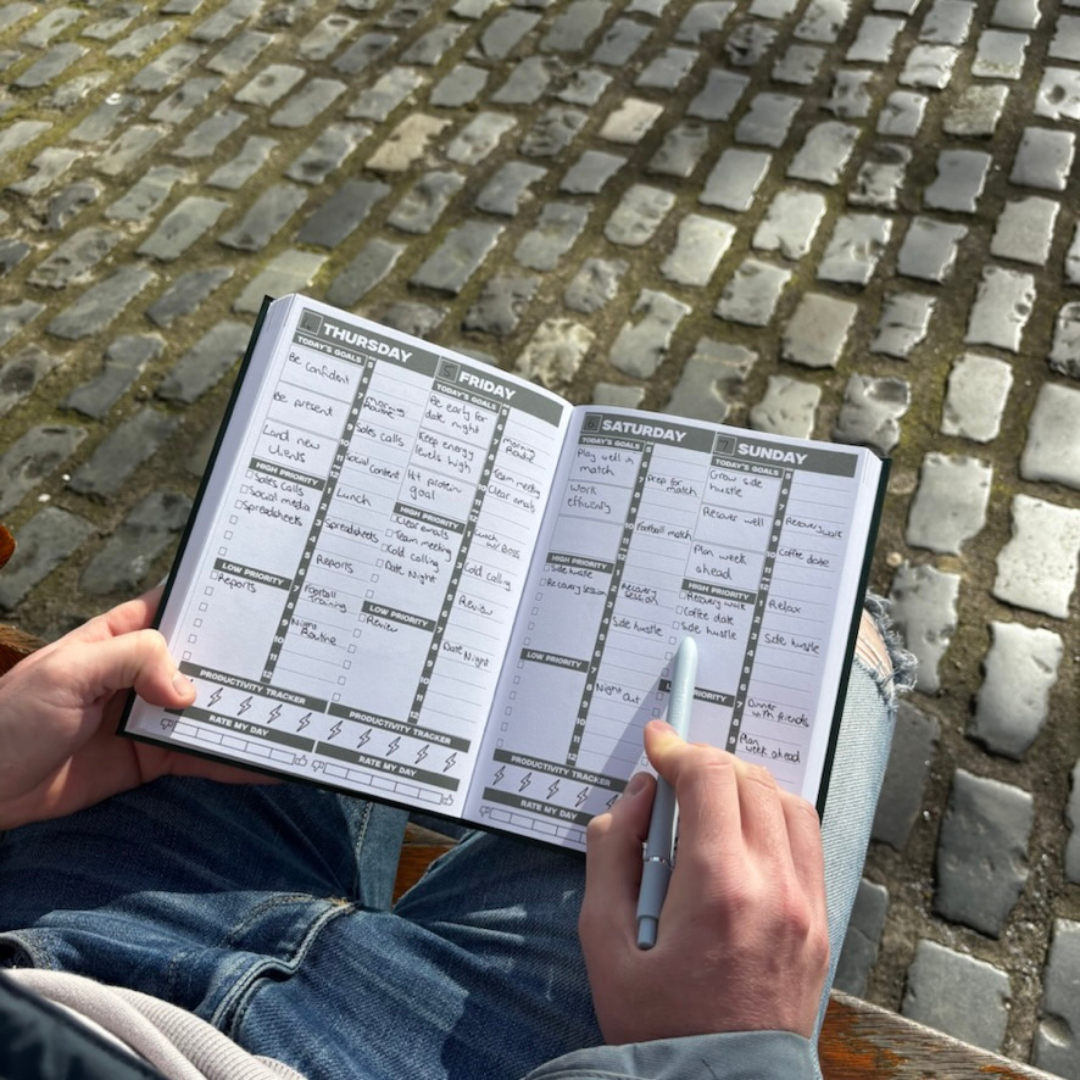
Breaking bad habits benefits enormously from tracking not just whether the bad habit happened, but the specific circumstances around each occurrence, time of day, location, emotional state beforehand. This pattern data, tracked over two or three weeks inside the Plan Your Growth undated weekly agenda, often reveals a much narrower trigger window than assumed. A habit that feels like it happens "all the time" frequently turns out to cluster around one or two specific, predictable situations, and once that pattern is visible, the environment and replacement changes can be targeted precisely at those windows rather than applied vaguely across an entire day.
Expecting Relapse and Planning for It Anyway
Nearly every man breaking a genuine habit experiences at least one relapse, a return to the old routine after a period of successfully avoiding it. Treating a single relapse as proof the whole effort has failed tends to produce a much larger collapse than the relapse itself warranted, an all-or-nothing mentality that turns one bad day into an abandoned month. The more durable response treats a relapse as expected data, not a verdict, and simply returns to the cue-elimination and replacement-routine strategy immediately the next day, without an extended period of self-punishment first.
The Bottom Line
Breaking bad habits durably requires more than willpower, it requires identifying and eliminating the cue, building a genuine replacement routine that delivers a similar reward, and tracking the actual pattern rather than fighting a vague, undefined enemy. Expect at least one relapse along the way and treat it as information, not failure. The men who successfully break long-standing habits are rarely the ones with the most willpower, they are the ones who stopped relying on willpower alone and built an actual mechanism instead.
Track your habit patterns and replacement routines directly inside the Plan Your Growth undated weekly agenda, where the data has somewhere real to accumulate week over week.