Breaking the Doomscrolling Habit Without Deleting Every App
It starts with checking one thing, then somehow forty-five minutes have disappeared into a feed that left you more anxious than informed. Breaking the doomscrolling habit does not require deleting every app or throwing your phone in a drawer for a month, extreme measures that rarely survive contact with real life anyway. It requires understanding the specific mechanism that makes scrolling feel compulsive, and building deliberate friction into exactly that mechanism instead of relying on willpower to override it every single time.
Why the Term "Doomscrolling" Undersells the Habit
The word doomscrolling specifically describes consuming negative news content compulsively, but the same underlying mechanism applies equally to any endless feed, entertainment, social comparison, sports content, regardless of whether the material itself is negative. Framing the problem only around doom-related content risks missing the broader habit, an engineered, variable-reward feed of any kind that produces the same compulsive pull and the same lingering cost to focus and mood afterward. The interventions in this piece apply equally to any endless-scroll feed, not just news, and it is worth being honest with yourself about which specific feeds actually trigger the compulsive pull in your own case, since it is rarely only the news app.
Why Doomscrolling Feels So Hard to Stop Mid-Scroll
Social media feeds are engineered using a variable reward schedule, the same underlying mechanism that makes slot machines compelling, where the next piece of content might be genuinely interesting or might be nothing, and the unpredictability itself is what keeps attention hooked rather than the content's actual value. This is not an accident or a side effect, it is a deliberate design choice built into how these platforms are engineered to maximise time spent. Understanding this mechanism matters because it reframes the problem correctly. Doomscrolling is not a personal failure of discipline against ordinary content, it is a deliberately engineered behavioural loop, and treating it as a simple willpower problem underestimates exactly what it is actually up against.
The Late-Night Version Deserves Its Own Fix
Doomscrolling in bed, right before attempting to sleep, deserves specific attention beyond the general daytime strategies, because the combination of an activating feed and the immediate proximity to sleep compounds both problems at once, a harder time falling asleep and a worse quality of whatever sleep is eventually achieved. A phone charging outside the bedroom entirely, rather than on a nightstand within reach, removes the late-night version of this habit almost completely, since the friction of physically getting up to retrieve it is usually enough to break the automatic reach that would otherwise happen without a second thought.
The Real Cost Beyond Wasted Time
The most obvious cost of doomscrolling is the time itself, but the less visible cost is often larger: a measurable increase in anxiety and a degraded ability to focus on subsequent tasks. Content engineered to trigger an emotional response, outrage, comparison, alarm, tends to leave a residue that lingers well after the scrolling session ends, affecting mood and focus on whatever comes next. This means the true cost of a forty-five minute doomscrolling session is not just the forty-five minutes lost, it includes the reduced quality of the hour or two that follows it, while the mind is still processing the emotional residue of what was just consumed.
Recognising the Emotional State That Triggers It Most
Doomscrolling rarely happens in a neutral emotional state, it tends to cluster around specific feelings, boredom, anxiety, avoidance of an unpleasant task sitting on your actual to-do list. Noticing which emotional state most reliably precedes your own scrolling sessions turns the habit from a mysterious compulsion into a more legible pattern with an identifiable trigger. If avoidance of a specific dreaded task is the real driver, the actual fix is not primarily about the phone at all, it is about addressing the avoided task directly, since the phone in this case is simply the most convenient available escape rather than the root cause of the behaviour.
Building Friction Instead of Relying on Willpower
The most effective interventions against doomscrolling do not rely on willpower in the moment, they add genuine friction to the behaviour before the craving even fires. Moving social apps off the home screen, into a folder requiring an extra step to find, adds enough friction to interrupt the automatic, unthinking reach for the phone. Logging out of an app after each use, requiring a password re-entry to get back in, adds a meaningful pause that a simple app icon tap does not. Neither of these changes requires ongoing willpower once set up, the friction does the work automatically, every single time.
Replacing the Trigger Moment, Not Just Blocking the App
Doomscrolling tends to cluster around specific trigger moments, waiting in a queue, a break between tasks, the first few minutes after waking. Simply blocking the app without addressing what fills that specific moment leaves a gap that often gets filled by an equally unproductive substitute. Identifying your own specific trigger moments and having a defined, ready alternative, a specific short article, a few minutes of a physical stretch, genuinely present observation of your surroundings, gives the moment somewhere else to go rather than leaving a vacuum the old habit will happily refill.
Scheduling Deliberate Check-In Windows
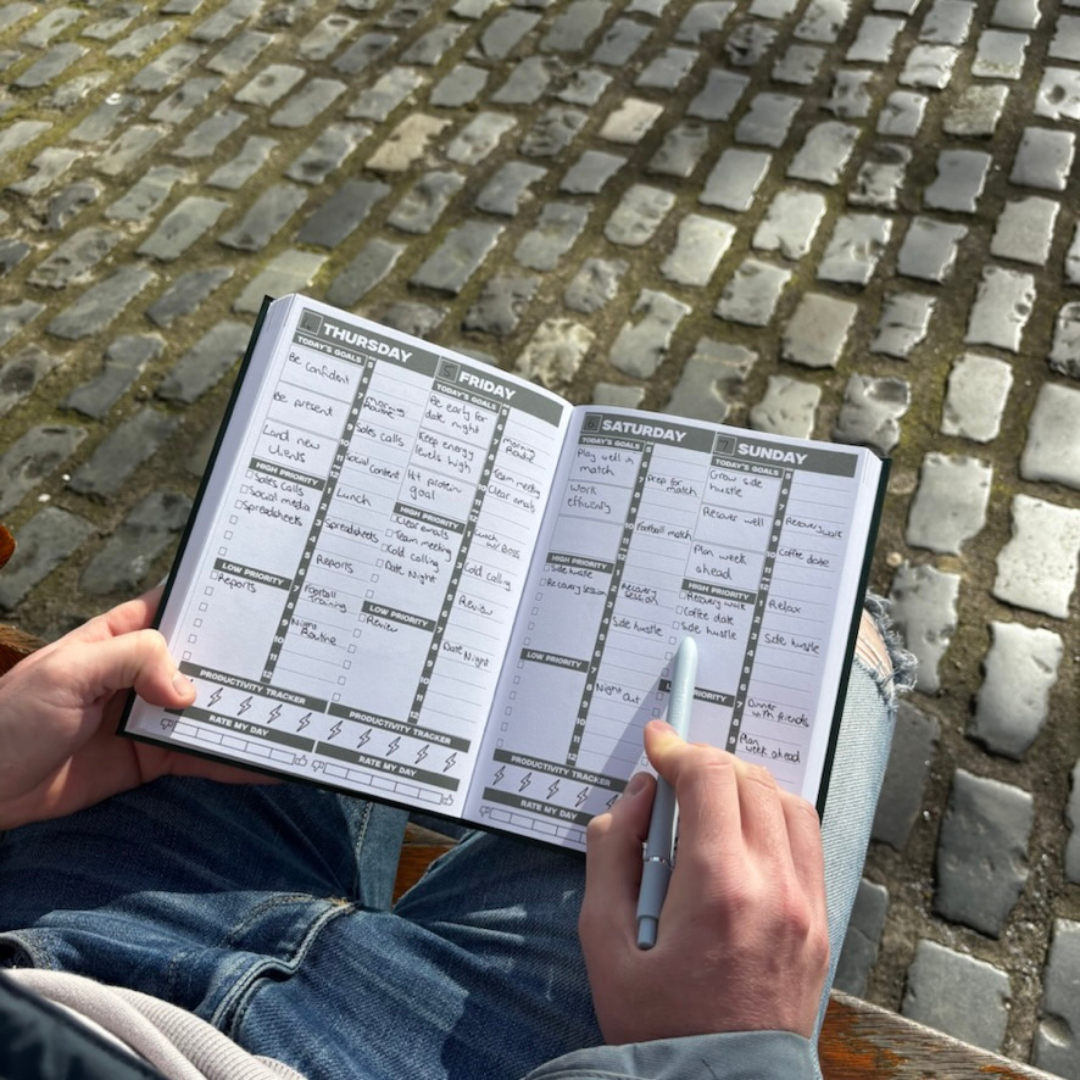
Rather than attempting total elimination, which tends to produce an eventual, larger relapse, scheduling two or three specific, time-boxed windows a day for checking social media and news, set inside the Plan Your Growth undated weekly agenda the same way any other block would be, channels the behaviour into a contained, deliberate space rather than letting it bleed unpredictably across the entire day. Nir Eyal, an author who has written extensively about attention and distraction after previously writing about the mechanics of habit-forming products, has argued that scheduled, deliberate consumption of this kind of content is generally more sustainable than an all-or-nothing prohibition, precisely because prohibition tends to produce a rebound effect once willpower inevitably runs out.
Tracking the Pattern to See the Real Scale
Most men underestimate how much time doomscrolling actually consumes until they see it measured directly, using a phone's built-in screen time tracking or a simple daily estimate logged for a week. This tracking step alone, without any other intervention, often produces a genuine behavioural shift, because the abstract sense of "a bit too much scrolling" becomes a concrete, sometimes startling number that is much harder to rationalise away.
The Bottom Line
Breaking the doomscrolling habit works through deliberate friction and scheduled, contained windows, not extreme, all-or-nothing elimination that rarely survives more than a few days. Add friction to the automatic reach for the phone, replace the specific trigger moments with a ready alternative, schedule contained check-in windows rather than prohibiting the behaviour entirely, and track the actual pattern to see the real scale of it. The goal was never a phone-free life, it was a deliberate relationship with your own attention instead of a hijacked one.
Schedule your deliberate check-in windows directly into the Plan Your Growth undated weekly agenda, and give the rest of your day back the attention it was quietly losing.