Deep Work for Men Who Cannot Protect Their Calendar
The average knowledge worker's calendar is not a planning tool anymore. It is a shared resource that anyone with access can claim, and most men never actually decided that arrangement was acceptable, it simply happened one meeting invite at a time. Deep work, the uninterrupted, high value work that actually moves your career or business forward, requires blocks of time long enough to think in. If your calendar belongs to whoever books it first, you do not have those blocks. You have fragments, and fragments do not add up to depth no matter how many of them you collect.
This is the quiet trap behind feeling busy all day and still having nothing real to show for it. Fragmented hours get filled with shallow work by default, replying, scheduling, small administrative tasks, because shallow work is the only thing that actually fits into a fifteen minute gap. The meaningful work gets pushed to whenever a long enough block finally appears, which for most men means it rarely happens at all.
Why Your Calendar Stopped Being Yours
Nobody handed their calendar over deliberately. It happened through a thousand small moments of saying yes to a meeting that felt easier to accept than to question. Researcher Cal Newport, whose work on deep work has become the reference point for this entire conversation, argues that most professional calendars drift toward shallow, reactive work by default, not because anyone chose it, but because shallow work is easier to schedule, easier to measure, and easier for other people to request than deep, protected focus time.
This drift is not neutral. Every meeting that gets accepted without question signals, to yourself and to everyone around you, that your time is available by default and needs a reason to be protected rather than a reason to be claimed. Reversing that signal is the actual work here, more than any specific scheduling trick, because the trick only holds if the underlying assumption about your availability has actually changed.
Most men do not notice this drift until the damage is already significant, a calendar so fragmented that no single day contains more than forty five minutes of unbroken time. At that point, deep work is not a scheduling adjustment. It is a full renegotiation of what your time is for, and that renegotiation has to start with you, because nobody else is going to offer it to you first.
Run a quick audit before changing anything. Look back at last week's calendar and count how many blocks of ninety uninterrupted minutes actually existed. Most men expect the number to be low and are still surprised by how low it actually is. That number is your real starting point, not the number of hours technically scheduled for deep work that never actually held.
Do this audit again in a month once the new system is running, and compare the two numbers directly. A rising count of real, uninterrupted blocks is the clearest evidence you will get that the system is actually working, far more reliable than how productive any single day happened to feel in the moment.
Blocking Time Before Anyone Else Can Claim It
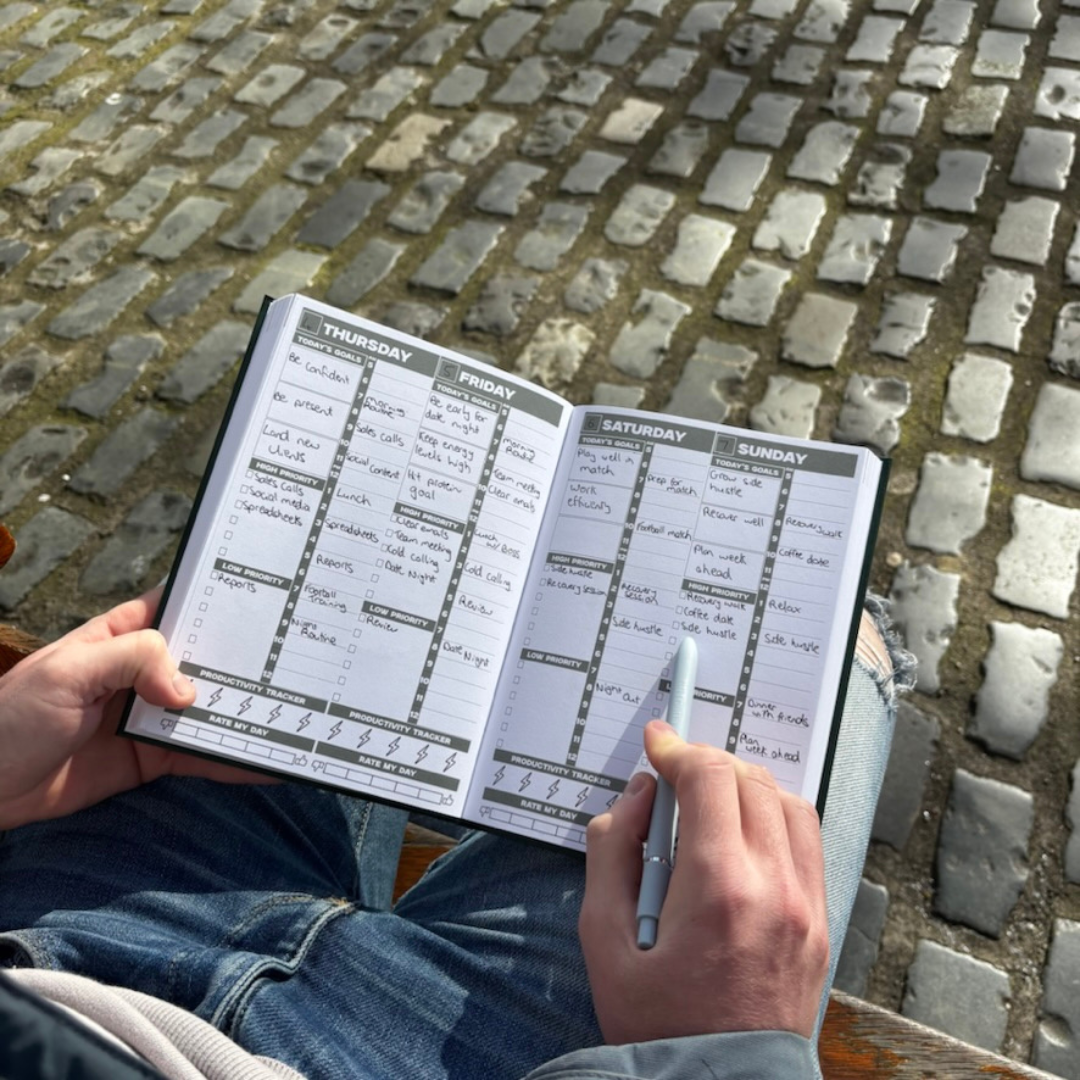
The single most effective tactic for reclaiming deep work time is blocking it before the week starts, not reacting to what is left once everyone else has already claimed their share. Open your Plan Your Growth undated weekly agenda on Sunday and block your deep work hours first, before a single meeting gets accepted for the coming week. Whoever schedules first gets the good hours. Make sure that is you.
Treat the block the same way you would treat an external meeting, because that is functionally what it is, a meeting with the work that actually matters. Do not leave it labeled vaguely as "focus time" if that label makes it easy for you or anyone else to bump it. Name the specific task. A block labeled with a real deliverable is harder to casually override than one labeled with an abstraction.
Start with blocks you can actually defend, even if that means starting smaller than you would like. Two protected ninety minute blocks a week, defended completely, build more real momentum than five blocks a week that collapse under the first scheduling conflict. Build the habit of defending the block before you try to expand how many of them you are running.
Put the block at the same time each week rather than moving it around to fit whatever else is happening. Consistency builds a reputation, both with yourself and with everyone who shares your calendar, that this specific hour is simply unavailable, the same way a standing external commitment would be. A block that moves constantly never earns that same automatic respect.
Saying No to Meetings Without Burning Relationships
Protecting deep work time inevitably means turning down meetings, and most men avoid this because they have not built a clean, low friction way to do it. The fix is not becoming unavailable. It is becoming selectively available, with a clear, repeatable response ready before the request even arrives. "I'm blocked until two, can we do three instead" is a complete sentence. It does not require justifying your calendar to someone who was never entitled to every hour of it in the first place.
Offer an alternative whenever you decline, rather than a flat no. This keeps the relationship intact while still protecting the block, and it signals that you are managing your time deliberately rather than simply avoiding the person or the topic. Most colleagues respond better to a specific reschedule than to a vague decline, because the reschedule shows the request was heard, just not immediately accommodated.
Expect some initial friction from people used to unlimited access to your time. This friction is temporary and almost always smaller than anticipated. Once a pattern of protected blocks becomes normal, most colleagues simply adjust their expectations and start scheduling around it, the same way they already schedule around anyone else's known unavailability.
If you manage other people, model this behaviour openly rather than protecting your own blocks quietly while expecting your team to stay reactive to anything that lands in their inbox. A team that watches its manager defend focus time without apology tends to adopt the same standard for itself far faster than one that only hears about the value of deep work in a meeting about productivity.
Designing Your Environment to Support the Block
A protected hour on the calendar does nothing if your phone, your open inbox tab, and your office door conspire against it the moment the block starts. Attention researcher Gloria Mark at UC Irvine, whose work tracks how digital environments fragment focus, has found that a single notification can derail concentration for over twenty minutes, far longer than the interruption itself ever takes. Deep work blocks need an environment that physically removes those triggers, not just a calendar entry asking for restraint.
Close every application not directly required for the task before the block starts, not during it. Put your phone in a different room, not simply on silent on the desk, since visibility alone has been shown to pull attention even without a single notification firing. These adjustments feel excessive until you notice how much of your supposed focus time was actually being quietly leaked to a phone sitting face up six inches from your hand.
Tell the people physically around you, at home or in an office, that the block is happening and what it means for interruptions during that window. A closed door means nothing if everyone around you has never been told what it signals. A brief, direct heads up removes the ambiguity and makes the boundary something other people can actually respect rather than accidentally violate.
Consider a visible signal in addition to a verbal one, headphones on, a specific light, a sign on the door, whatever fits your actual environment. A consistent visible cue reduces the number of times you have to repeat the explanation verbally, and it trains the people around you to recognise and respect the signal automatically over time.
What to Do When the Block Gets Interrupted Anyway
No system holds up perfectly against every emergency, and deep work blocks will occasionally get broken by something genuinely urgent. The mistake most men make is treating one broken block as proof the entire system does not work for their particular job or life, when a single interruption is simply the cost of operating in a real environment with real obligations.
Build a short recovery protocol rather than abandoning the block entirely once it has been interrupted. Note exactly where you stopped before dealing with the interruption, so returning to the work does not require rebuilding the entire mental model from scratch. A specific note, even one sentence, cuts the re-entry cost dramatically compared to trying to simply remember where your head was twenty minutes earlier.
Review interruptions during your weekly check in rather than reacting to each one individually in the moment. If the same type of interruption keeps breaking the same block week after week, that is a pattern worth solving structurally, moving the block, changing the notification settings, having a direct conversation with whoever keeps causing it, rather than something to just keep absorbing indefinitely as the cost of doing business.
Separate genuine emergencies from things that merely feel urgent in the moment they arrive. Most interruptions marked urgent could have waited two hours with no real consequence. Building a habit of asking that question before breaking the block, even silently to yourself, filters out a large share of the interruptions that would otherwise feel unavoidable.
The Bottom Line
Deep work does not require a quieter job or a more understanding boss. It requires a calendar you actually control, blocked before anyone else can claim it, defended with a clear and repeatable response, and supported by an environment that removes the obvious interruptions before they start. Your calendar became shared property one meeting at a time. It becomes yours again the same way, one protected block at a time, defended consistently enough that the new pattern becomes the expected one rather than the exception you have to keep explaining.
Start this week. Open your Plan Your Growth undated weekly agenda, block your deep work hours before anything else gets scheduled, and treat that block with the same seriousness you would give any meeting you did not want to miss. The calendar will not protect itself. That part is still on you.