Deep Work: How to Reclaim Your Focus in a Distracted World
Your day isn't crowded. Your attention is. The average knowledge worker switches tasks every 47 seconds and loses roughly 23 minutes to fully refocus after each interruption, according to research from Gloria Mark at UC Irvine. Deep work is not a productivity trend. It is the deliberate practice of protecting a rare and shrinking resource: the ability to concentrate on demanding work without distraction, long enough to produce something that actually matters. If you have not built a real deep work practice, the problem is not your schedule. It is that nothing in your day is currently protecting your attention from everything competing for it.
What Deep Work Actually Means
Georgetown professor Cal Newport, who coined the term, defines deep work as professional activities performed in a state of distraction-free concentration that push your cognitive capacity to its limit. Its opposite, shallow work, is the logistical noise that fills most careers: email, status updates, quick replies, low-stakes tasks performed while half-distracted. Shallow work feels productive because it produces a constant stream of small completions. Deep work is what actually moves your career, your business, or your goals forward, and it is precisely the kind of work most men's days no longer make room for.
The distinction matters because these two modes of work are not interchangeable. You cannot do deep work in fifteen-minute fragments between meetings. The cognitive cost of switching in and out of focus, known as attention residue, means a fragmented hour produces a fraction of the output of one unbroken hour. This is why the man who "worked all day" and produced almost nothing of substance is not lazy. He is fragmented, and fragmentation is a scheduling failure, not a character flaw.
Why Deep Work Is Getting Rarer, and More Valuable
Every tool built into modern work is optimized to interrupt you. Notifications, open-plan offices, instant messaging that expects an instant reply. The default environment of most careers is engineered against sustained focus, which means the ability to resist that engineering and actually concentrate has become a genuine competitive advantage, not just a personal preference.
This creates a specific opportunity. If deep work is rare because most people cannot resist the interruption economy, then the man who builds a real practice around it produces output that is disproportionately valuable, simply because so few of his peers are producing at that level of focus anymore. This is not a mindset claim. It is a straightforward consequence of scarcity: the skill that is hardest to maintain in a distracted environment is the skill that separates the top output from the average.
Building a Deep Work Block Into Your Week
Start by choosing a fixed time, not a "whenever I get to it" approach. Deep work that depends on finding a spare moment never happens, because a spare moment never survives contact with an open inbox. Block ninety minutes to three hours, depending on what your schedule realistically allows, at the time of day your energy and focus are naturally highest. For most men that is the first two to three hours after they are fully alert, well before the accumulated decisions of the day have worn down their willpower.
Protect the block the way you would protect an important meeting. Phone in another room, not just on silent. Notifications off, not just muted. Door closed if you have one, headphones on if you don't. The goal is to remove every low-friction path back to distraction, because willpower alone consistently loses to a phone sitting within arm's reach.
Start with one deep work block a day and hold it for two weeks before adding a second. Most men who fail at this try to convert their entire day to deep work immediately, burn out on the intensity within a week, and abandon the practice entirely. A single protected block, held consistently, builds the underlying stamina for longer or additional sessions later.
What to Actually Put Inside a Deep Work Block
Not every task belongs in a deep work session. Reserve the block for work that genuinely requires sustained, undistracted thought: writing, strategy, analysis, problem-solving, anything where the quality of the output depends on the depth of your concentration, not just the completion of a task. Email, scheduling, and quick replies do not belong here even if they feel urgent. They belong in a separate, batched shallow work block.
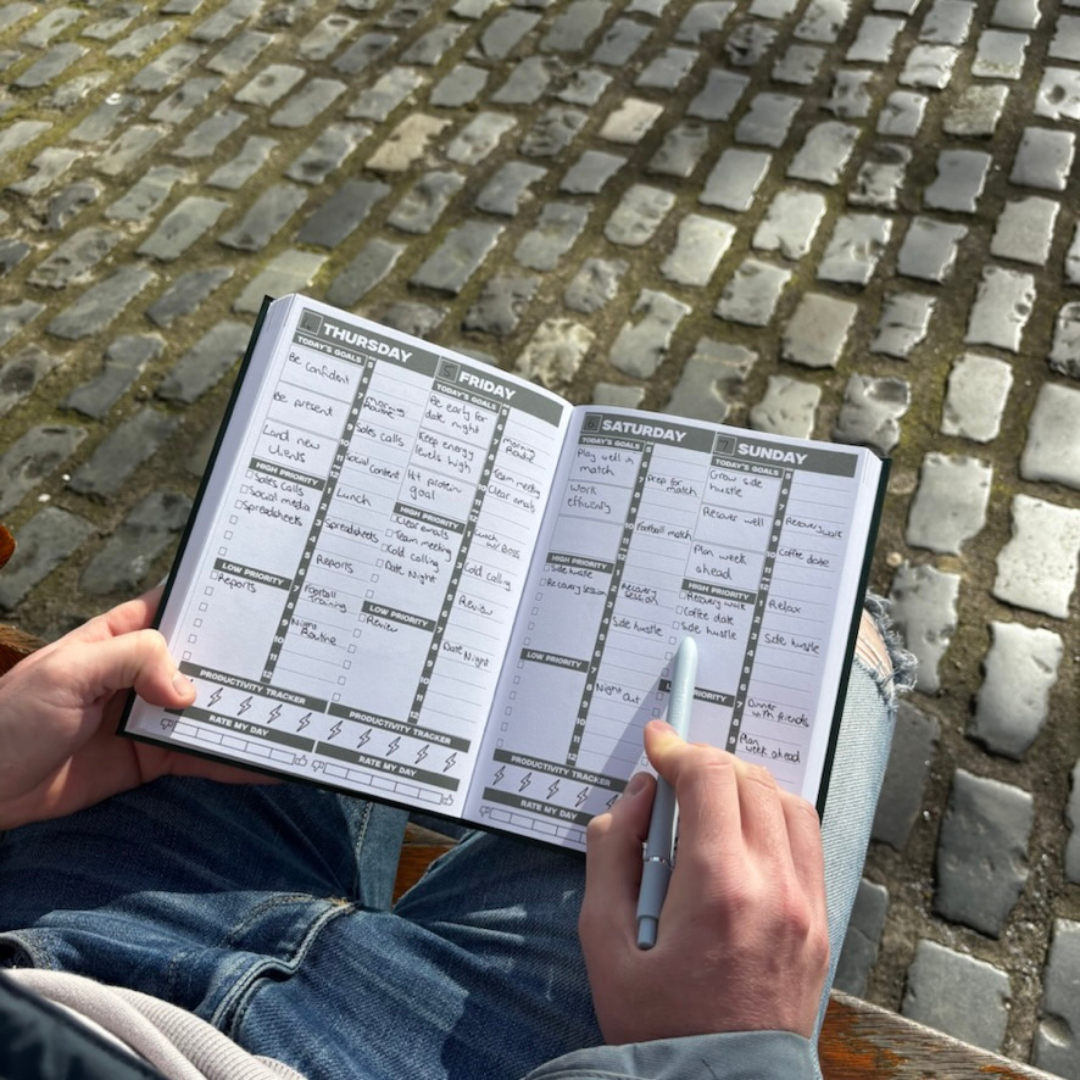
Before the block starts, know exactly what you are working on. Walking into deep work time without a clear target wastes the first ten to fifteen minutes deciding what to do, which defeats the purpose. This is where a weekly plan earns its keep: if you have already identified your priority tasks for the week using something like the Plan Your Growth undated weekly agenda, you walk into every deep work block already knowing the target, and the full ninety minutes goes toward execution instead of orientation.
Recovering the Skill If You Have Lost It
Most men who have spent years in a fragmented work environment find that deep focus, when they first try to rebuild it, feels genuinely uncomfortable. The mind wanders within minutes. The pull to check a phone that isn't even present feels physical. This is not a sign the practice isn't working. It is the expected symptom of a focus muscle that has atrophied from years of constant task-switching.
Rebuild it the way you would rebuild physical strength: gradually, with progressive overload. Start with twenty-five to thirty minutes of genuinely protected focus, not the full ninety, if that is what you can currently sustain. Add five to ten minutes every few sessions as your tolerance improves. Trying to jump straight to a three-hour deep work block after years of fragmented attention is the equivalent of attempting a max deadlift on your first day back in a gym. The capacity has to be rebuilt in stages.
Measuring Whether It's Working
Track your deep work sessions the same way you would track a workout: date, duration, what you produced. Over a few weeks, a clear pattern emerges. You will start to see your actual output from protected focus time against your output from a comparable stretch of fragmented, interrupted time, and the gap is usually far larger than most men expect before they measure it directly. This tracking does not need a complicated app. A simple daily log inside a weekly planner, noted alongside your other habits, is enough to see the trend.
Deep Work in a Role That Doesn't Seem to Allow It
Some roles genuinely have less flexibility for a protected ninety-minute block, particularly customer-facing or highly reactive positions. The fix is not abandoning deep work but shrinking the window and defending it more aggressively. Even a protected twenty-five to thirty-minute block, taken at the same time daily, produces a measurable gain over zero deep work at all, and it is far more achievable to defend twenty-five minutes in a chaotic role than to defend ninety.
The other option worth considering is claiming a deep work window at the edges of the day rather than the middle: early morning before the reactive demands of the role start, or a protected block negotiated explicitly with a manager or team as a standing exception. Framing it as a specific, bounded exception, "I am unreachable from 7 to 8am, reachable immediately after," tends to succeed more often than an open-ended request for general flexibility, because it gives colleagues and managers a concrete, predictable boundary to plan around instead of an ambiguous one to push against.
What Deep Work Feels Like When It's Actually Working
It's worth naming the signal so you know what you're aiming for. Genuine deep work rarely feels effortless in the moment, particularly in the first ten to fifteen minutes, when the pull toward distraction is strongest before focus settles. What it does feel like, consistently, once the session ends, is a specific kind of tiredness that is different from the scattered exhaustion of a day spent context-switching: a used, productive fatigue that comes with a clear sense of what actually got produced. If a session ends and you cannot clearly name what you built, wrote, or solved, that is a signal the session drifted into shallow work despite being scheduled as deep, and it's worth reviewing what pulled focus away.
Ending a Session Well
How a deep work session ends matters almost as much as how it starts. Stopping mid-thought, rather than at a natural pause point, tends to leave a lingering mental loop that follows you into the next task and quietly drains focus from whatever comes after. Where possible, plan to stop a few minutes before a natural breakpoint, jot a one-line note on exactly where to pick back up next session, and close the work deliberately rather than letting an external interruption end it for you. This small habit compounds: a session that ends cleanly makes the next session's first few minutes faster, because you are resuming a clearly marked thread instead of reconstructing where you left off from scratch.
The Compounding Value Over a Career
A single deep work session produces a modest, sometimes unremarkable output. The real case for building this practice is the multi-year compounding effect. A man who protects even one genuine deep work block a day accumulates roughly 250 hours of true focused output a year that his peers, running entirely on fragmented attention, simply never bank. Over a five or ten-year career, that gap does not stay modest. It becomes the difference between a body of work that stands out and one that quietly blends into the background of everyone else's scattered, interrupted effort.
A Simple Way to Start This Week
If none of this feels achievable yet, ignore the full framework for now and commit to one thing: twenty-five minutes, phone in another room, one clear task, tomorrow morning before anything else. Do it for five consecutive days before judging whether the broader system is worth building out further. Most men overthink the starting point when the actual barrier is simply beginning at a scale small enough to sustain.
The Bottom Line
Deep work is a trainable skill, not a personality trait, and it has become one of the rarest and most valuable capabilities in a work environment engineered against it. Block a fixed time for it every day, protect that block the way you would protect a client meeting, start with a duration you can actually sustain, and track your output over a few weeks to see the real gap between focused and fragmented time. The men who build this practice consistently outperform not because they are smarter, but because they are simply producing at a level of concentration almost nobody else is still capable of.
The Plan Your Growth undated weekly agenda gives you the weekly structure to identify your priority tasks before the week starts, so every deep work block you protect goes straight to execution instead of decision-making. No printed dates, no wasted pages, just a system built to get your best hours pointed at your most important work, every single week.