Deep Work Techniques for Men Who Can't Seem to Focus
Most men have never actually experienced deep work, not because they lack discipline, but because they have never built an environment where it was possible. The modern workday is engineered against focus: constant notifications, open-plan offices, a Slack channel that never stops, an inbox treated as an emergency line. Deep work techniques are not about trying harder to concentrate inside that environment. They are about restructuring the environment itself, because willpower alone loses to a well-designed distraction every time.
Why Focus Feels Impossible by Default
Attention is not a fixed trait, it is a resource that gets depleted by every switch between tasks. Gloria Mark, a researcher at UC Irvine who has spent decades studying attention and digital interruption, has documented that the average knowledge worker's attention on a single screen lasts under a minute before switching, and that recovering full focus after even a brief interruption takes far longer than the interruption itself. This means an environment full of small interruptions, a notification here, a quick Slack check there, is not a minor inconvenience. It is actively preventing deep work from ever occurring, no matter how disciplined the person attempting it.
Deep work techniques start from this understanding. The problem is rarely willpower. It is an environment that makes sustained focus structurally impossible, and no amount of discipline fixes a structural problem.
The Economics of Rare, Valuable Focus
Newport's core argument extends beyond personal productivity into a broader economic point: as the ability to focus without distraction becomes rarer across the workforce, the men who retain it produce output that is disproportionately valuable, not incrementally better but categorically different from output produced in a fragmented, interrupted state. This is worth internalising because it reframes deep work techniques from a personal wellness practice into a competitive skill. Two men with identical raw ability, one who has built the capacity for sustained, uninterrupted focus and one who has not, will produce measurably different outcomes over a career, not because of talent, but because one of them has trained a capacity the other never developed.
Building the Environment Before the Habit
Before attempting a longer focus block, remove the obvious interruption sources entirely, not just silenced, removed. Phone in another room, not face down on the desk, because visibility alone reduces available cognitive capacity even without a single notification firing. Close every browser tab unrelated to the task. If the work allows it, a closed door or a clear, communicated signal that this block is not available for interruption.
This environmental setup takes two minutes and does more for focus than any mindset shift, because it removes the decision to resist temptation entirely. You cannot check a phone that is not in the room. Willpower spent avoiding a visible phone is willpower not spent on the actual work.
Ritualising the Start of a Deep Work Block
The transition into deep focus is often the hardest part of the entire practice, harder than the sustained work itself once it actually begins. Building a short, consistent ritual to mark the start of every deep work session, the same drink, the same seat, the same first two minutes reviewing exactly what the block is for, trains the brain to associate that specific sequence with an immediate shift into focus mode. Over weeks of repetition, this ritual shortens the warm-up time considerably, because the environment cue itself starts doing part of the work that used to require conscious effort every single time.
Starting With Shorter Blocks Than You Think You Need
The common mistake with deep work techniques is starting with an ambitious four-hour block and abandoning the practice within a week when it proves unsustainable. Attention is a trained capacity, not a switch you flip on. Start with 45 to 60 minutes of genuinely protected focus, and build from there only once that duration is consistently achievable without the mind wandering toward the phone in the other room.
A single, well-executed 45-minute deep work block produces more usable output than three hours of work interrupted every ten minutes by a notification, because the cost is not just the interruption itself, it is the 20-plus minutes of refocusing required after each one. Four interruptions in an hour can consume the entire hour in refocusing costs alone, leaving almost nothing left for the actual task.
Measuring Output, Not Hours Logged
A common mistake in evaluating deep work techniques is measuring success by hours spent at the desk rather than actual output produced. A man can log eight hours of "work" and produce almost nothing of real value if most of that time was fragmented, while another man logs three genuinely protected hours and ships something substantial. Tracking actual output, pages written, problems solved, decisions made, rather than time logged, is the honest metric that reveals whether deep work techniques are actually working. This shift in measurement alone often exposes just how little genuine output a fragmented eight-hour day was actually producing.
Sequencing Deep Work Around Your Energy
Deep work techniques work best scheduled during your highest cognitive energy window, which for most people falls within the first few hours after waking, before decision fatigue and accumulated interruptions have worn down the day's mental reserves. Scheduling deep work for late afternoon, after a full day of meetings and smaller decisions, sets the practice up to fail before it starts, not because the technique is flawed but because the fuel required for it has already been spent elsewhere.
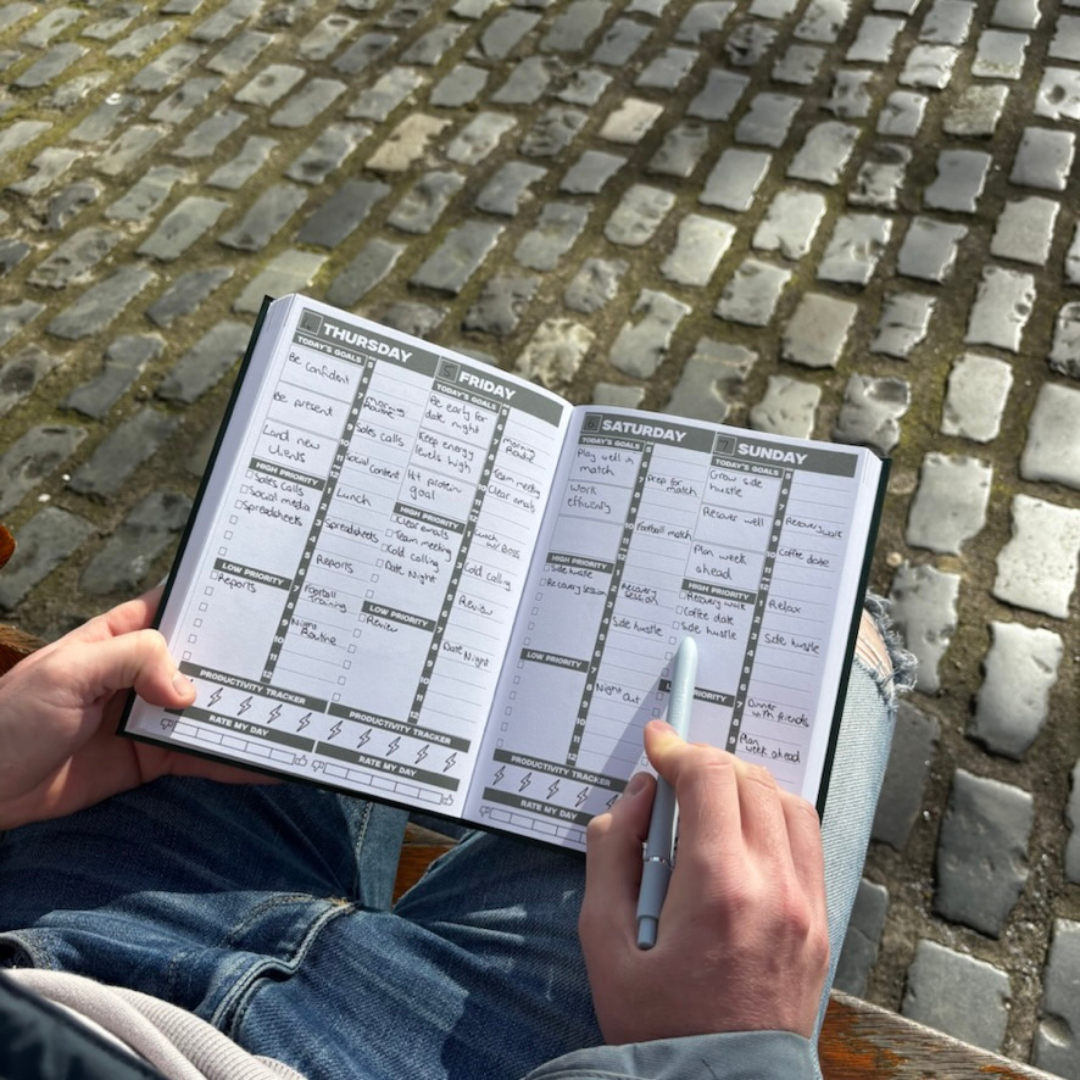
This is where the Plan Your Growth undated weekly agenda earns its place, giving you a dedicated place to block deep work into your highest-energy hours deliberately, rather than letting it get squeezed into whatever time survives after every meeting has claimed its slot.
Balancing Deep Work With Genuine Rest
Deep work is cognitively demanding in a way that requires real recovery, not just between sessions but across the day and the week. Scheduling four or five deep work blocks back to back without any recovery time between them tends to degrade the quality of the later blocks significantly, even if the hours are technically protected from interruption. One or two well-executed deep work blocks a day, separated by genuine breaks, produces more sustainable output over months than an aggressive schedule that burns out the capacity for focus within a few weeks of overuse.
Handling the Pull Toward Distraction Mid-Block
Even in a well-designed environment, the pull toward checking something will show up, usually within the first fifteen minutes. This is not a sign the technique has failed. It is a normal part of attention training. The move is to note the urge without acting on it, a specific phrase works well: "not now, noted," and return attention to the task. Keeping a small notepad beside you for these stray thoughts, quick capture without switching tasks, prevents the mental effort of trying to hold onto an idea while also trying to stay focused on the current one.
Over repeated sessions, the frequency and intensity of this pull decreases measurably. This is trainable. Most men who claim they "can't focus" have simply never given the skill enough consistent repetition to develop, because every attempt got abandoned within the first few distracted minutes.
Recovering When a Block Gets Interrupted Anyway
Some interruptions are unavoidable, a genuine emergency, a call that has to be taken. When this happens, do not attempt to resume the same block immediately. Take two minutes to fully close out the interruption, then restart with a brief re-orientation: what was I doing, where did I leave off. Jumping straight back in without this brief reset tends to produce a lower-quality remainder of the block, because the mind is still partially occupied with whatever just interrupted it.
The Bottom Line
Deep work techniques succeed or fail based on environment, not willpower. Remove the phone from the room, start with shorter blocks than feels sufficient, schedule the block during your highest energy hours, and treat the pull toward distraction as a normal, trainable part of the process rather than a personal failure. Focus is a capacity you build through repetition, not a trait you either have or lack. Most men have simply never given it the conditions to develop.
Block your next deep work session into the Plan Your Growth undated weekly agenda, and give it the same non-negotiable status you would give a client call. The work that actually moves the needle deserves the same protection.