The Eisenhower Matrix: How to Stop Confusing Urgent With Important
Dwight Eisenhower, who led Allied forces in World War II and later served two terms as US president, is credited with a line that cuts straight to the heart of most men's productivity problem: what is important is seldom urgent, and what is urgent is seldom important. Almost every man who feels constantly busy but rarely advances his actual goals is suffering from exactly this confusion. He is spending his best hours on the urgent, and his important work, the work that actually compounds into a different life, sits untouched at the bottom of an ever-growing list. The Eisenhower Matrix exists to fix that confusion permanently.
What Urgent and Important Actually Mean
Urgent means a task demands immediate attention. A ringing phone, an email marked high priority, a deadline today. Urgency is loud. It creates a physiological sense of pressure that feels like it must be responded to right now.
Important means a task moves you meaningfully toward a goal that matters to your life, your business, or your health. Importance is quiet. It does not announce itself with a deadline or a notification. The gym session that builds the body you want in five years does not ping your phone. The strategic planning session that determines whether your business survives the next two years does not feel urgent on a random Tuesday.
The trap is that urgent and unimportant tasks feel productive in the moment, because completing them produces a small dopamine hit and the appearance of progress. Important and non-urgent tasks feel like they can always wait, because nothing forces them into today. Left unmanaged, this dynamic guarantees that important work gets perpetually deferred in favour of whatever is loudest.
The Four Quadrants
The Eisenhower Matrix sorts every task into one of four quadrants based on two axes: urgent versus not urgent, and important versus not important.
Quadrant 1 is urgent and important. Crises, deadlines today, problems that will cause real damage if ignored. This quadrant needs to exist, but a man who lives here constantly is not managing his time, he is managing a permanent fire. The goal is to shrink this quadrant over time, not to get faster at fighting fires inside it.
Quadrant 2 is important but not urgent. This is where the actual life-changing work lives: strategic planning, skill building, relationship investment, health maintenance, the deep work that compounds. Nothing in this quadrant demands your attention today, which is exactly why it gets ignored by default. The entire purpose of the matrix is to force deliberate, scheduled attention onto this quadrant before it becomes a Quadrant 1 crisis.
Quadrant 3 is urgent but not important. Most interruptions live here: a colleague's request that could have waited, a notification, a low-stakes email marked urgent by someone else's poor prioritisation. This quadrant disguises itself as Quadrant 1 because it shares the urgency, but it lacks the actual importance. Learning to recognise the difference is the single biggest skill the matrix teaches.
Quadrant 4 is neither urgent nor important. Mindless scrolling, low-value busywork, tasks that exist mostly to feel productive without producing anything. This quadrant should be cut aggressively, not managed.
How to Actually Sort Your Tasks
At the start of each week, take your full task list and run every item through both questions: does this have a real deadline or consequence attached (urgent), and does this move something that genuinely matters forward (important). Be honest, particularly about Quadrant 3. Most men dramatically overestimate how many of their tasks are truly Quadrant 1, because urgency feels the same whether it is self-imposed, externally imposed, or manufactured by someone else's poor planning.
A useful diagnostic: if a task disappeared entirely without you doing it, would anything meaningfully bad happen within a week. If the honest answer is no, it was never Quadrant 1, no matter how urgent it felt.
Quadrant 2 items, once identified, get scheduled directly onto your calendar at a specific time, not added to a someday list. This is the critical mechanical step that most time management advice skips. A Quadrant 2 task on a list competes against every Quadrant 3 interruption that shows up that day and loses every time, because Quadrant 3 has the unfair advantage of feeling urgent. A Quadrant 2 task with a calendar block has equal footing.
Why Quadrant 2 Is Where Your Real Future Gets Built
Stephen Covey, who popularised the Eisenhower Matrix in his work on effectiveness, argued that the central discipline of highly effective people is protecting Quadrant 2 time against the constant pressure of Quadrant 3 demands. This is not a minor point. It is the entire argument. Quadrant 1 keeps you alive. Quadrant 2 is what actually changes your trajectory.
Consider what lives in Quadrant 2 for most ambitious men: strength training, strategic business planning, deep relationship investment, skill development, financial planning, sleep. None of these will ever generate a deadline. None of them will ever feel urgent on any given day. And yet five years from now, the difference between the man who protected this quadrant and the man who let Quadrant 3 eat his entire week will be enormous and completely visible.
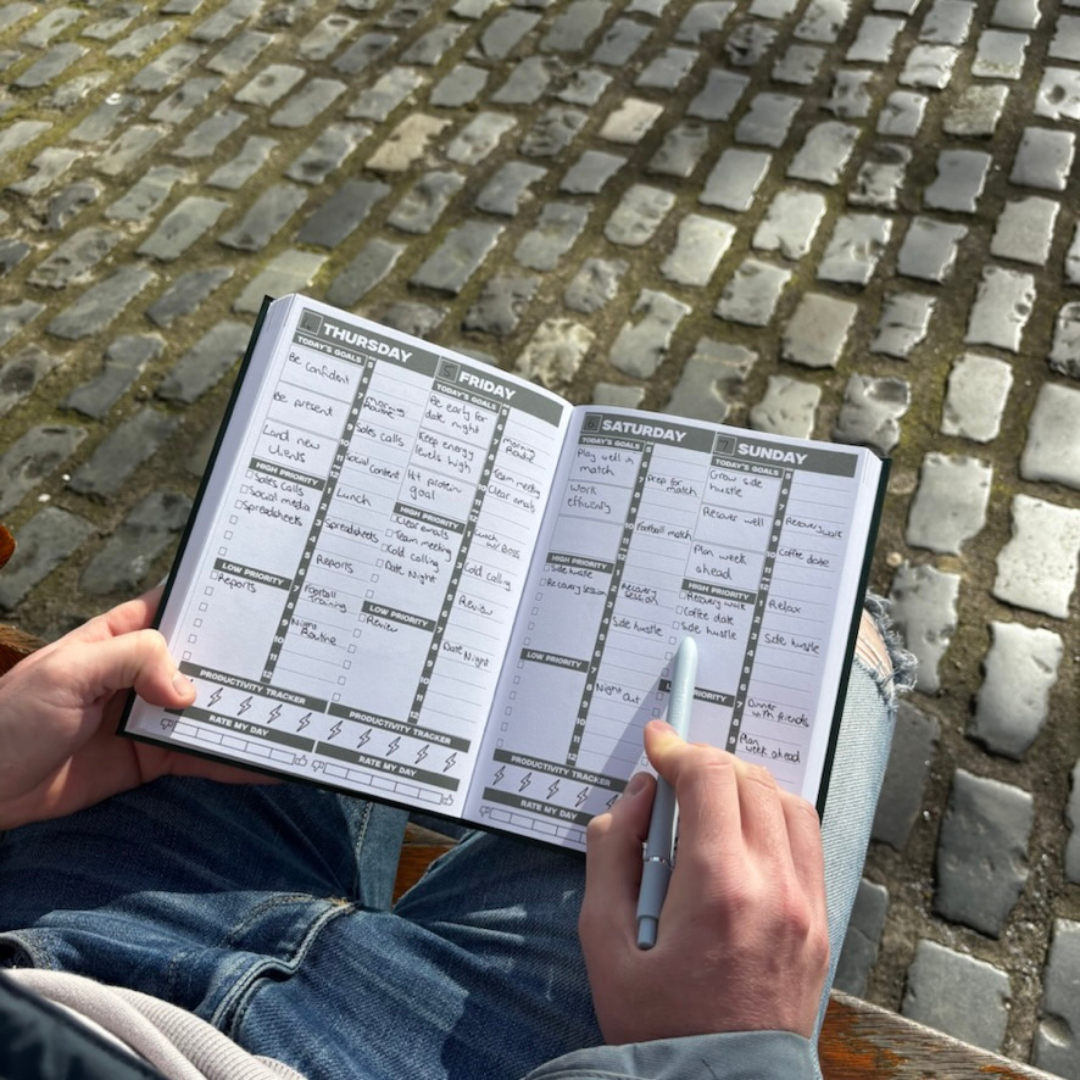
This is also where systematic planning earns its keep. Using the Plan Your Growth undated weekly agenda to block out Quadrant 2 time at the start of every week, before the inevitable Quadrant 3 noise arrives, is the practical mechanism that turns this theory into actual weekly behaviour. A Quadrant 2 priority that exists only as an intention loses to a ringing phone every single time.
Defending Quadrant 2 Against Quadrant 3 Pressure
Knowing the framework does not automatically protect your time. Quadrant 3 pressure is relentless precisely because it borrows urgency's emotional weight. The fix is structural, not willpower-based.
First, build a delay reflex for anything that feels urgent but has not yet been verified as important. A two-minute pause before responding to most "urgent" requests reveals that the large majority can wait an hour, a day, or sometimes indefinitely.
Second, set explicit boundaries around when you check inputs that generate Quadrant 3 noise: email, messages, notifications. Checking constantly guarantees a constant stream of manufactured urgency. Checking at two or three set windows a day breaks that stream into something manageable.
Third, treat your Quadrant 2 calendar blocks with the same seriousness you would give an external meeting. If a Quadrant 3 request arrives during a scheduled Quadrant 2 block, the default answer is that it waits until the block ends, the same way you would not interrupt a client meeting for a low-stakes internal question.
The Bottom Line
The Eisenhower Matrix exists to break the confusion between what is loud and what actually matters. Urgent and important tasks need handling, but a life spent entirely in that quadrant is a life in permanent crisis mode. The real leverage sits in Quadrant 2: important, never urgent, and easy to defer indefinitely unless you build a structure that protects it. Sort your tasks honestly, schedule Quadrant 2 work directly onto your calendar, and build the discipline to defend that time against the constant pull of manufactured urgency.
The Plan Your Growth undated weekly agenda gives Quadrant 2 priorities a fixed place in your week before the noise of the day has a chance to crowd them out. Protect the quiet work. It is the only work that compounds.