Environment Design: The Discipline Hack Nobody Talks About
The most disciplined men you know are not winning more willpower battles than you. They have arranged their environment so that fewer willpower battles need to be fought in the first place. This is the core insight behind environment design, and it is consistently underrated compared to motivational advice because it is less exciting to talk about. Nobody writes an inspiring quote about moving the biscuit tin to a different cupboard. But moving the biscuit tin to a different cupboard, repeated across every domain of your life, produces more behaviour change than nearly any amount of willpower training.
Why Willpower Is the Wrong Tool for Most Discipline Problems
Willpower is a depleting resource across a day, not a fixed trait some men have more of. Every decision you make, every temptation you resist, draws down the same limited reserve. By evening, a man who has spent his willpower resisting a dozen small temptations throughout the day has very little left for the temptation that actually matters at 9pm.
This means that a strategy built entirely on willpower is structurally guaranteed to fail eventually, not because the man is weak but because the resource itself is finite and depletes predictably. The fix is not to find more willpower. It is to reduce the number of willpower-dependent decisions your environment forces on you in the first place.
Environment design works by changing the default. If the path of least resistance in your environment leads to the behaviour you want, you do not need willpower to choose it, because it is already the easiest option. If the path of least resistance leads to the behaviour you do not want, you are fighting an uphill battle against your own space every single day, regardless of how disciplined you are.
The Two Levers of Environment Design
There are exactly two moves available in environment design: increase the friction on behaviours you want less of, and decrease the friction on behaviours you want more of. Almost every practical application reduces to one of these two moves.
Increasing friction means making the unwanted behaviour slightly harder to access. Logging out of social media apps after every session, rather than staying perpetually logged in, adds a small friction cost that is often enough to break the automatic reach for the phone. Keeping junk food out of the house entirely, rather than relying on willpower at 10pm, removes the option before the moment of temptation arrives.
Decreasing friction means making the wanted behaviour slightly easier to access. Sleeping in gym clothes the night before an early workout removes one small decision point that, multiplied across dozens of mornings, has derailed plenty of good intentions. Keeping a notebook and pen on the desk rather than in a drawer means the habit of writing down the day's priorities happens because it is the path of least resistance, not because you remembered to be disciplined about it.
How to Audit Your Own Environment
Most men have never actually looked at their physical and digital environment as a deliberate system. The audit is straightforward: walk through a normal day and note every point where your environment either supports or undermines a behaviour you are trying to build or break.
Start with your phone, since it is the single biggest source of friction-reduction toward behaviours most ambitious men are actively trying to reduce. What is on your home screen. What notifications are enabled. Is the phone in the room while you work, sleep, or eat. Each of these is a friction setting you control, and most men have never deliberately set them.
Move to your physical workspace. What is visible from your desk. A cluttered desk with a dozen visible objects competing for attention creates friction against the one task you are trying to focus on. A desk with only the current task's materials visible removes that friction entirely.
Check your kitchen, your gym bag, your car. Each of these spaces either makes a wanted behaviour the easy default or makes an unwanted behaviour the easy default. There is rarely a neutral setting. Every environment is already designed, whether you designed it deliberately or it accumulated by accident.
Applying Environment Design to a Daily Planning Habit
A concrete example makes this practical. Most men who want to build a consistent daily planning habit fail not because they lack discipline but because their environment never supports the habit becoming automatic. The notebook is in a drawer. The to-do app requires three taps to open. The habit depends entirely on remembering and choosing it fresh, every single day, which is exactly the kind of willpower-dependent design that fails over time.
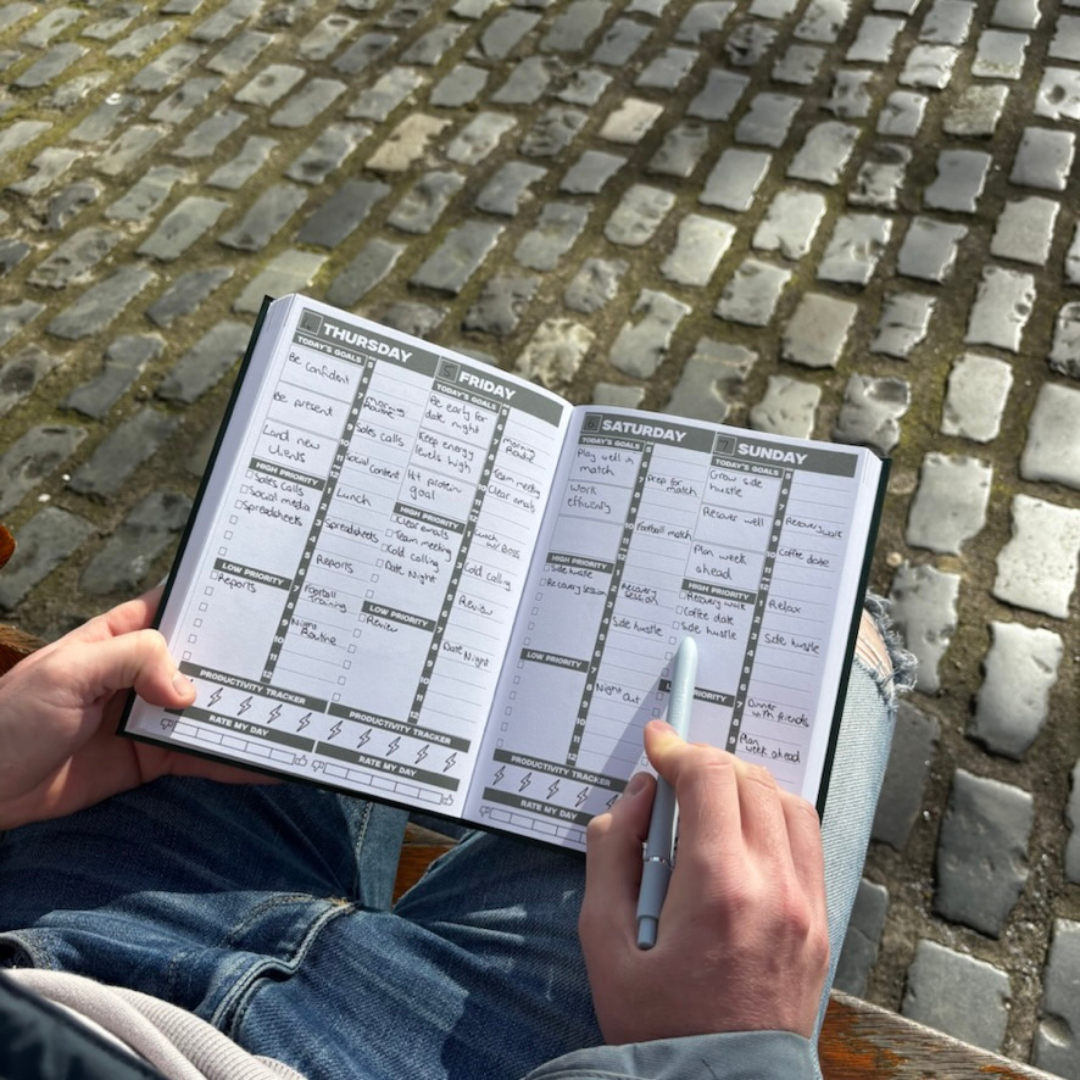
Environment design fixes this by removing the decision. Keep your planner, specifically something like the Plan Your Growth undated weekly agenda, open on your desk at all times, not closed in a drawer between uses. Pair it with your morning coffee, so the habit attaches to something you already do automatically. The undated format itself is a piece of environment design: there is no missed date staring back at you to create the shame spiral that causes most men to abandon a planner after one bad week. The friction to start, or restart, stays low permanently.
This is the same principle applied at a system level rather than a single behaviour level. The right tool, placed in the right physical location, attached to an existing habit, removes the daily willpower cost of deciding to plan at all.
Why This Compounds Faster Than Motivation Ever Will
Motivation is unreliable by nature. It spikes after a podcast, a tough conversation, a New Year, and fades within days regardless of how genuine it felt in the moment. Building a system on motivation guarantees that the system collapses the moment motivation dips, which is to say, regularly.
Environment design does not depend on how you feel on a given day. The friction is either there or it is not, independent of your mood, your energy, or how inspired you feel that morning. This is precisely why it compounds more reliably than motivation-based approaches. A well-designed environment produces the right behaviour on your worst days almost as reliably as your best days, because the behaviour was never actually dependent on your internal state in the first place.
Audit one domain this week. Pick the single behaviour costing you the most ground right now, and change exactly one friction point around it. Do not try to redesign your entire life in a weekend. One domain, one change, observed for a week, is how this actually gets built.
The Bottom Line
Discipline is not primarily a willpower contest. It is a design problem, and the men who appear most disciplined have simply arranged their environment so that good behaviour requires less resistance than bad behaviour. Increase friction on what you want less of, decrease friction on what you want more of, and audit your environment honestly rather than assuming it is neutral. None of this requires more motivation. It requires looking clearly at the spaces you already operate in and changing what is currently the path of least resistance.
The Plan Your Growth undated weekly agenda, kept visible and attached to an existing daily habit, is itself a piece of environment design that removes the willpower cost of planning at all. Build the environment. Let the behaviour follow.