Environment Design: The Discipline Hack Willpower Cannot Beat
You do not have a discipline problem. You have an environment problem, and you have been trying to solve it with willpower, which is the single most expensive and least reliable resource available to you. Environment design is the practice of engineering your physical and digital surroundings so the disciplined choice becomes the easy choice, and the undisciplined one becomes friction-heavy enough that you skip it without a fight. Men who understand this stop relying on motivation. Men who do not understand it keep losing the same battle every single day and calling it a character flaw.
Why Willpower Is a Losing Strategy
Willpower is not unlimited. Psychologist Roy Baumeister's research on ego depletion found that self-control operates like a muscle that fatigues with use. Every resisted temptation, every difficult decision, every moment of forcing yourself to do the hard thing instead of the easy thing draws from the same limited daily reserve. By 8pm, that reserve is running low for almost everyone, which is exactly when the phone comes out, the junk food gets eaten, and the workout gets skipped.
This means a strategy built entirely on willpower is structurally doomed to fail during your lowest-capacity hours, which happen to be most evenings. You are not weak for reaching for your phone at 9pm instead of reading. Your willpower reserve is depleted, and the phone is one tap away while the book requires you to stand up and find it.
Environment design sidesteps this entirely by removing the need for willpower in the first place. If the phone charges in another room, you do not need willpower to avoid checking it at 9pm. You need willpower for exactly one decision, made once, at the moment you set up the charging station. After that, the friction does the work for you every single night without you spending a single ounce of self-control.
The Two Levers: Friction and Visibility
Environment design operates on two levers, and understanding both is the entire skill.
Reduce friction for what you want to do. Want to work out at 6am? Lay your gym clothes out the night before, next to your bed, where stepping over them is more effort than putting them on. Want to eat better? Pre-cook meals on Sunday so the healthy option requires zero decisions on a Tuesday night when your willpower is gone. Want to read more? Put the book on your pillow, so getting into bed and picking up your phone requires physically moving the book out of the way first.
Increase friction for what you want to avoid. Want to check your phone less? Delete the apps that eat your time, log out of them, put the phone in another room, or use a lockbox with a timer. Want to stop late-night snacking? Do not buy the junk food. An empty pantry is a decision you made once at the grocery store, not a decision you have to remake every night at 10pm when your defenses are down.
Both levers work because they change the default. Humans overwhelmingly take the path of least resistance, not out of laziness but out of basic cognitive efficiency. Environment design simply makes sure the path of least resistance points toward the life you actually want.
Applying Environment Design to Deep Work
Deep work is the single highest-leverage activity most men underperform on, and it is also the area where environment design pays off fastest. Computer scientist Cal Newport, who has written extensively on the topic, argues that the modern knowledge worker's environment is engineered almost entirely against sustained focus, full of notifications, open tabs, and constant availability by design. Beating that environment with willpower alone is close to impossible. Redesigning it is not.
Concretely: put your phone in another room during your deep work block, not on silent on the desk, because visibility alone drains attention even when the phone stays quiet. Close every browser tab that is not directly required for the task. Use a website blocker during your scheduled deep work hours so the decision to avoid distraction is made once, in advance, rather than fought moment to moment. Tell the people around you when your deep work block runs, so interruptions are structurally reduced rather than something you have to fend off individually.
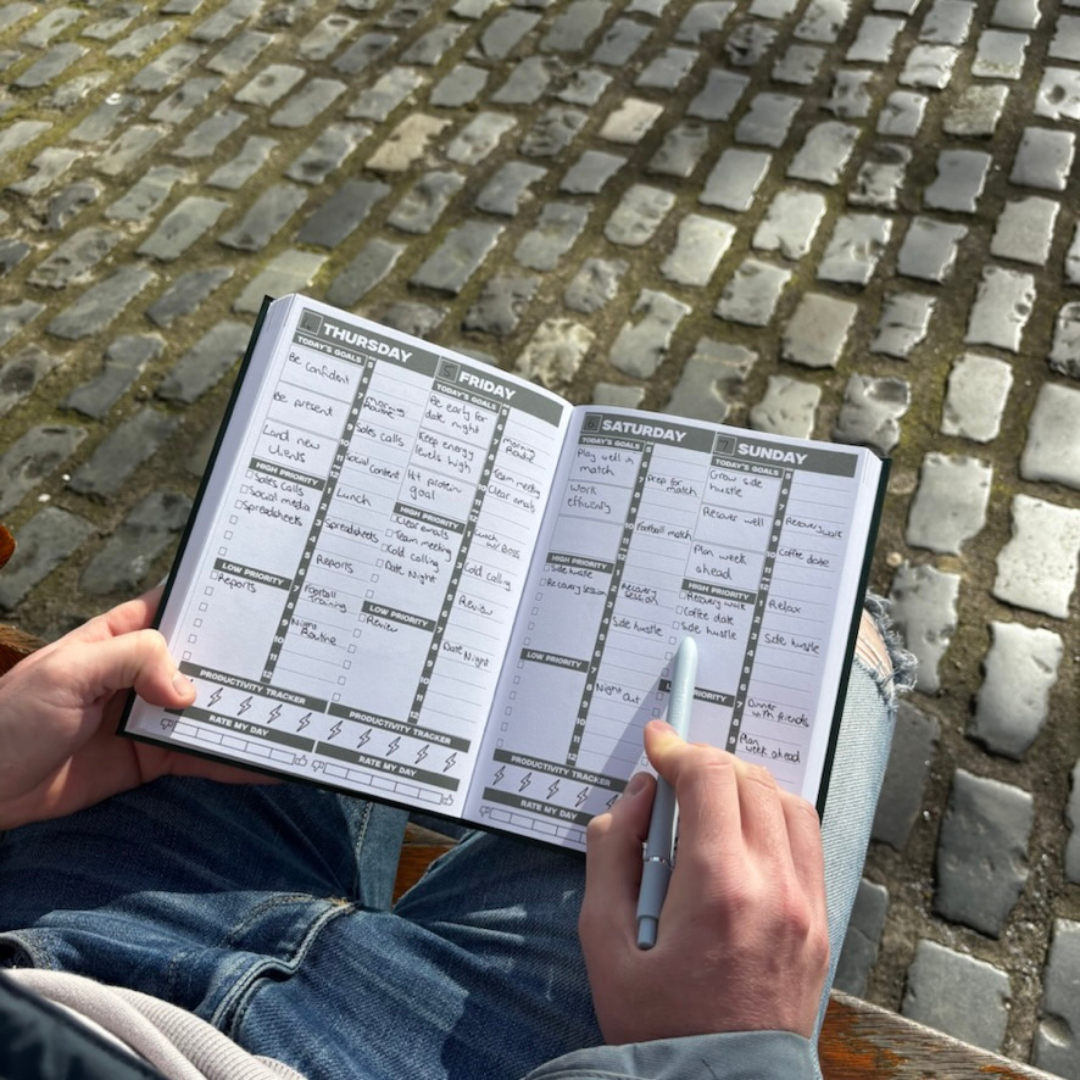
None of this requires more discipline than the average man already has. It requires designing the room, the desk, and the devices so discipline is rarely tested in the first place. This is also why time-blocking works better inside a planning system than as a mental note. The Plan Your Growth undated weekly agenda gives your deep work block a fixed, visible slot in the week, which itself functions as an environmental cue: the plan is written down, so the decision to protect that hour has already been made before the temptation to skip it ever shows up.
Designing Your Physical Space for Consistency
Your physical space sends constant, low-grade signals about what behavior it expects from you. A bedroom with a TV invites screen time before sleep. A desk buried under unrelated clutter invites task-switching instead of focus. A kitchen counter with a fruit bowl in plain view gets snacked from more than a pantry with the same fruit hidden behind cereal boxes, a finding replicated repeatedly in behavioral nutrition research.
Walk through your own spaces and audit them honestly. What does your bedroom currently signal? What does your desk currently signal? What does your kitchen currently signal? For each space, ask one question: does this room make the behavior I want easier, or does it make the behavior I want to avoid easier? Redesign accordingly. This is a one-time investment of an afternoon that pays dividends for months, unlike willpower, which you have to spend fresh every single day.
The Habit Stack: Combining Environment Design With Existing Routines
Environment design gets even more powerful when stacked onto behaviors you already do automatically. This is the principle behind habit stacking, a concept popularized by James Clear: attach a new behavior to an existing, automatic one, and use the environment to make the attachment frictionless.
If you already make coffee every morning without thinking, put your vitamins next to the coffee maker so taking them becomes part of the same automatic sequence. If you already brush your teeth every night, put your planner on the bathroom counter so reviewing tomorrow's priorities becomes attached to a behavior you never skip. The environment does the reminding. You do not have to remember, because the physical placement remembers for you.
The Bottom Line
Discipline is not a personality trait you either have or lack. It is largely a function of how much friction stands between you and the behavior you want, and how much friction stands between you and the behavior you are trying to avoid. Environment design shifts both, so the disciplined choice becomes the default rather than a daily fight against a limited willpower reserve. Redesign one room this week. Notice how much easier the right choice becomes when you stop relying on motivation to make it happen.
The Plan Your Growth undated weekly agenda is itself an environment design tool: a single visible place where your priorities, habits, and blocks live, so the plan is never something you have to hold in your head against the pull of a busy day. Build the system once. Let the environment carry the discipline from there.