Environment Design: Why Willpower Is the Wrong Tool for Focus
You have never once beaten a smartphone with willpower for more than a few days. Nobody has. Environment design is the recognition that discipline is a finite, depleting resource, and the men who stay focused consistently are not running on more of it than you, they have simply removed the need for it by restructuring the space they work in.
The Willpower Model Is Broken by Design
Most focus advice assumes willpower is the mechanism: resist the phone, resist the notification, resist the urge to check email mid-task. This model fails because willpower depletes over the course of a day, and the moment it runs low, usually mid-afternoon, the environment wins by default. If your phone is on the desk, it gets picked up. If the notification is visible, it gets read. Willpower was never built to win a repeated fight against a stimulus sitting three inches from your hand.
Environment design flips the entire premise. Instead of asking you to resist a distraction that is present, it removes the distraction from being present in the first place. You cannot pick up a phone that is in another room. You cannot get pulled into a notification that never appears on screen. The fight you were losing every afternoon simply stops existing.
Auditing Your Current Environment Honestly
Before redesigning anything, do a genuinely honest audit of your workspace as it exists right now. What is within arm's reach that has nothing to do with the task in front of you. What notifications are currently enabled on the device sitting near you. What is visible on your desk that pulls your eye away from the work.
Most men are shocked at how much of their environment is passively working against their own stated priorities. A phone face up on the desk, notifications on for apps that have nothing to do with work, a browser with fifteen tabs open including three that are pure distraction. None of this happened because you lack discipline. It happened because nobody ever audited the environment and asked whether it was actually built for the outcome you say you want.
James Clear's research on habit formation makes the mechanism explicit: the visibility and accessibility of a cue is one of the strongest predictors of whether a behavior gets triggered, which means reducing visibility and accessibility is one of the most reliable ways to reduce an unwanted behavior without relying on willpower at all (jamesclear.com). Removing the cue is a structural fix. Resisting the cue every time it appears is not.
Redesigning for the Work You Actually Want to Do
Once the audit is done, redesign deliberately. Put the phone in a drawer, a different room, or on airplane mode during deep work blocks, not just on silent, which still allows visual notifications to pull your eye. Close every browser tab that is not directly required for the current task. Keep only the physical materials relevant to what you are working on visible on the desk.
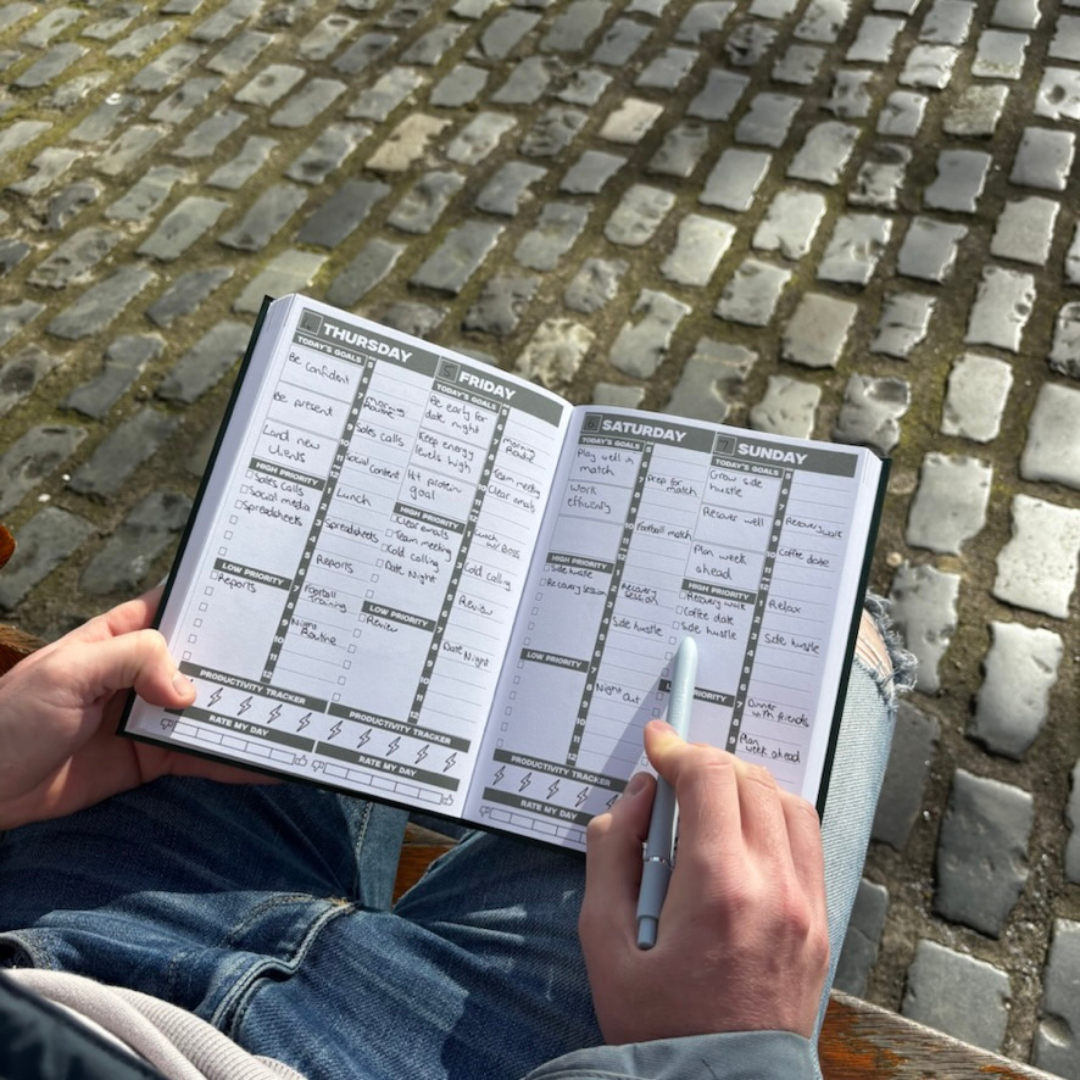
Go further and design for the behavior you want to increase, not just the one you want to decrease. If you want to read more, leave the book open on the desk where you will see it. If you want to plan your week consistently, keep your agenda open on the desk during your morning coffee instead of closed in a drawer where it is easy to forget. Visibility works in both directions, use it to pull yourself toward what matters, not only to block what does not.
This is exactly why the <a href="/products/plan-your-growth-undated-weekly-agenda">Plan Your Growth undated weekly agenda</a> works best kept physically open on your desk rather than closed on a shelf. A planning system you have to actively retrieve competes with one that is simply present in your field of view every time you sit down. Environment design applies to your systems the same way it applies to your distractions.
Designing Your Environment by Time of Day
Environment design is not static. The setup that supports deep focus work in the morning may need to shift for a different kind of task in the afternoon. If mornings are for your highest cognitive demand work, the environment should be at its most stripped down then, minimal visual noise, phone fully out of reach, single task materials only.
Afternoons might reasonably include a slightly less restrictive environment if the work itself is lower stakes, admin, email batches, routine calls. The mistake is applying the same restrictive environment uniformly across a day with genuinely different demands, which usually leads to the restrictions being abandoned entirely by 2pm because they felt unnecessary for the task at hand.
Designing Your Digital Environment, Not Just Your Physical One
Environment design applies just as directly to your digital workspace as it does to your desk. Notification settings, browser bookmarks, app placement on your phone home screen, all of these are environmental cues that either support or sabotage focus, and most men have never deliberately configured any of them.
Move distracting apps off your phone's home screen entirely, requiring a deliberate search to open them rather than a single tap. Turn off notifications for everything except genuinely time sensitive communication, not because you lack discipline to ignore a notification, but because the notification itself is the cue that triggers the distraction, and removing the cue is more reliable than resisting it every time it appears.
On a work computer, keep a single browser window open with only task relevant tabs, and close your email client entirely during deep work blocks rather than minimizing it, since a minimized inbox is still one click away and one click is often all it takes to break focus. These changes take fifteen minutes to set up once and then work passively in your favor every single day afterward, unlike willpower, which has to be summoned fresh each time.
Environment Design at the Level of a Whole Room
Beyond the desk itself, consider what room you actually do deep work in and whether that room's normal function fights against focus. A home office that doubles as a TV room, a kitchen table that is also where the household eats and socializes, both send conflicting signals about what behavior is expected in that space.
Where possible, designate one space exclusively for focused work, even if it is small, and protect it from other uses. Over time, simply sitting in that space becomes its own cue for focus, the same way a gym becomes associated with exercise partly through repeated association with the physical location itself, not just the equipment inside it.
Environment Design Is Not a One Time Fix
Environment design is not something you set up once and forget. As work changes, as new tools and apps enter your life, the environment quietly drifts back toward distraction unless you periodically audit it again. A phone that was in a drawer during deep work six months ago may have crept back onto the desk without a deliberate decision to put it there.
Build a short quarterly review into your existing planning rhythm: look again at what is visible and accessible in your main workspace, and ask whether it still matches what you are actually trying to focus on right now. Priorities shift, and an environment designed for last year's goals may be quietly working against this year's. Treat the audit as routine maintenance, the same category of task as reviewing your financial goals or updating your weekly systems, not a one time project you complete and move past permanently.
Track how often you notice yourself reaching for a removed distraction during the first week after a redesign. A high number is not a sign the redesign failed, it is a sign of exactly how strong that cue had become, and it usually drops sharply within ten days once the environment stops offering the temptation in the first place.
Start with a single change rather than overhauling everything at once. Remove the phone from your desk this week and nothing else. Once that single adjustment feels automatic, add the next one, closing unnecessary browser tabs, then the next, designating a single focus space. Sequential changes stick far better than a complete overhaul attempted in one weekend, which tends to feel like too much disruption at once and quietly reverses within a month.
Share the concept with people in your household or office if the environment is shared rather than fully under your control. A workspace that other people also use will only stay redesigned if everyone understands why the phone lives in the drawer or why the desk stays clear of unrelated items during certain hours. Buy-in from the people around you protects the redesign far more reliably than trying to maintain it alone against a shared space that keeps drifting back.
Measure the results honestly after a month, not by how disciplined you felt but by what actually got produced. Men who redesign their environment properly typically report finishing deep work sooner and with less mental fatigue, a concrete result that is easy to notice once you are actually paying attention to output instead of simply assuming the change worked.
The Bottom Line
Environment design works because it treats focus as a structural problem rather than a character problem. Audit what is currently visible and accessible in your workspace, remove what pulls you toward distraction, and deliberately increase the visibility of what you actually want to do more of. Willpower was never going to win a daily fight against a phone sitting on the desk. The next action is simple: right now, put your phone in another room and see how the next hour of work feels different, then build on that single change one week at a time.
A system you have to remember to open loses to one that is simply in view. The Plan Your Growth undated weekly agenda is designed to sit open on your desk, so the plan you built for the day stays visible instead of competing with everything else fighting for your attention.