The First-Hour Rule: Why Your First 60 Minutes Decide Your Day
Most men do not lose their day at 3pm when the energy crashes. They lose it at 7am, in the sixty minutes they hand over to their phone without thinking twice. The first-hour rule is simple: how you spend the first sixty minutes after waking sets the operating mode for everything that follows. React first thing, and you spend the day reacting. Execute first thing, and momentum carries you through the parts that would otherwise stall. This is not a theory about willpower. It is a structural fact about how your brain allocates attention, and it is fixable in one week.
What the First-Hour Rule Actually Means
The first-hour rule is not about waking up at 5am, cold plunges, or a twelve-step morning ritual borrowed from someone else's Instagram. It is about sequence. In the first sixty minutes of your day, your prefrontal cortex, the part of your brain responsible for planning and decision-making, is at its highest available capacity before the noise of the day depletes it. What you feed that window determines what kind of day you are building.
Two men wake up at the same time. Man one reaches for his phone, scrolls email and social media for forty minutes, and starts his workday already reacting to other people's priorities. Man two spends that same sixty minutes reviewing his priorities, moving his body, and starting on the one task that actually matters. By 9am, man two has already won something. Man one has already lost something and does not know it yet.
This is not about virtue. It is about leverage. The first hour is the only part of the day you fully control before external demands start pulling at you. Waste it, and you spend the rest of the day trying to claw back ground you gave away for free.
The Structure: Building a First-Hour Rule Routine
A first-hour rule routine does not need to be complicated. It needs four elements, done in order, without your phone as the first input.
No phone for the first twenty minutes. This is the single highest-leverage rule in this entire system. The moment you check a notification, you have handed your attention to someone else's agenda. Delay it. The emails will still be there. The world will not end.
Move your body for ten minutes. This does not mean a full workout. A short walk, ten push-ups, a few minutes of stretching. The goal is circulation and a signal to your nervous system that the day has started on your terms.
Review your priorities for five minutes. Look at what you planned the night before, or if you did not plan the night before, decide right now what the one thing is that actually matters today. Not the urgent thing. The important thing.
Start the hardest task for the remaining time. Not check email. Not scroll Slack. The task that requires the most cognitive effort, tackled while your mental capacity is highest. Researcher Anders Ericsson's work on deliberate practice consistently found that peak performers do their most demanding work during their highest-energy windows, not whenever it happens to fit.
This is not rigid. Adjust the minutes to your life. What stays fixed is the sequence: no external input first, movement, priority clarity, then the hardest task.
The First-Hour Rule and Decision Fatigue
Every decision you make burns a limited daily resource. Psychologist Roy Baumeister's research on decision fatigue found that the quality of your choices degrades the more choices you have already made that day, regardless of how important those choices were. This is why the men who protect their morning hours perform better later in the day than the men who spend those same hours making a hundred small reactive decisions about emails, notifications, and other people's requests.
The first-hour rule works because it front-loads your highest-stakes decision, what you will actually work on, before decision fatigue has a chance to erode your judgment. By 8am, most men have already made dozens of micro-decisions responding to inputs they did not choose. The man running the first-hour rule has made exactly one decision on purpose, and it was the right one.
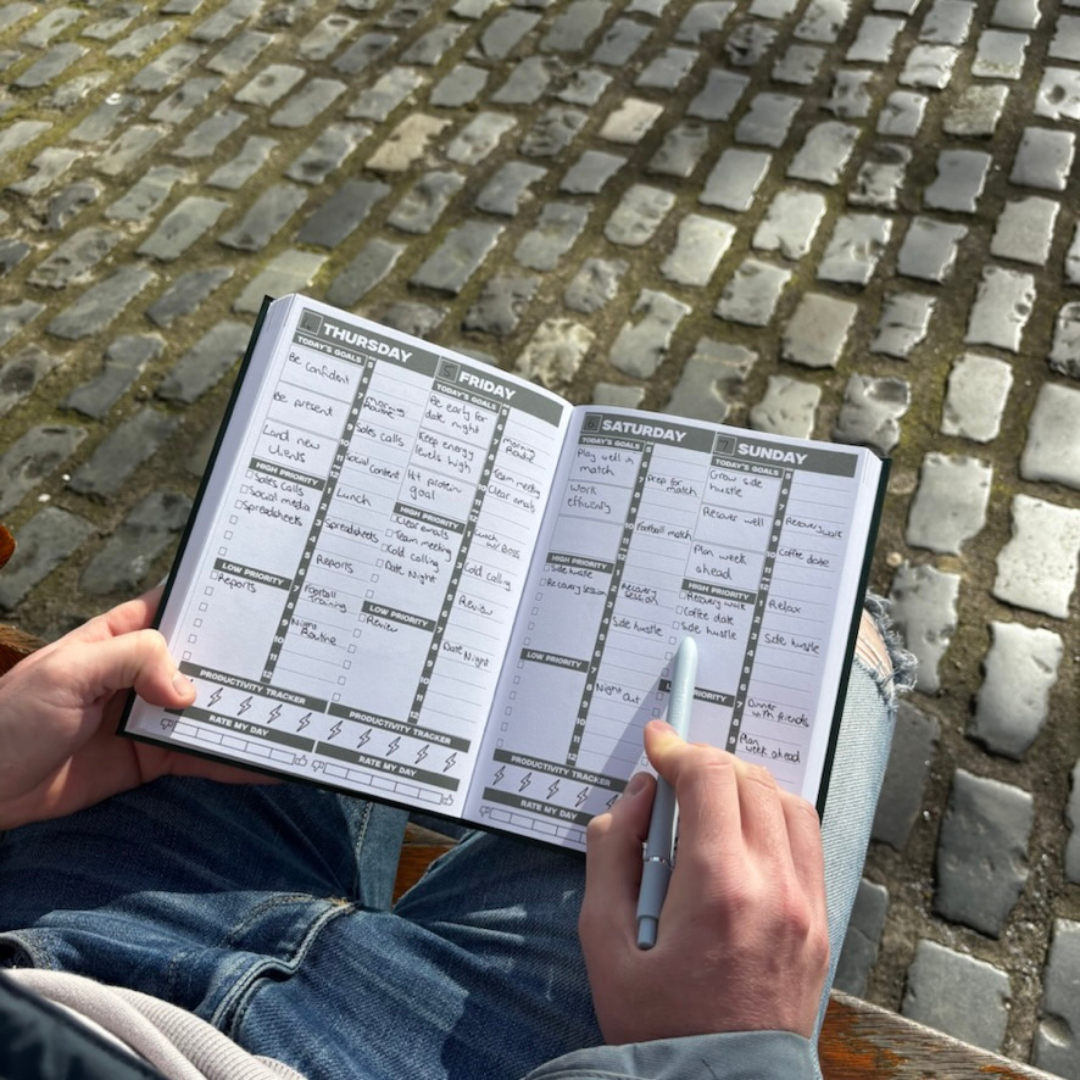
This connects directly to why undated weekly planning works better than daily improvisation. If you are deciding your priorities fresh every single morning under time pressure, you are burning decision capacity you need for execution. The Plan Your Growth undated weekly agenda is built to remove that friction. You set your weekly priorities once, in a calm five-minute session, so your first hour each day becomes execution instead of negotiation with yourself about what matters.
What Kills the First Hour (and How to Protect It)
Three things reliably destroy the first-hour rule before it starts.
The phone on the nightstand. If your phone is the first thing your hand touches when you wake up, you have already lost. Charge it in another room. Buy a five-dollar alarm clock. This single change does more for your mornings than any other adjustment on this list.
Vague intentions instead of a fixed sequence. "I'll try to do something productive in the morning" is not a system. It is a hope. Hope does not survive contact with a snooze button. Write the sequence down. Put it somewhere you will see it.
No non-negotiable wake time. If your wake time floats with how tired you feel, your first hour floats with it. Pick a time. Hold it for two weeks even on the days you do not feel like it. Consistency, not intensity, is what makes this stick.
Build in slack, not perfection. If you miss a day, you have not broken the system. You have had one bad morning. Run it again tomorrow.
The Compound Effect of 90 First Hours
One good first hour changes almost nothing measurable. Ninety of them in a row change the shape of your entire year. This is the same math behind every compounding system: small, consistent inputs produce outsized outputs given enough repetitions.
Men who run the first-hour rule for 90 consecutive days report the same pattern. The first two weeks feel effortful, almost artificial. Around week three, the sequence starts running without deliberate willpower. By week eight, skipping it feels wrong, the way skipping a shower feels wrong. The behavior has moved from discipline to identity, and identity is what actually sustains a habit long after motivation runs out.
This is the entire point of building structure around your mornings instead of relying on daily motivation. Motivation is unreliable. It is high some days and completely absent on others. A fixed first-hour sequence does not ask how you feel. It asks what you do next, and it removes the negotiation.
The Bottom Line
The first-hour rule works because it puts you in control of the one window each day you actually own before the world starts making demands. No phone first. Move your body. Clarify your one priority. Start the hardest task while your mind is sharpest. Run this sequence for two weeks straight and notice what changes by the time you hit lunch. The compounding starts small and becomes the difference between a year that drifted and a year you actually built.
The Plan Your Growth undated weekly agenda exists to make that five-minute priority review effortless, so your first hour is never wasted deciding what matters. Set the week once, execute daily, and let the first hour do what it is built to do.