How to Break Bad Habits for Good: A System, Not a Willpower Contest
Ask any man what's holding him back from breaking a bad habit and he'll usually say he just needs more willpower. That's rarely true. Willpower is a limited, depleting resource, not an unlimited character trait, and relying on it as your only strategy for breaking bad habits is why most attempts fail within a couple of weeks. If you actually want to know how to break bad habits, the answer has less to do with wanting it badly enough and more to do with redesigning the structure around the habit so willpower barely needs to show up.
Why Willpower Alone Fails
Every decision you make during a day draws from the same finite pool of mental energy, a phenomenon researchers call decision fatigue. By the evening, after a day of small decisions, your capacity to resist a bad habit is measurably lower than it was that morning, which is exactly why most bad habits get triggered at night: not because you are weaker at night, but because your decision-making reserves are genuinely depleted by then.
This means a strategy that depends entirely on "just don't do it" is fighting the habit at the exact moment you have the least capacity to win that fight. The fix is not trying harder in that moment. The fix is changing the structure well before that moment arrives, so the decision never has to be made under depleted willpower in the first place.
Step One: Identify the Actual Trigger
Every habit, good or bad, runs on a loop: a cue, a routine, and a reward. You cannot break a habit you have not actually mapped, because most men are fighting the wrong part of the loop. They try to resist the routine itself, the scrolling, the snacking, the drinking, without ever identifying what cue set it off in the first place.
Spend a week simply noting the trigger every time the habit fires. Time of day, location, emotional state, who you were with. A pattern emerges quickly. Most bad habits are not random. They are a predictable response to a specific, repeatable cue: boredom at 9pm, stress after a specific type of meeting, loneliness on a Friday night. Once you can name the cue reliably, you have found the actual lever to pull, not the symptom.
Step Two: Change the Environment, Not Just the Intention
James Clear's research on habit formation makes a consistent point: environment design beats willpower almost every time, because it removes the decision entirely instead of asking you to make a better one in the moment. If the habit is picking up your phone the second you wake up, the fix is not a stronger intention to resist it. The fix is charging the phone in another room, so the habit requires an active choice to walk and retrieve it, rather than an unconscious reach that happens before you are even fully awake.
Apply this to whatever habit you are trying to break. Add friction to the bad habit: make it physically harder to do. Remove friction from the alternative: make the better choice the easiest one available. A habit that requires three extra steps to start is a habit that gets interrupted by those three steps often enough to break the automatic loop, especially in the early weeks when the pattern is still fragile.
Step Three: Replace, Don't Just Remove
Removing a habit without replacing it leaves a gap, and gaps get filled with something, usually the original habit or one just as unproductive. If the habit served a real function, boredom relief, stress management, social connection, you need a replacement that serves the same function, not just the absence of the old behavior.
If late-night scrolling was filling a boredom gap, the fix isn't just "don't scroll." It's identifying a specific replacement activity for that exact window: reading, a short walk, planning the next day. The replacement needs to be pre-decided, not improvised in the moment, because an improvised decision at the exact time the old habit usually fires is a decision made with depleted willpower, and you already know how that goes.
Step Four: Track It Honestly, Every Day
You cannot manage a pattern you are not tracking, and vague self-assessment ("I've been better about it lately") is consistently less accurate than a simple daily log. Mark it, every day, in the same place: did the habit fire today, yes or no. Over two to three weeks, you get a genuinely honest picture of your trend, including the days and triggers where you are most vulnerable.
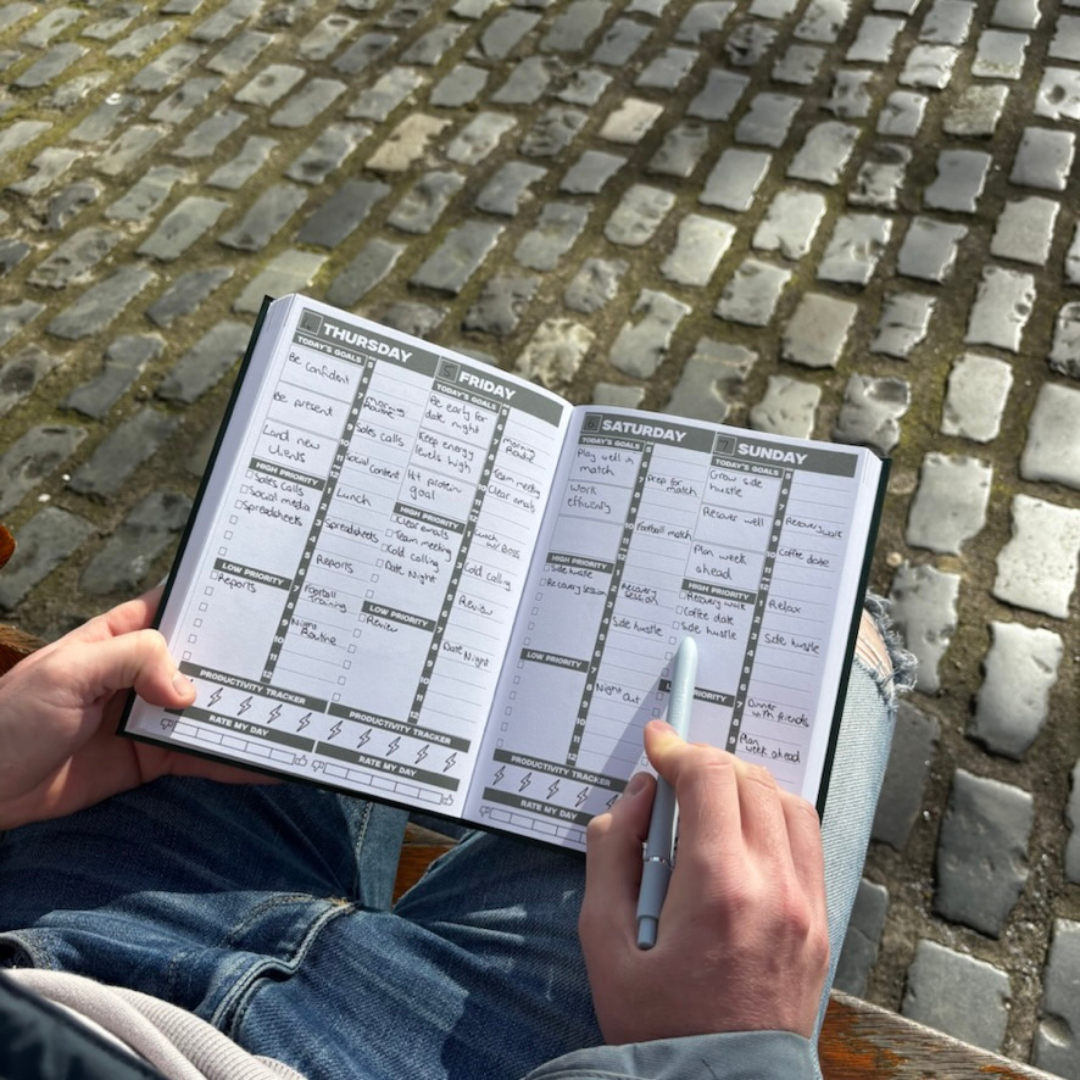
This kind of tracking works best inside a system you already check daily, which is exactly why habit tracking built into a weekly planner tends to stick better than a separate app most men forget to open. The Plan Your Growth undated weekly agenda includes daily tracking space specifically for this reason: the habit you are trying to break gets logged in the same place you are already planning your day, which removes yet another point of friction between intention and follow-through.
Step Five: Expect Setbacks and Plan for Them
A single slip does not erase three weeks of progress, but the story you tell yourself about that slip determines whether it stays a single slip or becomes a full relapse. Research on behavior change consistently shows that people who treat a lapse as evidence they have failed entirely are far more likely to abandon the change altogether. People who treat a lapse as data, useful information about a trigger they had not fully accounted for, get back on track within a day or two.
Decide in advance how you will handle a slip before it happens. Not what you will do if it happens, what you will do the moment it does: acknowledge it without spiraling, note the trigger that caused it, and resume the plan the next opportunity, not the next Monday. Waiting for a symbolic restart date is one of the most common reasons a temporary slip becomes a permanent relapse.
Why This Takes Longer Than You Think
Popular claims about habits forming in twenty-one days are not well supported by research. Studies on habit automaticity, including work summarized by behavioral scientists studying repetition and behavior, suggest the real range is closer to two to eight months, depending on the complexity of the habit and the consistency of the environment supporting it. Set your expectations accordingly. A habit that still requires conscious effort after three weeks has not failed. It is simply still in the normal window for becoming automatic.
Handling Habits Tied to Stress or Social Pressure
Some bad habits are not simple boredom loops. They are coping mechanisms for genuine stress, or behaviors reinforced by a social environment that expects them, drinking after work with colleagues, for instance, or a habit tied to a specific relationship dynamic. These require an additional layer beyond environment redesign, because removing the habit without addressing the underlying stressor or social pressure tends to produce a rebound, often stronger than the original pattern.
If the habit is stress-driven, the actual fix has to include a genuine stress-management replacement, not just a substitute activity. Exercise, structured breathing, or simply a planned decompression window at the end of a hard day address the root cause in a way a substitute snack or scroll session does not. If the habit is socially reinforced, the honest fix often requires a direct conversation, setting an explicit boundary with the people involved, rather than assuming willpower alone will hold in a social setting explicitly built around the behavior you're trying to change.
Why Tracking Beats Memory Every Time
Men consistently overestimate how well a habit change is going when relying on memory alone, and underestimate the value of a simple written log. This isn't a discipline flaw, it's a known bias: recent days weigh disproportionately in how we assess a trend, so three good days after a rough week can create a false sense that the habit is now under control, when the actual data over a full month tells a different story. A daily yes or no mark removes that bias entirely and gives you the real trend line, not the story you're currently telling yourself about it.
Stacking Habit Changes Without Overloading Yourself
A common mistake once the system starts working is trying to apply it to three or four habits simultaneously. Each habit change draws on the same limited pool of attention and willpower during its most fragile early weeks, and stacking several at once dilutes the focus each one needs to actually take hold. Pick one habit, run the full five-step process against it, and give it real weeks of consistent tracking before adding a second. A single habit changed thoroughly is worth more than four attempted half-heartedly at the same time, and the sequential approach also lets you apply what you learned diagnosing the first habit's triggers to the second one, making each subsequent change genuinely easier than the last.
The Long Arc of a Successful Change
Six months from now, a habit you're working to break today will typically fall into one of three states: fully replaced and no longer requiring conscious effort, significantly reduced but still occasionally present, or unchanged because the underlying system was never actually built, just wished for. The difference between the first two outcomes and the third is rarely intensity of desire. It's whether the five steps above were actually run, tracked, and adjusted over enough weeks to let the new pattern take hold. Judge your progress on the honest trend across months, not on any single difficult evening, and the odds move firmly in your favor.
What Success Actually Looks Like Month to Month
Set realistic expectations for what progress looks like on a monthly basis, because vague hope for "eventually being done" is a poor substitute for a concrete benchmark. Month one usually looks like frequent slips alongside growing awareness of the trigger pattern. Month two typically shows the habit firing less often and with more conscious catching before it fully executes. Month three onward is where the replacement behavior starts to feel less like a forced substitute and more like the actual default. If your own timeline looks roughly like this, the system is working even on the weeks it doesn't feel like it. If a full three months pass with zero shift in frequency, that's the signal to revisit the trigger mapping, because something in step one was likely missed.
The Bottom Line
Breaking a bad habit is a structural problem before it is a willpower problem. Identify the actual trigger, redesign your environment to add friction to the bad habit and remove it from the better one, pick a specific replacement in advance, track the pattern daily and honestly, and decide now how you will handle the inevitable slip so it doesn't become a full relapse. Give it months, not weeks, and judge the system by the trend, not any single day.
The daily tracking space inside the Plan Your Growth undated weekly agenda makes step four easy to actually maintain: one page, checked every day you're already planning your work, no separate app to remember. If you're ready to build the structure instead of relying on willpower alone, that's exactly what it's built for.