How to Build Discipline When Motivation Runs Out
Lazy men don't feel guilty. You do. That difference matters, because it tells you what you're actually dealing with. You're not short on motivation in some deep sense. If you were, you wouldn't be reading this. What most men actually lack is not motivation, it is a system for executing when motivation is absent, because motivation is unreliable by nature and discipline was never supposed to depend on it. Learning how to build discipline means building mechanisms that function on the days you feel nothing at all, not chasing a feeling that was never going to show up reliably in the first place.
The Guilt Signal Is Actually Useful Information
Guilt after skipping something you committed to is not a sign of weakness, it is a signal worth paying attention to, because it indicates the goal genuinely matters to you at some level, even if execution failed that particular day. Men who feel nothing after skipping a commitment typically have a different problem entirely, a goal that was never really theirs in the first place, borrowed from someone else's expectations rather than chosen deliberately. How to build discipline starts with distinguishing between these two situations. If the guilt is present, the fix is mechanical: adjust the system. If the guilt is genuinely absent, the more honest question is whether this goal deserves the effort at all.
Discipline Is Not a Trait, It's a System
The common assumption is that some men are simply born disciplined and others are not, that it is a fixed personality characteristic like height. This is false, and believing it is actively counterproductive, because it frames every lapse as proof of an unchangeable deficiency rather than a fixable gap in structure. Discipline is closer to a skill built through specific, repeatable mechanisms than a trait some men have and others lack. Understanding how to build discipline starts with rejecting the trait framing entirely and replacing it with a systems framing: what specific structure, repeated consistently, produces disciplined behaviour regardless of how motivated you feel on a given day.
Identity Follows Action, Not the Other Way Around
A common mistake is waiting to feel like a disciplined person before acting like one, when the mechanism actually runs in reverse. Repeated action, executed regardless of current identity or mood, is what builds the identity over time, not a prerequisite for it. A man does not need to feel like "a disciplined person" to complete today's scheduled workout. He needs to complete the workout, and after enough repetitions of doing so regardless of feeling, the identity forms as a natural consequence of the accumulated evidence, not as something summoned first through belief alone.
The Environment Does More Work Than Willpower
The single most overlooked factor in discipline is environment design. Willpower is a limited, depletable resource, and relying on it to resist temptation repeatedly throughout the day guarantees failure eventually, usually by evening when willpower reserves are lowest. How to build discipline that actually holds up means removing the need for willpower in the first place, wherever possible.
This looks like concrete structural changes: the workout clothes laid out the night before, removing the decision entirely from a groggy morning. The phone in another room during deep work, removing the temptation rather than trying to resist it while it sits visible on the desk. The junk food never purchased, removing the choice at the grocery store rather than fighting it nightly in the kitchen. Every one of these changes moves the discipline requirement upstream, to a single decision made once, rather than repeated fights against temptation throughout the day.
Discipline in One Area Tends to Spread
There is a well-documented spillover effect where building discipline in one specific area, a consistent workout schedule, for instance, tends to make discipline in unrelated areas easier as well, diet, work habits, financial behaviour. This is not mystical, it is a practical consequence of the same mechanism, environment design and scheduled commitment, being applied and reinforced repeatedly across a life. Men learning how to build discipline are often better served focusing intensely on a single area first, building the mechanism there until it is genuinely automatic, rather than attempting to overhaul five areas of life simultaneously and diluting the same limited willpower across all of them at once.
Small, Consistent Actions Beat Occasional Heroics
A common mistake in trying to build discipline is going all-in immediately: a complete overhaul of diet, sleep, and work habits simultaneously, starting Monday. This approach produces impressive results for roughly ten days and then collapses entirely, because it demands more sustained willpower than any system can supply. Angela Duckworth's research on grit, the combination of sustained passion and perseverance toward long-term goals, found that consistency over time predicted achievement far better than intensity in short bursts. A small, unglamorous action repeated daily for a year outperforms an intense effort sustained for two weeks and then abandoned.
Start smaller than feels sufficient. A five-minute version of the habit, done every single day without exception, builds the actual mechanism of discipline, the neural pathway of following through regardless of mood, far more effectively than an ambitious version attempted three times before being abandoned entirely.
Scheduling Discipline Instead of Hoping for It
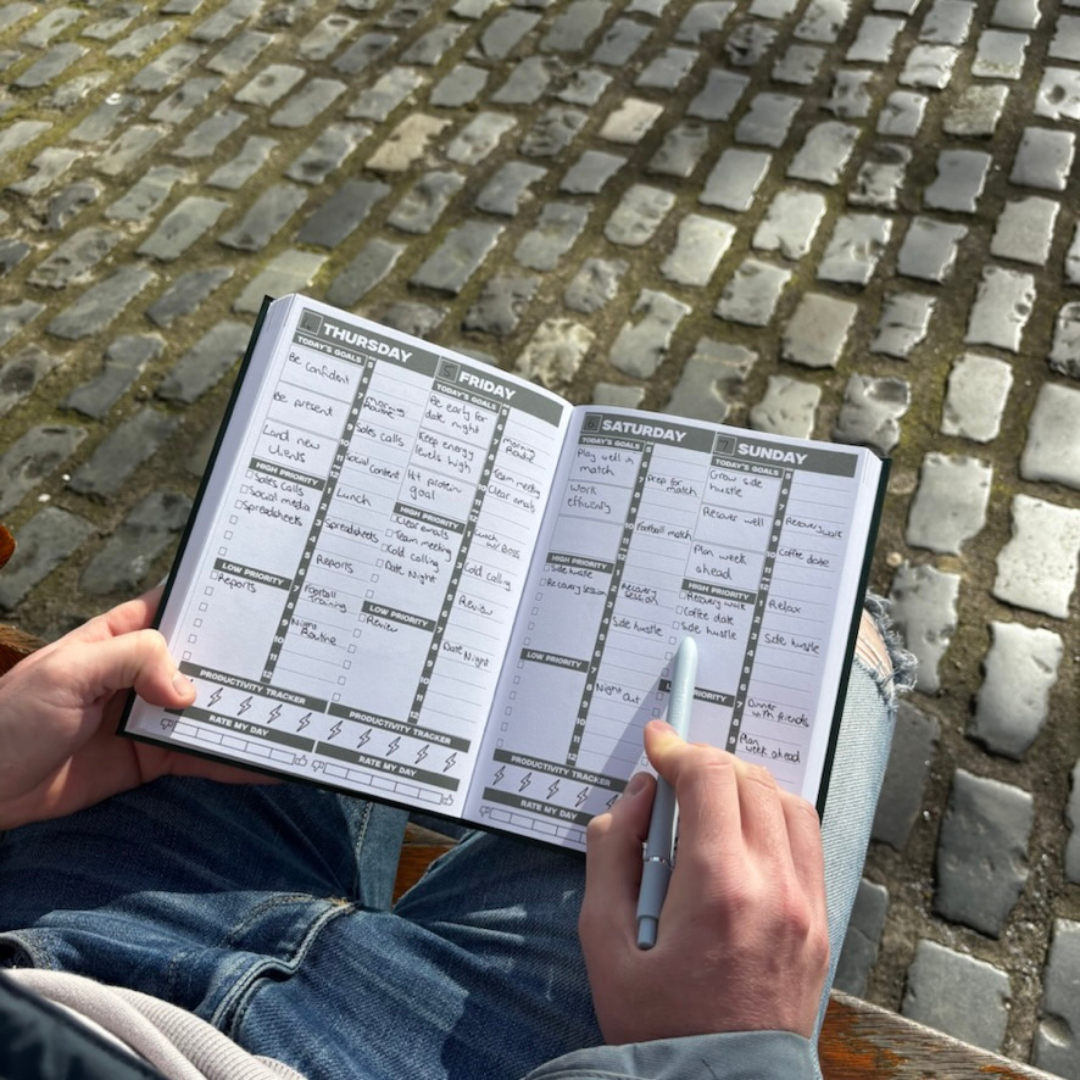
How to build discipline in practice comes down to a specific mechanism: put the disciplined behaviour on the calendar with the same weight as an unmissable commitment, rather than leaving it as a floating intention competing against everything else in the day. A workout with no scheduled time is a suggestion. A workout blocked at 6am in the Plan Your Growth undated weekly agenda is a commitment with a specific time and place, which removes the daily negotiation of whether today is the day it happens.
This single shift, from intention to scheduled commitment, is responsible for more consistent discipline than any mindset change. The behaviour stops requiring a fresh decision every single day and instead becomes the default unless something actively interrupts it.
Measuring Discipline by Streaks Worth Tracking
A simple, visible streak tracker, a running count of consecutive days or weeks a specific commitment has been kept, provides concrete feedback that abstract willpower never does. Seeing a streak reach three weeks, then six, then twelve, builds momentum that becomes its own motivating force, distinct from and more reliable than the original motivation that started the habit. This tracking works best kept simple, a single line in a planner, not an elaborate app requiring its own maintenance, because the tracking system itself needs to be low-friction enough to survive the same busy weeks the underlying habit is trying to survive.
Rebuilding After a Broken Streak
Every discipline system eventually gets broken, a missed workout, a skipped review, a day that fell apart entirely. The critical skill is not avoiding every broken streak, which is unrealistic over any meaningful timeframe, it is the speed of the rebuild. Missing one day and immediately returning to the system the next day has a negligible long-term impact. Missing one day, feeling like a failure, and using that feeling as evidence the whole system does not work, turns a single missed day into a month-long collapse.
Treat a broken streak as data, not a verdict. What specifically caused the miss, and does the system need a small adjustment, or was it simply an outlier day. Rebuild immediately, without the extended self-punishment that usually does more damage than the original miss ever did.
The Bottom Line
How to build discipline comes down to systems, not willpower: design the environment so the disciplined choice requires no ongoing resistance, start with a version small enough to sustain daily, schedule the behaviour with the same weight as an unmissable commitment, and rebuild immediately after any broken streak instead of spiralling over it. Discipline was never a trait some men are born with. It is a mechanism, built the same deliberate way anything else worth having gets built.
Schedule your next disciplined action into the Plan Your Growth undated weekly agenda and give it a specific time, not just a vague intention to get to it eventually.