How to Build Mental Toughness: 10 Daily Habits That Compound
Mental toughness is not a trait, not a temperament, not an identity. It is the compounding output of ten daily habits a lot of men cannot maintain. That distinction matters more than it sounds. If toughness were an inborn trait, you would either have it or you wouldn't, and there would be nothing to do about it. It isn't. It is built the same way strength is built: through repeated, unglamorous repetition that nobody sees, applied consistently over months, not summoned once during a crisis. If you want to know how to build mental toughness, stop looking for the mindset shift and start looking at your daily habits, because that is where it actually gets built.
Habit One: Do the Uncomfortable Thing First
Cold showers, an early wake-up, the hard workout before the easy one. The specific discomfort matters less than the pattern: choosing the harder option deliberately, on a schedule, when an easier one is available. This trains a very specific skill, which is acting despite discomfort instead of waiting for the discomfort to pass. Most men wait for motivation before doing hard things. Mentally tough men do the hard thing and let the motivation catch up, because it usually does, about ten minutes in.
Habit Two: Keep Promises to Yourself
Every broken promise to yourself, even a small one, erodes your own trust in your word. Say you will train at 6am and hit snooze, and you have taught your own brain that your commitments are negotiable. This compounds in both directions. A month of kept promises builds a level of self-trust that shows up under real pressure. A month of broken ones does the opposite, and you will feel the difference the next time something actually hard happens and you need to believe your own resolve.
Habit Three: Separate Discomfort From Danger
Mental toughness requires the ability to sit with discomfort without immediately reacting to escape it. Most modern lives are engineered to remove discomfort the second it appears: hungry, order food; bored, check your phone; uncomfortable in a conversation, change the subject. Practicing the ability to notice discomfort and stay in it anyway, when there is no actual danger, is a trainable skill. It shows up later as the ability to stay calm and functional when a real high-pressure situation hits, because you have rehearsed not panicking at the first sign of difficulty.
Habit Four: Control What You Actually Control
A huge amount of wasted mental energy goes toward things entirely outside your control: other people's opinions, outcomes you cannot influence, decisions already made. Mentally tough men develop a near-automatic filter for this, redirecting energy toward the input side of the equation, not the outcome side. This isn't passive acceptance. It's precision: spend zero energy on what you cannot change, and all of it on what you can.
Habit Five: Train Your Body Deliberately
Physical training is one of the most reliable, repeatable ways to build mental resilience, not because of the physique outcome but because of the mechanism. You are deliberately putting your body under load, past the point of comfort, on a schedule, and finishing anyway. That specific rep, over months, transfers directly to non-physical situations. The man who has trained himself to push through the last set when his body wants to stop has a rehearsed pattern for pushing through other kinds of resistance too.
Habit Six: Reflect Without Spiraling
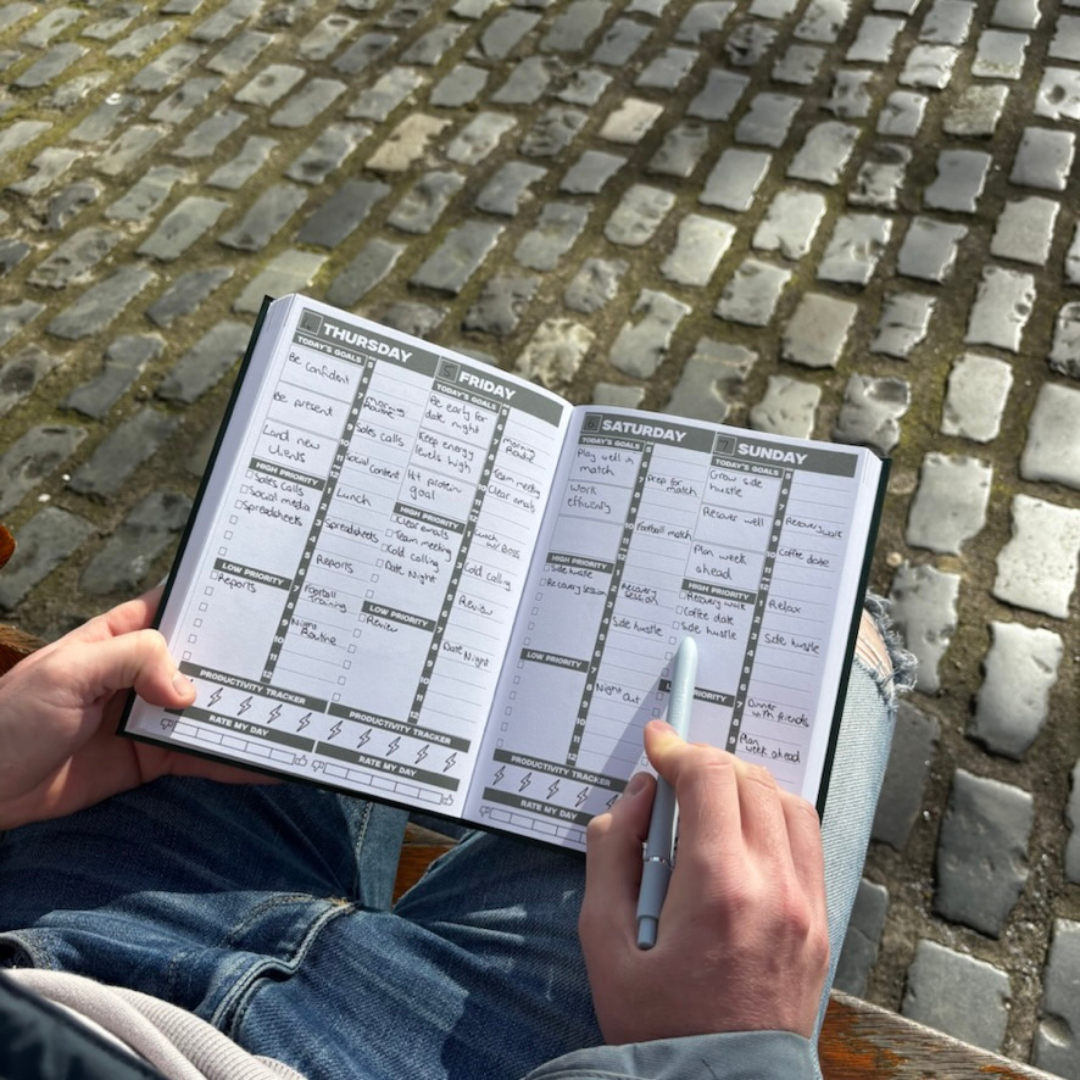
There is a real difference between honest self-assessment and rumination, and mentally tough men learn to tell them apart. Reflection asks what happened and what you will do differently. Rumination just replays the failure on a loop without producing a decision. A structured weekly review, where you look back deliberately instead of ruminating randomly at 11pm, builds the habit of honest reflection without the spiral. This is one of the reasons a dedicated weekly review slot, like the one built into the Plan Your Growth undated weekly agenda, does more for resilience than people expect from a planning tool.
Habit Seven: Set a Standard, Not a Mood-Based Goal
Motivation fluctuates daily. A standard does not. "I train five days a week" is a standard. "I train when I feel like it" is a mood. Mentally tough men build their systems around standards specifically because standards do not care how you feel on a given Tuesday. Psychologist Angela Duckworth's research on grit found that sustained achievement correlates far more strongly with consistency of effort over years than with any measure of raw talent or intensity in a single moment. A standard is what makes that kind of consistency possible on the days motivation does not show up.
Habit Eight: Finish What You Start, on a Smaller Scale First
Most men who lack follow-through on big goals also have a pattern of not finishing small things: the book left at sixty percent, the project abandoned halfway. Practicing completion on small, low-stakes tasks builds the actual muscle you will need for the big ones. Pick a small project this month and finish it fully, not because the project matters, but because the completed pattern does.
Habit Nine: Get Comfortable Being Bad at Something New
Toughness includes the willingness to be a beginner in public. Most men avoid this instinctively, sticking to what they are already good at because failure in front of others is uncomfortable. Deliberately picking up something new, where you will be visibly bad for a while, builds tolerance for exactly the kind of ego discomfort that shows up in every real setback later in life.
Habit Ten: Review the Week, Every Week, No Exceptions
This is the habit that ties the other nine together. Without a weekly review, none of the above compound, because you have no mechanism for noticing what worked, what slipped, and what needs adjusting. The review does not need to be long. It needs to happen every single week, on the same day, without fail. The Plan Your Growth undated weekly agenda builds this in as a standing part of the weekly layout, specifically because the habit of reviewing is what turns nine separate practices into one compounding system.
The Science Behind the Compounding
None of this works as a single event. A cold shower once does nothing. A kept promise once does nothing measurable. The entire mechanism relies on repetition over a long enough period that the pattern becomes default behavior rather than a conscious decision each time. This is consistent with what habit researcher James Clear has written extensively about: identity change happens through repeated small votes for the kind of person you are becoming, not through single dramatic decisions. Mental toughness, in that framing, is simply the accumulated evidence, built daily, that you are someone who follows through.
What Mental Toughness Is Not
It's worth being precise about what this is not building toward, because the concept gets distorted often. Mental toughness is not the suppression of every emotion, nor is it grinding through genuine physical or medical warning signs because stopping feels like weakness. Confusing toughness with ignoring real signals is how men end up injured, burned out, or worse, and none of that serves the actual goal, which is sustainable capacity for hard things over a long career, not a single act of self-destruction mistaken for grit.
The distinction that matters is between discomfort and danger, covered above, and it deserves reinforcing here because it's the single most common way this entire practice gets misapplied. Discomfort is the target: the extra rep, the uncomfortable conversation, the early alarm. Danger is not: chest pain during a workout, a genuinely unsafe decision made to prove a point, ignoring your body's clear signal that something is actually wrong. Toughness built correctly increases your capacity to handle real adversity precisely because it hasn't been spent recklessly on manufactured, unnecessary risk.
Applying This Under Actual Pressure
The real test of any of the habits above is not how they perform on a calm Tuesday. It's whether they hold when something genuinely difficult happens: a job loss, a health scare, a relationship ending. This is where the compounding argument matters most. A man who has spent six months keeping small promises to himself, sitting with manageable discomfort, and reviewing his week honestly has built a rehearsed pattern of not collapsing at the first sign of difficulty. A man who has spent those same six months avoiding all of it is meeting his first real test with no reps behind him.
This is precisely why the daily habits matter more than any single dramatic decision made in a crisis. You do not rise to the moment. You fall to the level of what you've actually practiced, consistently, in the months before the moment arrived.
Starting Point Matters Less Than the Trend
Men new to this often feel discouraged comparing themselves to someone who has been running these habits for years, assuming the gap is unbridgeable. It isn't, and the comparison is the wrong one to make in the first place. What matters is not where you're starting from, it's whether this month's habits are more consistent than last month's. A man who couldn't sit with five minutes of discomfort six months ago and can now sit with fifteen has built real capacity, regardless of how that compares to someone else's twenty years of practice. Track your own trend, not someone else's current level.
The Role of Community in an Individual Practice
Most of the habits described above are individual by nature, but they build faster with even minimal outside support. A training partner who expects you at 6am, a friend who checks in on a shared standard, a small group running the same weekly review, all add a layer of social accountability that solo willpower struggles to match on its own. This isn't a contradiction of the individual nature of toughness. It's a recognition that even the most self-reliant men build consistency faster with some structure around them, and there's no cost to using that leverage while you're building the underlying habits into something that no longer needs external reinforcement to hold.
The Bottom Line
Mental toughness is not something you either have or don't. It is the visible result of ten unglamorous daily habits, repeated consistently, tracked honestly, and reviewed every week without exception. Pick two or three of the habits above and start this week. Do not try all ten at once. The compounding effect only works if the habits stick, and habits stick when you start small enough to actually sustain them.
If you want a structure that makes the weekly review, the standard-setting, and the follow-through easier to maintain, the Plan Your Growth undated weekly agenda is built around exactly this kind of system: a place to set your standards for the week, track them daily, and review honestly every Sunday, with no printed dates to make you wait for a symbolic fresh start.