ime Blocking: The System That Turns Your Calendar Into Leverage
Most men do not have a time problem. They have an allocation problem. You worked nine hours today and cannot name three things you actually finished. The time blocking method fixes this, not by giving you more hours, but by forcing every hour you already have to answer to a specific purpose before the day starts, instead of after it is already gone.
What Time Blocking Actually Is
Time blocking means assigning every working hour of your day to a specific task or category before the day begins, rather than working from an open ended to-do list you dip into reactively. Instead of "work on the proposal sometime today," you write "9:00 to 10:30, proposal, first draft of section two." The task gets a start time, an end time, and a defined scope.
This sounds simple because it is. The power is not in the complexity, it is in the fact that a blocked calendar makes every decision about what to work on next in advance, at a moment when you have the clarity to make that decision well, instead of at 2pm when you are tired and defaulting to whatever feels easiest.
An unblocked day is a series of small negotiations with yourself, dozens of times, about what to do next. A blocked day removes almost all of those negotiations, because the decision already happened this morning, or better, last night.
Why an Unstructured Calendar Quietly Sabotages You
Without time blocks, your day gets colonized by whoever is loudest. An email arrives and you answer it immediately because it is right there. A colleague stops by and the fifteen minute conversation eats the momentum you had built on deep work. None of these interruptions feel large individually. Collectively they are why a nine hour day produces three hours of actual output.
Cal Newport, who has studied focused work extensively, argues that time blocking is one of the few structural defenses against what he calls the shallow work trap, the tendency for low value, easily available tasks to expand and fill all available time unless a competing claim on that time already exists (calnewport.com). A block on your calendar is that competing claim. It is much harder to let an email interrupt a scheduled block than to let it interrupt an undefined stretch of "working time."
This is the core insight most productivity advice misses. You do not need more discipline to resist distraction. You need your calendar to already have made the decision, so resisting distraction becomes a matter of protecting a commitment rather than summoning willpower from nothing.
Building Your First Time Blocking Schedule
Start the night before, not the morning of. List every task you need to accomplish tomorrow, then estimate how long each genuinely takes, not how long you wish it took. Most men underestimate this badly. If a task usually takes ninety minutes, block ninety minutes, not sixty.
Group similar tasks together. Batch your email responses into one or two defined blocks instead of letting them interrupt the rest of your day. Put your highest cognitive demand work, the proposal, the strategy document, the hard conversation you need to prepare for, in the block where your energy is highest, which for most men is the first two to three hours after starting work.
Leave one buffer block of thirty to forty five minutes somewhere in the middle of the day. Something will run over or something urgent will land, and a buffer absorbs that without collapsing the rest of your schedule. A time blocking system with zero slack breaks the first time reality intrudes, which is every single day.
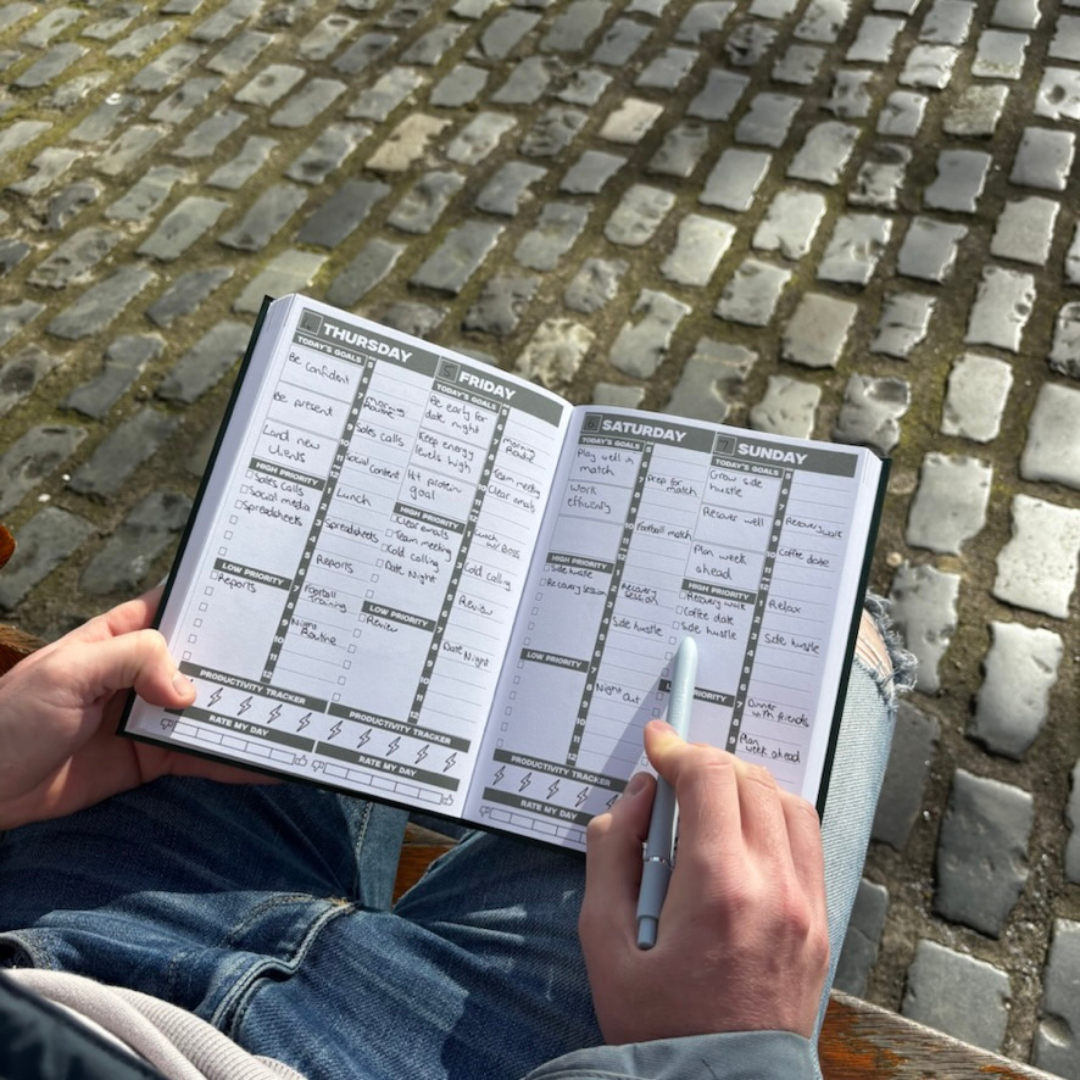
This is exactly the structure the <a href="/products/plan-your-growth-undated-weekly-agenda">Plan Your Growth undated weekly agenda</a> is built to hold. Its weekly layout gives each day enough room to lay out real blocks rather than a cramped to-do list, so the system has a physical home instead of living exclusively in an app you close the moment it gets inconvenient.
Protecting the Blocks You Set
A time block that gets abandoned the moment something else comes up is not a system, it is a suggestion. Treat your blocks the way you would treat a meeting with someone whose respect you want to keep. If a request comes in during a deep work block, the default answer is that it waits until the block ends, not that it interrupts immediately because it feels urgent.
This requires setting expectations with the people around you. Tell your team or your household that certain hours are blocked for focused work and largely unavailable. Most interruptions are not actually as time sensitive as they feel in the moment, and a clear boundary, stated once, prevents dozens of smaller negotiations later.
Review at the end of each day how accurately you estimated your blocks. If the proposal block ran forty minutes over three days in a row, that is data, not a personal failing. Adjust the estimate and move on. Time blocking gets more accurate the more you practice it, and the goal is calibration over perfection.
Handling the Days Your Blocks Fall Apart
Some days the schedule collapses within the first hour, a client calls with an emergency, a system goes down, a family situation demands immediate attention. This does not mean time blocking has failed. It means you now have new information and need to rebuild the day's blocks around it, ideally in a five minute reset rather than abandoning structure entirely and reverting to reactive mode for the rest of the day.
The men who get the most out of time blocking are not the ones whose days never get disrupted. They are the ones who treat a disrupted schedule as a rebuild, not a write-off. When something blows up your morning, take five minutes to look at what remains of the day, decide which blocked tasks still fit and which need to move to tomorrow, and reblock the afternoon accordingly. The alternative, letting one disruption cancel structure for the rest of the day, turns a single interruption into eight wasted hours instead of two.
This is also where a weekly buffer day or a weekly review matters. If Tuesday's blocks get destroyed by an emergency, Wednesday's schedule should absorb whatever critical work got displaced, rather than letting it silently drop off the list. A time blocking system that cannot survive a bad day is not actually a system, it is a good week's plan pretending to be a durable one.
Combining Time Blocking With Task Batching
Time blocking becomes considerably more powerful when combined with batching, grouping similar types of tasks into the same block rather than scattering them throughout the day. Answering messages, making calls, reviewing documents, each of these has a different cognitive mode, and switching between modes repeatedly throughout the day carries a real cost in lost focus and momentum.
Gloria Mark's research at UC Irvine on attention and task switching has found that returning to a state of deep focus after an interruption or a task switch takes significantly longer than most people estimate, often over twenty minutes, which means a day with frequent switching between task types loses far more productive time than the interruptions themselves would suggest. Batching similar tasks into single blocks, one block for calls, one for writing, one for administrative work, reduces the number of these costly transitions dramatically.
Build your blocks around task type as much as around individual tasks. A block labeled simply "communication" that covers email, messages, and calls together will usually outperform three separate scattered blocks for the same work spread across the day.
Adjusting the System as You Get Better at It
Your first two weeks of time blocking will be inaccurate. You will underestimate how long focused work actually takes and overestimate how many blocks you can realistically hold in a single day. This is normal and expected, not a sign the method does not work for you specifically.
Track your estimate versus actual time for two weeks, then adjust your blocking accordingly going forward. Most men discover their real capacity for deep, high value work is closer to three or four solid hours a day than the eight they initially tried to schedule, and building a system around three excellent hours outperforms a system that spreads mediocre focus across eight.
Once the estimates stabilize, time blocking stops feeling like an exercise in guessing and starts feeling like an accurate map of your actual capacity, which is when the real leverage of the system starts to show up in what you get done each week.
This calibration process also reveals something most men do not expect: the bottleneck is rarely time itself. It is almost always energy allocation across the hours you do have. Once your blocks are accurate, the obvious next lever is protecting your highest energy block for your single most important task of the day, rather than letting it default to whatever arrived first in your inbox that morning.
Do not aim for a fully blocked calendar from day one. Start by time blocking just the first two hours of your day, the highest leverage window for most men, and leave the rest of the day loosely structured while the habit forms. Expanding the practice to a full day comes naturally once the morning blocks are already sticking without much conscious effort.
The Bottom Line
Time blocking works because it moves every major decision about your day to a moment when you have clarity, instead of leaving those decisions scattered throughout a day when your judgment and energy are already depleted. Build your blocks the night before, protect your highest energy hours for your hardest work, leave one buffer for reality, and defend the blocks you set the same way you would defend a commitment to someone else. The next action is simple: block tomorrow tonight, before you close your laptop.
A calendar full of intentions is not the same as a calendar full of blocks. The Plan Your Growth undated weekly agenda gives your time blocking system a real structure to run on, so the plan you make at night is the plan you actually execute the next day.