Learning New Skills Fast: The System That Beats Raw Talent
Talented men who practice randomly will be outperformed by average men who practice deliberately. This is one of the most robust findings in the science of skill acquisition, and it has been validated across domains ranging from chess to surgery to music to sport. K. Anders Ericsson, whose research on expertise development at Florida State University and is documented via his foundational work at psy.fsu.edu, established across decades of study that elite performance is not primarily a function of innate ability. It is a function of the quality and structure of practice. Learning new skills fast is therefore not a genetic lottery. It is a system problem, and systems can be built. If you are trying to acquire a capability that matters to the direction you are building, the question is not whether you have the talent for it. The question is whether you are running the right method.
Why Most Skill Learning Stalls
The default approach to learning a new skill looks like this: consume content, practice inconsistently, plateau somewhere above beginner, and conclude that you have reached your natural ceiling. Most men stay in this loop for years across multiple skills. The skill is present but never sharp. The capability exists but never compounds.
The problem is not the ceiling. The problem is the method. Naive practice, repeating the same actions in the same way without specific feedback or structured stretch, produces improvement in the early stages when everything is new but produces diminishing returns quickly as the skill becomes familiar enough to be performed on autopilot. Autopilot performance does not develop capability. It maintains it at the current level.
This is why a man can play golf for twenty years and still carry the same handicap he had in year five. He plays regularly. He enjoys it. He has never practiced deliberately. The same pattern appears in professional skills, public speaking, negotiation, coding, writing. The hours are there. The improvement is not, because the hours are not structured around the specific mechanism of skill development.
The Four Components of Deliberate Practice
Anders Ericsson's research identifies four distinguishing features of the practice that actually produces rapid skill development. Understanding them changes how you structure every learning session.
The first is a specific, challenging target that sits at the edge of your current capability. Not a comfort zone activity, something you can already do. Not an impossibly advanced target beyond your current level. The precise zone just above what you can currently do reliably. Learning scientists call this the zone of proximal development. In practice it means identifying the specific sub-skill that currently limits your overall performance in the domain and targeting that sub-skill in every practice session until it is solid.
The second is concentrated effort during the session. Deliberate practice cannot happen on autopilot. It requires full cognitive attention, which means it is mentally demanding in a way that naive practice is not. This is why elite athletes and performers typically practise at high intensity for shorter sessions rather than low-intensity for long ones. Quality of attention during the session matters more than the total hours.
The third is immediate feedback. You need to know whether what you just did was correct and why or why not. In some domains, feedback is built into the activity. In others, you need to engineer it: a coach, a recording of your performance that you review critically, or a structured self-assessment against defined criteria. Practice without feedback is practice that cannot self-correct.
The fourth is corrective adjustment. The feedback is only useful if it drives a change in the next repetition. This sounds obvious and is routinely skipped. Most men receive feedback and acknowledge it without structurally changing the next attempt. Deliberate practice treats each repetition as a testing of the correction made in response to the previous repetition. The practice session is a rapid cycle of attempt, feedback, correction, attempt.
Building a Learning System That Compounds
Deliberate practice is the mechanism. A system is what makes it run consistently across weeks and months rather than burning bright for a week and fading.
The learning system has three structural components. First, a defined weekly learning block: a specific, protected time slot that belongs exclusively to skill development in the target domain. Not scattered moments of practice when it fits. A named block in the calendar, treated with the same seriousness as a client meeting. Forty-five minutes of deliberately structured practice three times per week outperforms five hours of unstructured practice twice per week, consistently and by a large margin.
Second, a session structure. Each learning session has a warm-up phase (briefly returning to a skill you have already developed to anchor confidence and activate the domain), a deliberate practice phase (the focused attack on the current limiting sub-skill), and a review phase (what improved, what still needs work, what the focus is for the next session). The review phase is what most men skip and what makes the compounding happen. Without it, each session starts from scratch. With it, each session builds on the last.
Third, a progress record. A brief log of each session: what you worked on, what the specific target was, what the feedback showed, and what you are focusing on next time. This log is the compound interest of the learning system. Reviewing it weekly shows you the trajectory, prevents repetition of the same corrections, and builds the self-knowledge of how you learn most effectively.
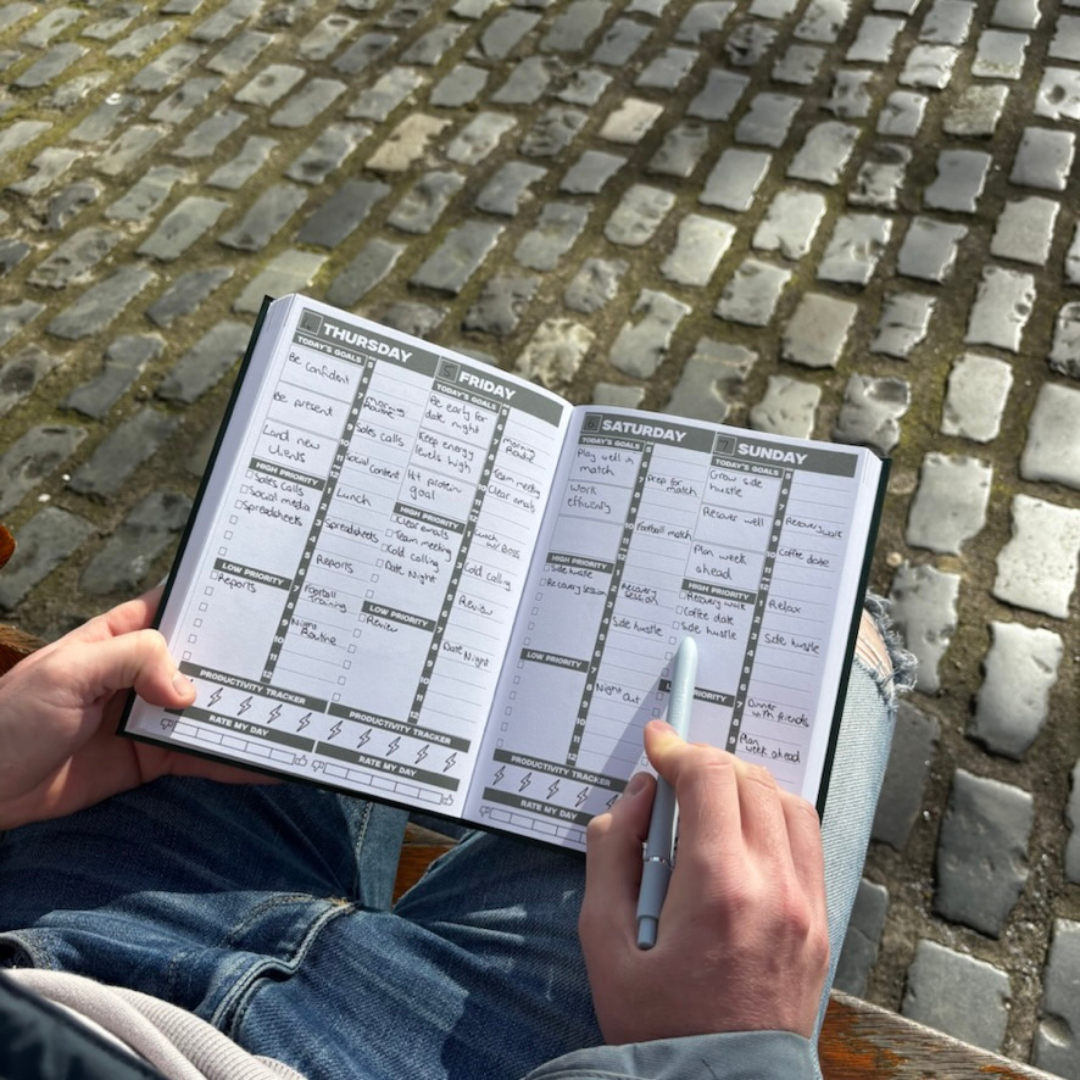
The Plan Your Growth undated weekly agenda holds the weekly learning block the same way it holds every other high-leverage commitment: as a named slot in the weekly layout before the week is filled with reactive demands. The skill that matters to the direction you are building needs protected time. It does not appear in the cracks of a full schedule.
Managing the Frustration Plateau
Every significant skill development process passes through a frustration plateau: the point where initial rapid improvement slows and the gap between your current performance and your target performance feels largest. This is not a signal that you have hit your ceiling. It is a signal that you have exhausted the gains available from your current practice approach and need to target a more specific sub-skill.
The frustration plateau is where most men quit. They interpret the slowing improvement as evidence that they are not talented enough for the domain, when in fact it is evidence that their practice needs to be restructured to target the next limiting factor. The skill that is blocking further progress is usually identifiable. If you cannot identify it alone, a single session with someone more advanced in the domain will almost always surface it.
The mental model that sustains through the plateau is the mountain analogy. From the bottom, the mountain looks like a smooth upward slope. As you climb, you discover it is a series of steep pitches and false summits. Each false summit is a plateau. The next steep pitch begins when you identify the specific technical limitation and attack it deliberately. The mountain is the same. The frame has changed.
Skill Development and the Compound Return
The case for building skills deliberately rather than casually is not just about the skill itself. It is about the compound return across a career or a life.
A man who builds a capability in year one with a proper system has a three to five year head start on the man who drifts through the same years with casual exposure. That head start compounds in two directions: the skill level achieved is higher, and the meta-skill of knowing how to learn deliberately is itself developed, which accelerates the acquisition of every subsequent skill. A man who has deliberately acquired two or three capabilities understands his own learning pattern well enough to cut the time required for the third by half.
Ambitious men tend to pursue many things simultaneously. The man who applies deliberate practice to two focused skill targets per year, rather than casually engaging with ten, will build more genuine capability in five years than the man who spread his learning energy across the wider field without ever going deep enough in any one area to compound.
The Bottom Line
Learning new skills fast is not a talent question. It is a method question. Deliberate practice, specifically targeting the current limiting sub-skill with concentrated effort, immediate feedback, and corrective adjustment in each repetition, dramatically outperforms the naive practice most men default to. Build the system: a protected weekly learning block, a structured session format, and a progress log. Push through the frustration plateau by identifying and attacking the next specific limitation rather than concluding you have hit a ceiling. Stack two or three years of this and the compound return on the capability you built is one of the highest-leverage investments you can make in the direction you are trying to go.
The Plan Your Growth undated weekly agenda gives the learning block a home in the weekly structure before anything else fills the time. The skill that matters enough to build deserves a named slot. Not the scraps at the end of the day. The deliberate time at the beginning of it.