Mental Toughness Habits: The Daily System Behind Resilience
Mental toughness is not a trait, not a temperament, not an identity. It is the compounding output of ten daily habits a lot of men cannot maintain. The men who seem unshakeable under pressure were not born that way. They built a specific set of small, repeated mechanisms that, executed daily over months and years, produce the resilience everyone else is admiring from the outside without seeing the actual mechanism underneath. Mental toughness habits are learnable, and none of them require a dramatic personality shift, just consistent daily execution.
Why the Trait Framing Actively Hurts Men
Framing mental toughness as an innate trait creates a self-defeating loop for the men who feel they lack it. If toughness is fixed, a struggle under pressure gets interpreted as permanent evidence of inadequacy rather than a temporary gap in trained capacity, and that interpretation itself makes the next high-pressure moment harder, not easier. Mental toughness habits reframe the entire situation. A rough response to pressure is not proof you lack toughness, it is data showing which specific habit needs more repetition, exactly the same way a missed lift in the gym indicates a specific weakness to train, not a permanent verdict on your strength.
Why "Just Be Tougher" Is Useless Advice
Telling a man to "be more mentally tough" gives him nothing to actually do. It is an identity statement with no mechanism attached, and identity statements without mechanisms do not change behaviour. Mental toughness habits work because they replace the vague identity goal with specific, executable daily actions: not "be disciplined" but "cold shower for sixty seconds every morning," not "handle pressure better" but "a specific breathing protocol before high-stakes conversations." The identity, if it forms at all, forms as a byproduct of the repeated actions, not the other way around.
Building a Pre-Performance Routine
A specific, repeatable sequence executed before any high-pressure situation, a big presentation, a difficult conversation, a competitive event, trains the nervous system to associate that sequence with a shift into a composed, functional state, the same way an athlete's warm-up ritual does. This might be as simple as a defined breathing pattern, a short physical movement, and a single, specific mental cue repeated silently before walking into the room. The specific content matters less than the consistency of the sequence, because repetition is what builds the association between the ritual and the composed state it is meant to trigger.
The Discomfort Habit
One of the most consistently cited mental toughness habits is deliberate, controlled exposure to physical discomfort: cold showers, hard physical training, fasting windows, anything that puts the body under genuine but safe stress on a regular basis. The mechanism is not the discomfort itself, it is the repeated practice of choosing to stay present and functional while uncomfortable, rather than escaping the sensation the moment it appears. This specific skill, staying functional under discomfort, transfers directly to high-pressure professional and personal situations where escape is not an option either.
Start small, sixty seconds of cold water at the end of a normal shower, not an ice bath from day one. The specific discomfort matters less than the consistency of choosing to face it deliberately, on a schedule, rather than only when circumstances force it.
Why Sleep Is a Toughness Habit, Not a Weakness
There remains a persistent cultural narrative equating sacrificed sleep with toughness, pushing through on minimal rest as proof of grit. This narrative is directly contradicted by what the research on cognitive performance and emotional regulation actually shows. A well-rested man responds to a genuinely stressful situation with more composure and clearer judgement than the same man running on insufficient sleep, regardless of how much willpower either version believes he is exercising. Reframing protected sleep as one of the mental toughness habits, rather than something toughness requires overriding, corrects a genuinely counterproductive assumption a lot of ambitious men still operate under.
The Recovery Habit
Counterintuitively, one of the strongest mental toughness habits is not pushing harder, it is deliberate, scheduled recovery. Matthew Walker, the sleep researcher behind extensive work on sleep and cognitive performance, has documented that sleep deprivation degrades emotional regulation and stress resilience faster and more severely than almost any other single factor. A man running on five hours of sleep is not building mental toughness by pushing through exhaustion, he is actively degrading the exact resilience he is trying to build. Protecting sleep, seven to eight hours, non-negotiable, is one of the highest-leverage mental toughness habits available, even though it does not feel as dramatic as a cold shower or a hard workout.
Building Toughness Through Chosen Difficulty, Not Just Endured Difficulty
There is a meaningful difference between difficulty life imposes on you and difficulty you deliberately choose to take on, and the second type builds mental toughness far more reliably than the first. A hard workout chosen and scheduled voluntarily trains the specific skill of staying composed under self-imposed pressure. A crisis that simply happens to you tests existing toughness but does not necessarily build new capacity in the same structured way, because there was no deliberate practice involved, only survival. Seeking out regular, chosen difficulty, a hard training session, a genuinely uncomfortable conversation deliberately initiated rather than avoided, is how the capacity actually gets built before it is urgently needed.
The Reflection Habit
Mental toughness habits also include a daily or weekly practice of honest reflection: what situation tested your composure this week, how did you actually respond, and what would a more composed response have looked like. This is not about self-criticism, it is about building the specific pattern-recognition that allows a man to notice his own reactive patterns in real time, which is the actual skill that separates a composed response from a reactive one under pressure.
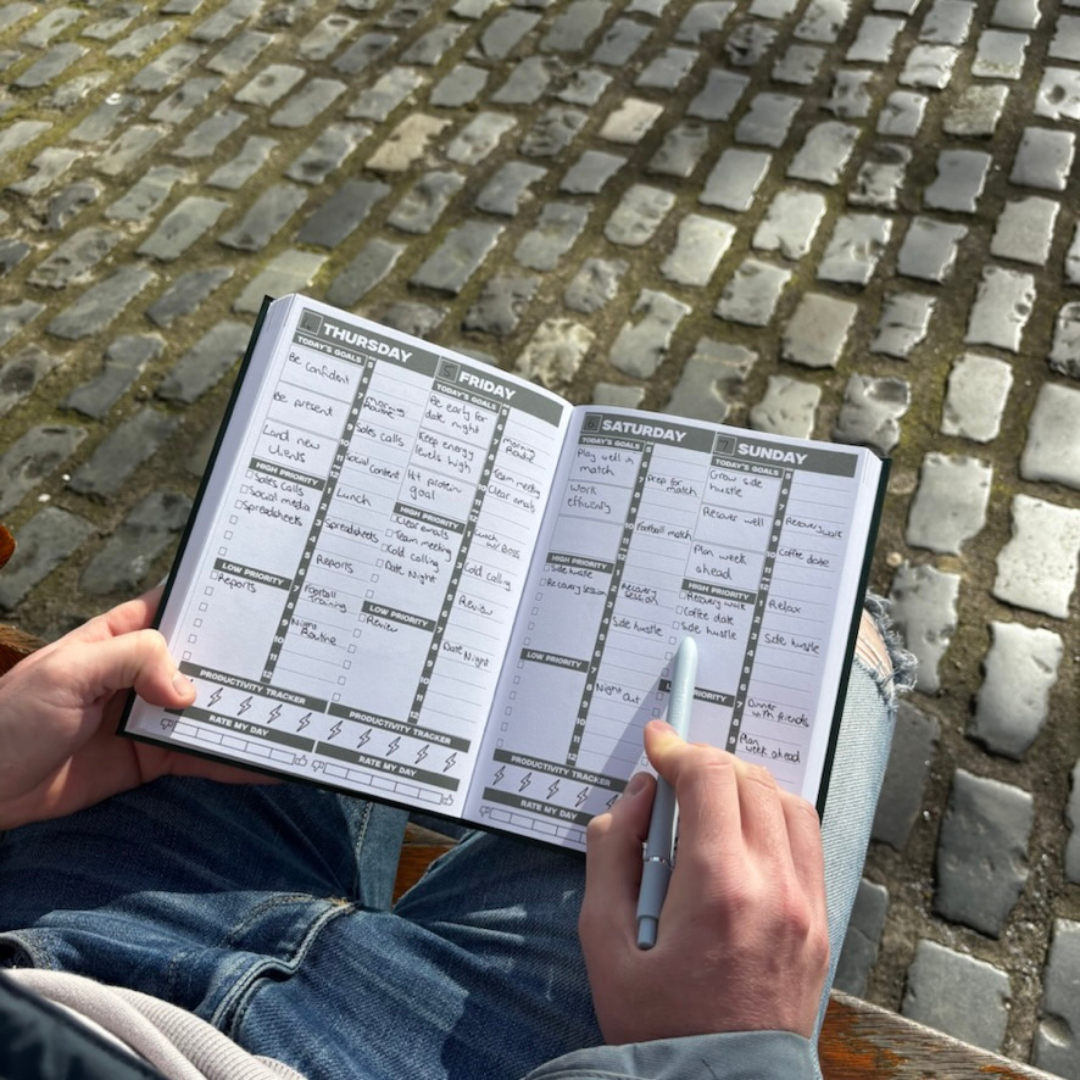
This reflection fits naturally into a weekly review, giving mental toughness habits the same structured, trackable space as any other goal. Inside the Plan Your Growth undated weekly agenda, a brief weekly note on composure under pressure sits alongside the broader weekly review, turning an abstract goal into something actually tracked over time.
The Commitment Habit
Mental toughness compounds through kept commitments, specifically the small ones nobody else is watching. A workout completed alone at 6am when nobody would know if it was skipped does more for genuine mental toughness than a public commitment made in front of colleagues, because the private, unwitnessed follow-through builds self-trust directly, with no external accountability propping it up. Every small commitment kept, especially the ones easiest to quietly abandon, is a deposit into a kind of internal evidence file: proof, accumulated over time, that you do what you say you will do, which is the actual foundation mental toughness is built on.
Building the System, Not Chasing the Feeling
The mistake most men make is waiting to feel mentally tough before acting tough, when the actual mechanism runs in the opposite direction. The daily habits, discomfort exposure, protected recovery, honest reflection, and kept commitments, come first, executed regardless of how tough or resilient you currently feel. The feeling of genuine mental toughness arrives later, as a byproduct of months of consistent execution, not as a prerequisite for starting.
The Bottom Line
Mental toughness habits are a specific, learnable system: deliberate discomfort exposure, protected recovery and sleep, honest weekly reflection on composure, and consistent follow-through on private commitments nobody else is checking. None of these require a personality transformation, only daily execution, repeated long enough to compound. The men who look unshakeable built it exactly this way, one unremarkable daily habit at a time.
Track your weekly composure and commitments inside the Plan Your Growth undated weekly agenda, and start building the evidence file that mental toughness is actually made of.