Mental Toughness: The Ten Daily Habits That Build It
Mental toughness is not a trait, not a temperament, not an identity. It is the compounding output of ten daily habits a lot of men cannot maintain. You do not wake up mentally tough any more than you wake up physically strong. Both are built the same way, through consistent, deliberate repetition of specific behaviors, most of them unglamorous, none of them requiring some rare inner grit you were either born with or without. This is the actual mechanism, broken down into ten concrete habits you can start today.
Why Mental Toughness Gets Misunderstood
The popular image of mental toughness is dramatic: pushing through extreme adversity, grinding through pain, refusing to quit under intense pressure. This image is not wrong, but it is incomplete, and it leads a lot of men to believe mental toughness is something you either possess in a crisis or you do not, discovered only in the moment it is tested. In practice, the men who perform well under real pressure almost always got there through smaller, repeated tests they built deliberately, long before the crisis arrived.
Psychologist Angela Duckworth's research on grit, the combination of passion and sustained persistence toward long-term goals, found that grit predicts achievement better than talent across a wide range of domains, and critically, that grit is buildable rather than fixed. This reframes mental toughness entirely: not a trait test you pass or fail under pressure, but a skill assembled from daily practice, the same way a muscle is built through repeated, incremental strain rather than a single dramatic effort.
The Ten Habits
One: a fixed wake time, even on hard days. Getting up at the same time regardless of how tired you feel is a small daily act of doing something uncomfortable on purpose. It sounds minor. It compounds.
Two: deliberate physical discomfort. A cold shower, a hard workout, a genuinely challenging physical effort a few times a week. This trains your nervous system to tolerate discomfort without immediately seeking relief, a skill that transfers directly to mental and emotional pressure later.
Three: doing the hardest task first. Tackling your most difficult, most avoided task before anything else, rather than warming up with easy wins. This builds a direct, repeated pattern of moving toward difficulty instead of away from it.
Four: keeping commitments to yourself. Not just commitments to others. The small promises you make to yourself, a workout, a work block, a boundary, kept consistently, build a form of self-trust that is foundational to mental toughness. Broken self-promises quietly erode it.
Five: controlled exposure to failure. Deliberately attempting things you might not succeed at, a hard conversation, an ambitious goal, a new skill, rather than only pursuing sure things. This builds tolerance for the discomfort of not being immediately good at something.
Six: delayed gratification, practiced daily. Small, repeated choices to delay an easy reward in favor of a better long-term outcome, skipping the immediate scroll to finish a task first, for instance, train the same mental muscle used in much larger delayed-gratification decisions.
Seven: a consistent review of your own performance. Honest, unflinching review of what you actually did versus what you planned, without excuse-making. This habit builds the self-awareness that mental toughness requires, since you cannot improve what you refuse to look at clearly.
Eight: physical training, treated as non-negotiable. Regular exercise is one of the most consistently documented builders of mental resilience, partly through direct physiological effects and partly through the repeated practice of pushing through discomfort in a controlled setting.
Nine: limiting complaint. Not suppressing genuine problems, but limiting the habit of verbalizing frustration without action attached to it. Chronic complaining reinforces a passive, victim-oriented mental posture. Naming a problem and immediately identifying one action toward fixing it builds the opposite posture.
Ten: a nightly review of the day's discomfort tolerated. A brief, honest acknowledgment of where you chose the harder path today, and where you did not. This is not about self-criticism. It is a feedback loop that keeps the other nine habits visible and intentional rather than forgotten in the noise of a busy day.
Why Daily Repetition Beats Occasional Intensity
A single extreme physical or mental challenge, an ultramarathon, a brutal week at work, does less for long-term mental toughness than most men assume, because intensity without repetition does not build a durable skill. It produces a memorable story, but the underlying capacity fades once the specific challenge ends, the same way a single hard workout does not build lasting strength on its own.
Daily, moderate repetition of the ten habits above builds something more durable: a default operating pattern where discomfort is routinely tolerated in small doses, rather than avoided until a crisis forces the issue. This is the same principle behind why consistent, moderate training outperforms occasional, extreme effort across almost every domain of human performance, physical or mental.
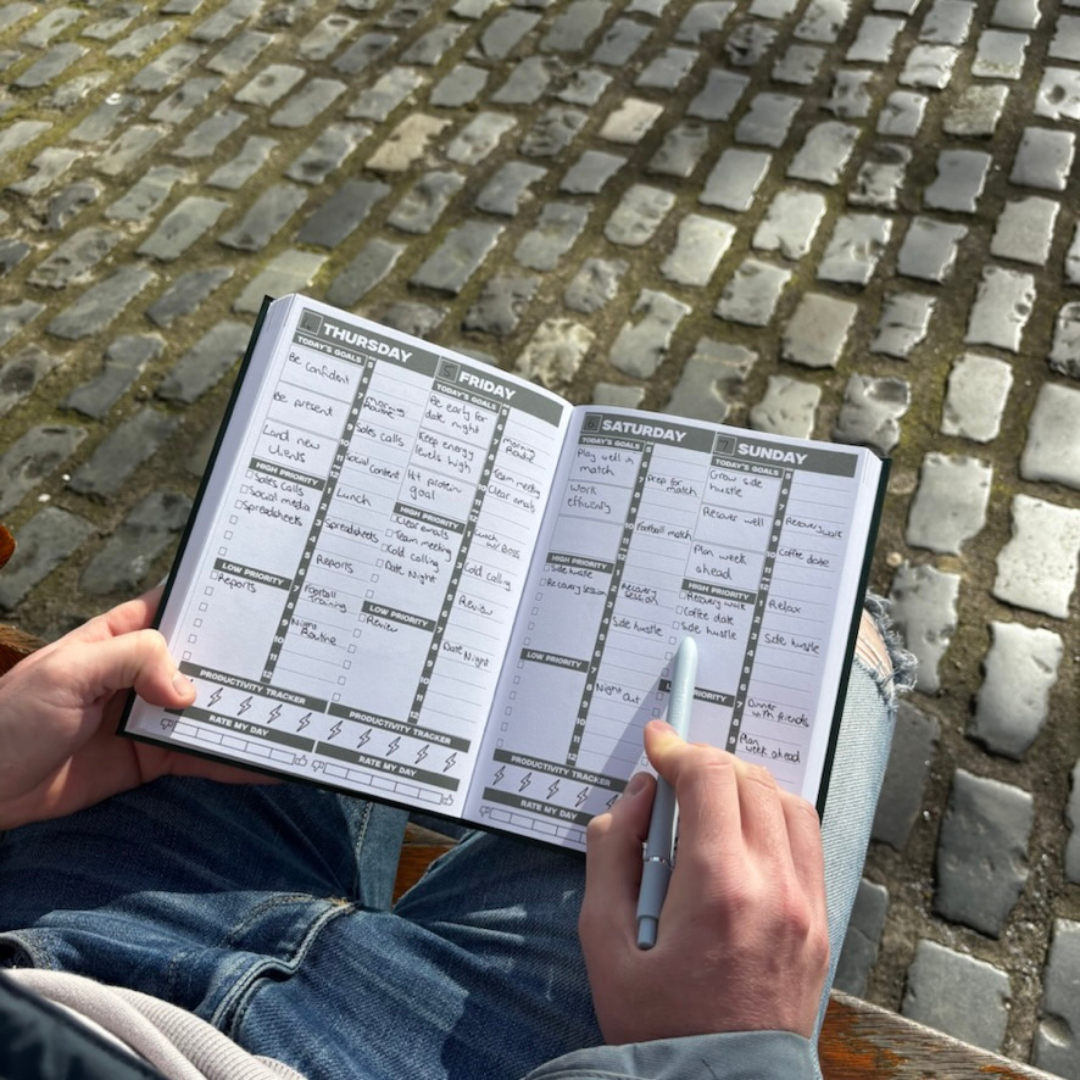
This is also why these habits need a structure to actually happen daily rather than becoming another set of good intentions that fade by week two. The Plan Your Growth undated weekly agenda gives daily habits like these a visible tracking space, so the ten behaviors above have a real chance to become a pattern rather than a list you read once and forget.
Tracking Without Turning It Into Self-Punishment
A daily habit tracker for mental toughness habits can easily slide into another source of self-criticism if a missed day gets treated as a moral failure rather than simply data. The habits above are meant to build resilience, and ironically, treating a missed day with harsh self-judgment undermines the exact resilience the practice is meant to build.
The better frame: a missed habit on a given day is information, not a verdict. What made that day harder than usual? Was the habit itself set at an unrealistic level, or did something genuinely disrupt the day? Adjust and continue, rather than treating one missed day as proof the whole effort has failed. This measured, non-catastrophic response to setbacks is itself one of the clearest markers of actual mental toughness, arguably more so than any single habit on the list.
What Changes Over 90 Days
Ten habits, practiced imperfectly but consistently for ninety days, produce a noticeably different baseline than the same ninety days spent hoping mental toughness will simply show up when needed. The change is rarely dramatic on any single day. It shows up gradually, in a slightly higher tolerance for discomfort, a slightly steadier response to setbacks, a slightly stronger habit of doing the hard thing first instead of avoiding it.
This is the compounding nature of the entire framework. No single habit on this list, done once, builds mental toughness. All ten, practiced imperfectly across ninety days, build something that starts to feel less like effort and more like identity, the same shift that happens with any well-built habit given enough repetition.
The Bottom Line
Mental toughness is not a trait some men have and others lack. It is the compounding output of ten specific, repeatable daily habits: a fixed wake time, deliberate discomfort, doing the hardest task first, keeping self-commitments, controlled exposure to failure, delayed gratification, honest self-review, non-negotiable training, limited complaint, and a nightly acknowledgment of the day's discomfort tolerated. Build them one at a time, track them consistently, and treat missed days as information rather than failure. Resilience built this way holds up under real pressure, because it was never dependent on a single dramatic moment to prove itself.
The Plan Your Growth undated weekly agenda gives these ten habits the daily tracking structure they need to actually compound, so mental toughness stops being something you hope shows up and becomes something you deliberately build, one tracked day at a time.