Single Tasking: Why Multitasking Is Quietly Wrecking Your Output
Multitasking does not exist in the way most men think it does. What you are actually doing when you "multitask" is rapidly switching attention between tasks, and each switch carries a measurable cost in time and cognitive accuracy. Researchers who study this, including Gloria Mark at the University of California, Irvine, have found that the average knowledge worker switches tasks roughly every three minutes and loses meaningful time reorienting after each switch. The man who believes he is efficiently running three things at once is, by every measure researchers can find, running all three worse than if he ran them one at a time.
What Actually Happens in Your Brain When You Multitask
The brain does not process two demanding cognitive tasks simultaneously. What feels like multitasking is task switching: dropping one task, loading the context of another, then switching back later and reloading the original context. Each switch has a cost, sometimes called the switch cost, and it shows up as slower completion time, more errors, and a measurable dip in the quality of output on both tasks.
This cost compounds in a specific way under modern working conditions. A notification arrives, you glance at it mid-task, and even a five-second glance forces your brain through a partial context switch. Gloria Mark's research finds that after any interruption, regardless of how brief, full reorientation back to deep focus takes an average of 23 minutes. A man checking his phone every ten minutes while doing important work is never actually reaching deep focus. He is perpetually reloading a task he never finished loading the first time.
The insidious part is that multitasking feels productive in the moment. Juggling several things at once produces a sense of motion and busyness that single-tasking, by comparison, can feel slower or less impressive. This feeling is misleading. The actual output data, measured across decades of cognitive research, consistently favours single tasking by a wide margin.
The Measurable Cost of Context Switching
Multiple studies on task switching find that heavy multitaskers complete cognitively demanding work measurably slower than single-taskers, even when total time invested is identical. The difference is not marginal. Some research finds switching costs eating up to 40 percent of available productive time in environments with constant interruption.
Beyond speed, accuracy suffers as well. Tasks requiring sustained attention to detail, the kind of work that actually moves a business or a goal forward, show significantly higher error rates when performed under constant task switching compared to focused, single-task conditions. This matters because the errors created under multitasking conditions often require additional time to find and correct later, compounding the original time cost.
There is also a less obvious cost: decision fatigue. Every task switch requires a small executive decision about what to prioritise next. A day full of constant switching is a day full of hundreds of these micro-decisions, each one drawing down the same finite cognitive resource that you need for the actual important decisions later in the day. By 3pm, a heavy multitasker has often spent his best decision-making capacity on switching rather than on the decisions that mattered.
How to Build a Single Tasking Habit
The shift from multitasking to single tasking is mechanical, not motivational. It requires removing the conditions that make switching easy and building structure that makes single tasking the default.
Start by closing every browser tab and application not directly required for the task in front of you. This sounds trivial. It is not. Every open tab is a standing invitation to switch, and the invitation does not need to be acted on to cost you something: the mere visibility of competing options measurably taxes attention even when you do not click on them.
Put your phone in a different room, not just face down on the desk. Research consistently shows that the mere physical presence of a phone, even powered off, measurably reduces available cognitive capacity, a phenomenon researchers call brain drain. The phone does not need to buzz to cost you something.
Block dedicated single-task windows on your calendar, the same way you would block a meeting. Inside that window, one task, one outcome, no exceptions. If something else demands attention, it gets written down for after the block ends rather than acted on immediately. This single structural change, used consistently, is what actually builds the single tasking habit over time, because it removes the constant decision of whether to switch.
Why Single Tasking Compounds Over Weeks, Not Days
The first few single-task sessions often feel uncomfortable, even slow. This is expected. A brain trained for years to switch constantly does not immediately enjoy sustained focus, the same way a body unused to exercise does not immediately enjoy a hard workout. The discomfort is the adaptation happening, not a sign the approach is wrong.
By the second or third week of consistent single tasking, most men report a noticeable shift: tasks that used to take an entire scattered afternoon get finished in a focused ninety minutes. This is not because the work became easier. It is because the switching cost, which was silently eating a large portion of every working session, stopped being paid.
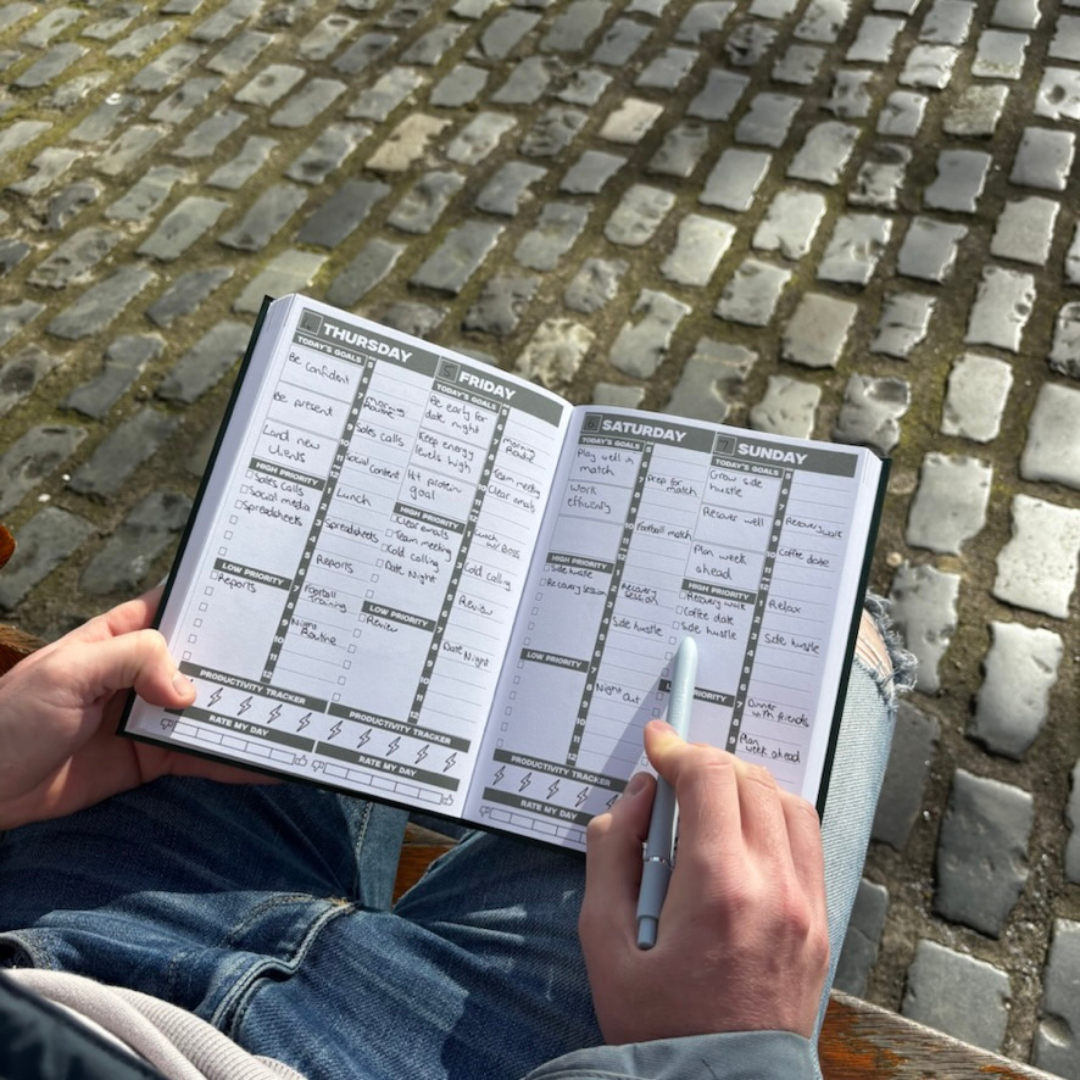
Building this into a weekly structure matters more than trying to white-knuckle single tasking on willpower alone in a single day. Planning specific single-task blocks at the start of each week, using a tool like the Plan Your Growth undated weekly agenda, turns single tasking from an occasional act of discipline into a default weekly rhythm. The agenda's structure makes it easy to see, at a glance, which hours are protected single-task time and which are open for the more reactive work that genuinely benefits from flexibility.
When Some Switching Is Actually Fine
This is not an argument that all task switching is bad in every context. Shallow, low-stakes tasks, replying to a quick message, glancing at a simple notification, genuinely cost very little to switch between. The damage happens specifically when switching interrupts cognitively demanding work: writing, strategic thinking, complex problem solving, anything that requires holding multiple pieces of information in working memory at once.
The practical rule is simple: protect single tasking aggressively during deep, demanding work, and allow yourself more flexibility during genuinely shallow administrative tasks where the switching cost is minimal. The mistake most men make is treating all tasks as equally interruptible, when in reality some work tolerates interruption fine and some work is destroyed by it.
The Bottom Line
Multitasking is not a skill some men have mastered and others lack. It is a measurable performance cost dressed up as productivity. Every switch between tasks carries a real price in speed, accuracy, and cognitive energy, and that price compounds across a day of constant interruption. The fix is structural: close the tabs, remove the phone, block dedicated single-task windows, and protect them the way you would protect a client meeting. The discomfort of single tasking in week one becomes the obvious advantage of single tasking by week three.
The Plan Your Growth undated weekly agenda gives single-task blocks a fixed, visible place in your week, which is what turns this from an occasional discipline win into the default way you work. Protect the focus. The output speaks for itself.